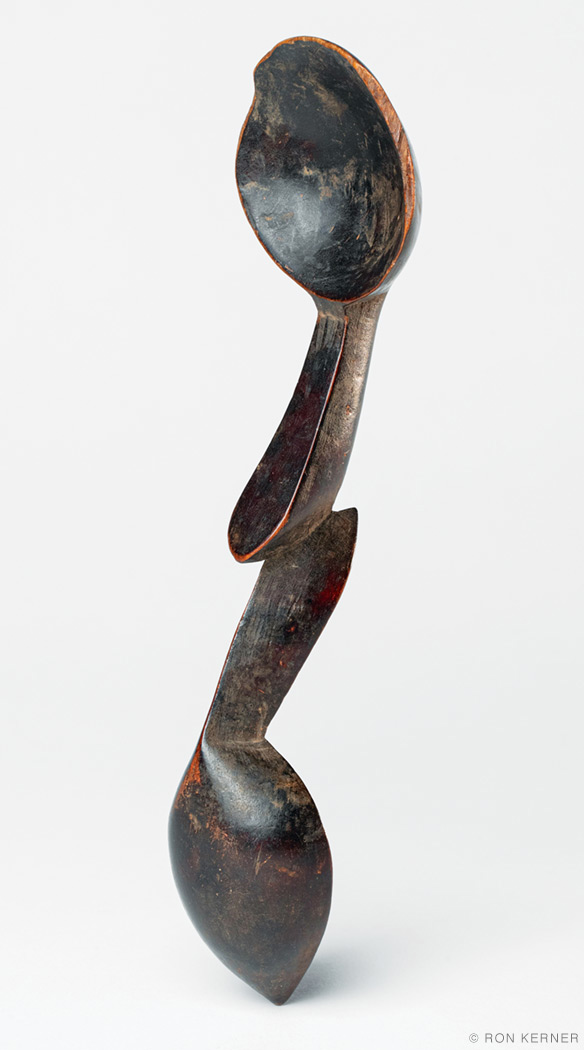
For Richard Ulevitch, the brilliance of African sculpture is distilled in carved spoons.
“There are two different kinds of collectors,” reckons Richard Ulevitch Gr’71. “There’s the hedge fund guy who has a very large bank account, finds an art consultant, and says, ‘Buy me some trophy art that I can put on my wall.’
“Then there are people like me,” he says, “who are really hunting for the objects that move them the most.”
Ulevitch, a Cleveland native who spent five years earning a PhD in biochemistry at Penn prior to a five-decade-plus career in life sciences at the Scripps Research Institute in La Jolla, California, cycled through a number of obsessions before landing on the one that would catalyze a museum exhibition and a lavishly photographed art book. As a kid he collected baseball cards and coins, along with rocks and minerals. During a postdoctoral year at the University of Minnesota, a chance meeting led to a fascination with tribal rugs from Turkey, Persia, Afghanistan, and the Caucasus. Over the next 15 or 20 years he bought, sold, and traded his way to a respectable collection—and a compendium of 19th- and 20th-century rug and textile books to rival any specialist library. As a young researcher at Scripps, he moonlighted teaching classes on rugs and textiles at the University of California, San Diego.
In 1986 he moved with his wife and children to Switzerland to spend a year learning new techniques in a Geneva laboratory. Trips to France and Belgium rekindled an interest in African art that had been sparked by visits to the Penn Museum during his graduate studies. The renowned Parisian art dealer Albert Loeb pointed him toward a handful of relevant galleries, and gradually Ulevitch became enthralled with 19th- and 20th-century African tribal sculpture. By the time he returned to Scripps, the stage was set for an auspicious encounter with a La Jolla resident named Jacques Hautelet, a Belgian national who was “one of the most knowledgeable people about Congo art probably in the world.”
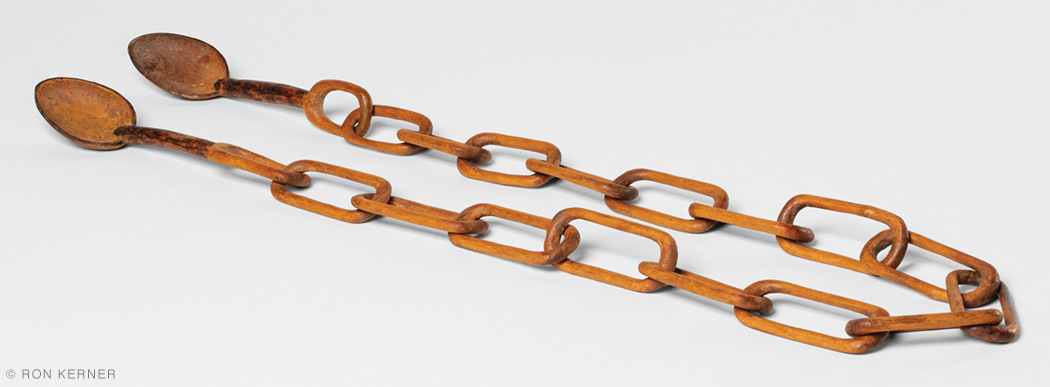
Hautelet, a private dealer who supplied many museums with African objects, gave Ulevitch some memorable advice. “If I were you,” he told the scientist who decidedly lacked hedge-fund money, “one thing you should really look for are spoons. Because you’ll see that the sculpture in the spoon is no different than a mask or a figure. The same carvers that carve fantastic masks and figures, carve spoons—and there aren’t that many people looking for them.”
For the next 30 years, Ulevitch did. On work trips to Europe, he scoured galleries and auction houses, buying, selling, and trading until he ended up with “probably the largest collection of traditional African spoons that exists.”
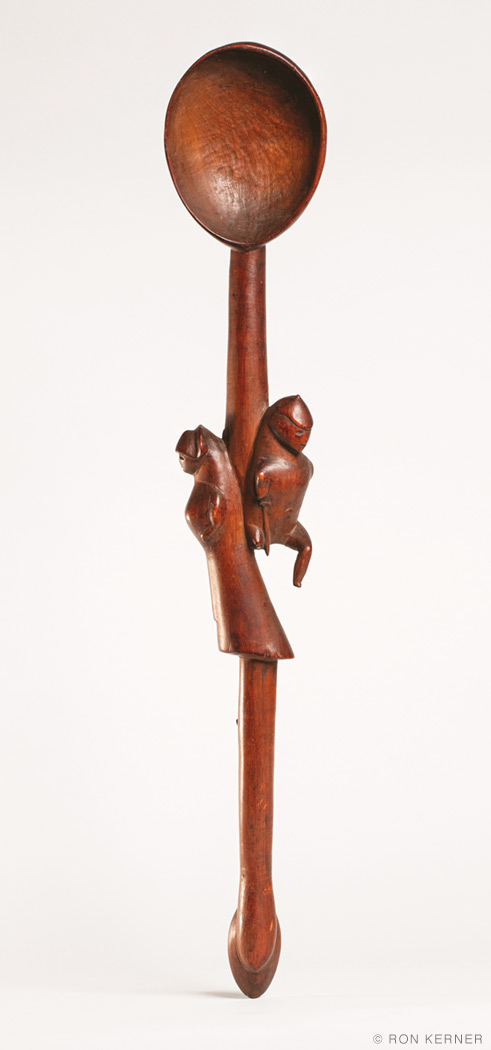
Although he targeted spoons that were “made by one tribal group for their own use,” the objects he acquired were rarely, if ever, used for eating. They were mostly “ceremonial or prestige objects,” more likely to be used as “dance wands” or in social rituals.
“In Liberia or the Ivory Coast,” for instance, spoons nearly three feet in length would be carved for “the most important woman in a little village,” Ulevitch explains. “And when a visitor came to the village, they would fill the spoons with beans or rice—just sort of a welcoming thing, saying, Yes, we’re happy to have you. You can eat with us.”
Yet Ulevitch is quick to add that he is “actually not that interested in the anthropology part of all of this stuff.” What moves him is the sheer artistry brought to bear on wood, copper, iron, and bone.
“Each one has an aesthetic appeal,” he says. “Their sculptor created these things with a certain amount of emotion and meaning, both to them and to the ultimate owner, whether it was owned by the whole tribe or an individual. And they come in all designs. … Most people don’t know this, but in Nigeria [alone], they probably have 70 or 80 tribal groups that all had a carving tradition—and they were all different, extraordinarily different. From unbelievably realistic forms to some of the most abstract work that would make Henry Moore drool if he saw them. And he did drool, actually,” Ulevitch says about the 20th-century English abstract sculptor. “I mean, he did a lot of hand drawings of African art at the British Museum that definitely influenced his sculpture.”
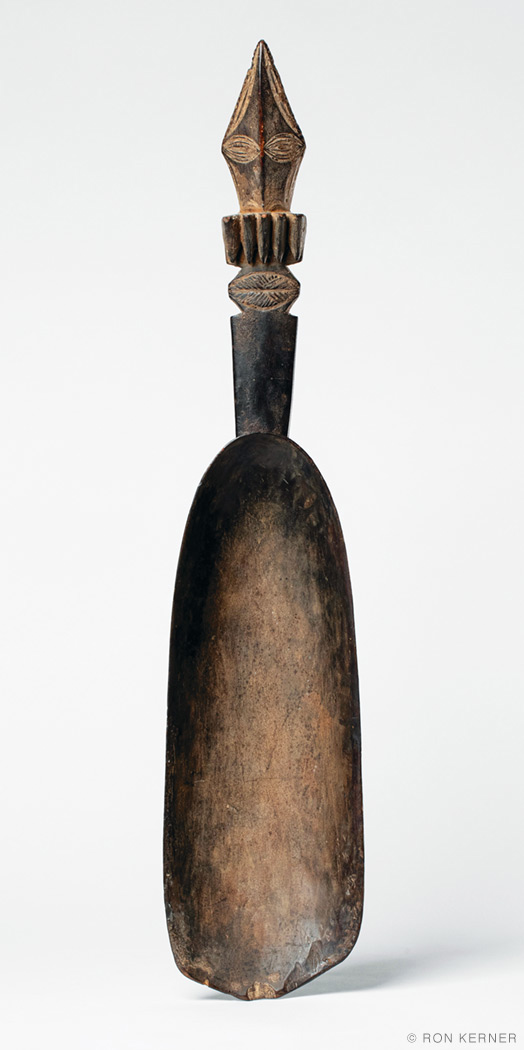
The Swiss sculptor Alberto Giacometti took inspiration from African spoons, whose influence is also visible in the work of contemporary American artist Nick Cave. These and other connections are explored in A Taste of Beauty: Spoons of Africa, authored by Bruno Claessens based on Ulevitch’s collection, which featured in a pair of 2025 exhibitions at San Diego’s Mingei International Museum and the Crocker Art Museum in Sacramento, California.
For Ulevitch, nothing showcases the skill of a carver quite like a spoon. “You know, a statue stands on its own, one way or another,” he observes. “A spoon actually has to be held. It has to have a certain balance. It has to have a certain ratio between where the bowl is, and where the handle is, and the decorative part, which is typically on the tops of the handles or on the back of the spoons.” So in each one of them, he sees a bravura demonstration of “phenomenal artistry and skill.”
He postulates that collectors and scientists share the same fundamental mindset. “You’re a hunter. If you’re a scientist, you hunt information and try to put it together into something that’s coherent. If you’re a collector, you hunt whatever you’re collecting and try to put it together in a way that’s coherent as well.”
The same cannot exactly be said of his longtime spouse. About the urge to collect, Ulevitch says, “Either you have it or you don’t. My wife is not a collector and still has a hard time, sometimes, coming to terms with the whole concept of collecting more than one object of the same kind.”
But they’ve “worked out how to handle that,” he says. “She told me our kids had to have shoes, when they were growing up, first. They had to have milk. So the needs of the family came first.” Limited buying power also helped, as has the physical size of his African acquisitions, which range from a few inches to roughly three feet across. “They’re mostly confined to a room I would call my office,” he confides. And that is a not a permanent home, because Ulevitch recently donated his entire spoon collection to the Crocker Museum.
“Collecting is one thing,” he says. “I can look at them every day, or friends can come in—but the whole point is to let the public see them, in the end.” —TP