A collaborative meditation on birders and the fleeting objects of their affection.
Birds have been near the center of Yvonne Love GFA’94’s family life for about as long as she can remember. If her father and stepmother weren’t peering through binoculars, they were likely paging through bird guides in preparation. And “from the time I was little, I was in the field with them,” Love says. “We’d get up at three o’clock in the morning so we could be someplace at dawn.”
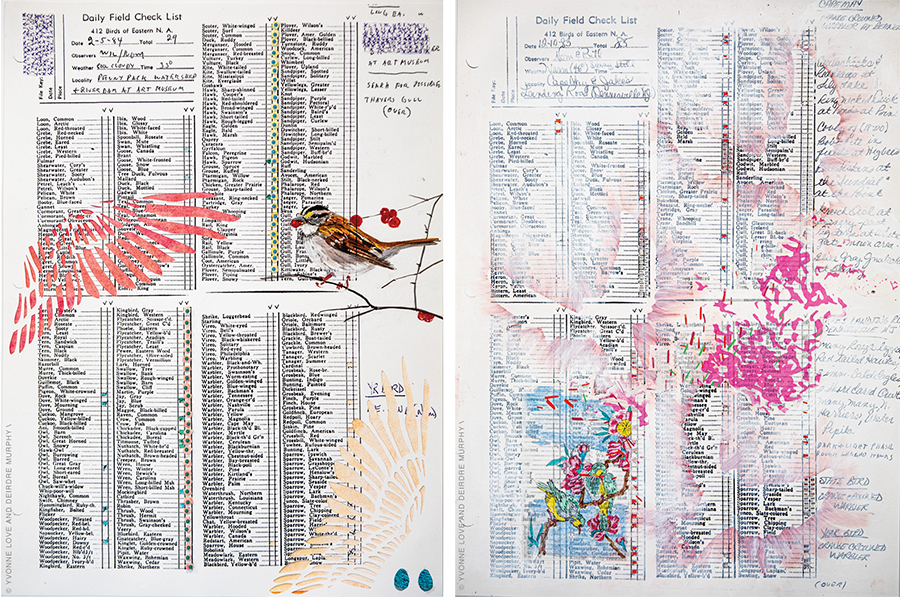
Whether they were counting yellow-throated vireos near their home in Oreland, Pennsylvania, or traveling to India in search of more exotic species, Love’s parents kept detailed checklists memorializing their findings. These data-rich documents, whose margins bloom with ballpoint annotations in Naomi’s cursive and Bill’s script, serve as the base layers of an exhibition that could hardly ask for a more fitting venue: the house in Mill Grove, Pennsylvania, where John James Audubon was first inspired to draw and paint birds in the early 1800s.
“Field Notes: Learning to See” was born of a collaboration between Love and Deirdre Murphy GFA’00. Passing expanded reproductions of the checklists back and forth in an iterative process that the artists liken to the “call-and-response” of birds in a forest, Love and Murphy embellished each page with paper cuts, paint, eggshells, fibers, and pins. With imagery ranging from pressed feathers and painted woodpeckers to abstract graphic renderings of migration data, the result is an homage to the role “citizen scientists” like Love’s parents—not to mention Audubon himself—have long played in the collection and transmission of knowledge about the natural world.
Curated by Heather Moqtaderi, the National Audubon Society’s senior coordinator of museums and collections (who formerly was associate curator at Penn’s Arthur Ross Gallery), “Field Notes” will be on display at the John James Audubon Center in Mill Grove through August 16 before traveling to the Ekhert Art Gallery at Millersville University in Millersville, Pennsylvania (September–October) and the Heidi Lowe Gallery in Lewes, Delaware (February–April 2027).
A companion installation by Murphy enriches the viewing experience at the John James Audubon Center. The large-scale oil paintings comprising “Home Making” present richly saturated renderings of bird nests—an aspect of avian life that Audubon depicted only occasionally in his monumental Birds of America.
Murphy has long been drawn to the theme of bird migration [“Arts,” Sep|Oct 2014] but turned her attention toward building and brooding during woodland walks at the outset of the COVID-19 pandemic. “It was March 2020, so the nest structures were still really visible because the leaves hadn’t come out on the trees,” she recalls. At a time when “everybody was stuck at home,” these “tensegrity sculptures” spoke to her. “Robins definitely use some mud, but a lot of birds just use the sticks and twigs … so it’s all tension that holds them together. So I was like, Perfect. Tension is holding all our homes together.”
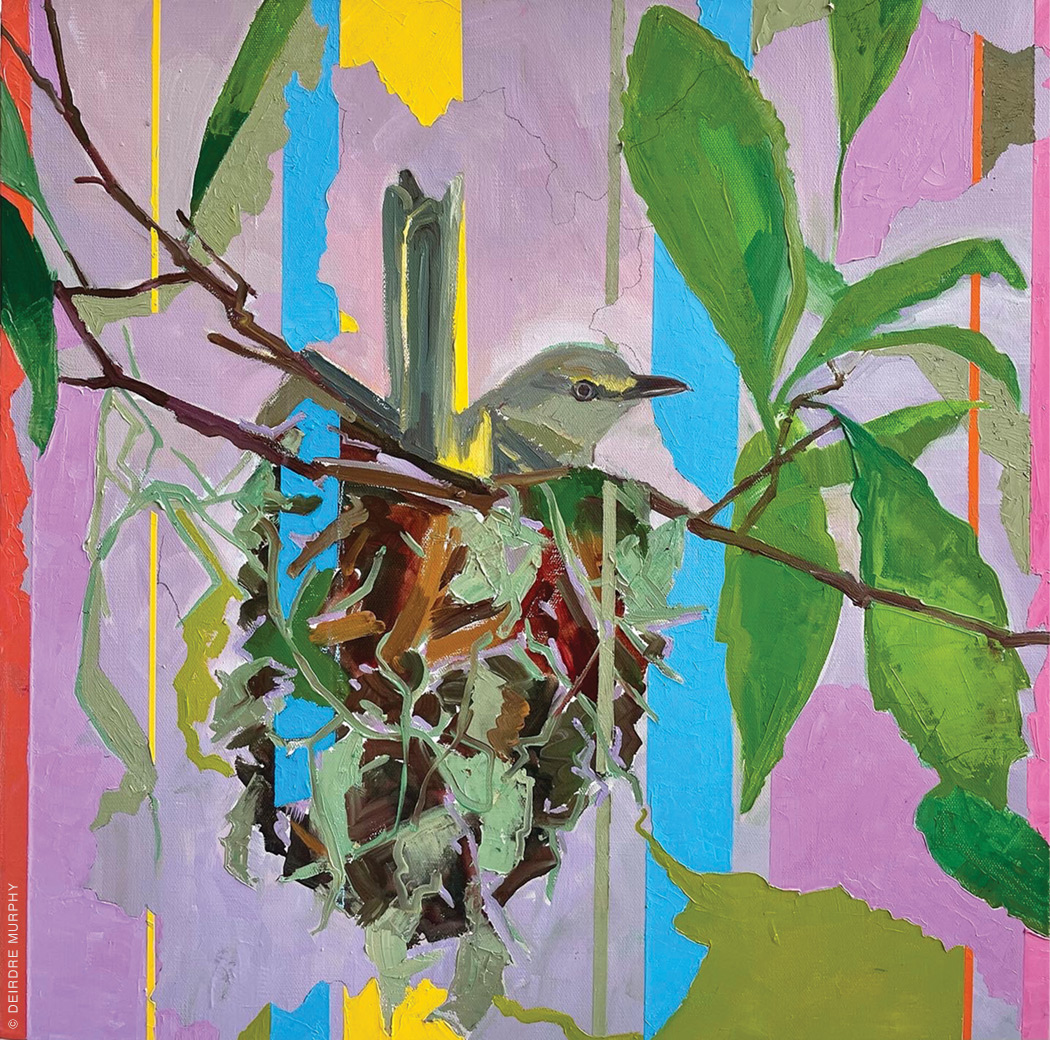
Her explorations morphed into evocations of seasons, from the “fever dance” of a robin sculpting the concavity of a cup nest in spring, to a vireo quietly incubating eggs in summer camouflage, to a vacant robin’s nest in the crook of a smoke bush whose autumnal foliage glows with the warmth of sunrays permeating panes of stained glass. In another mode, Murphy shifts the perspective to a literal bird’s eye view: expressionistic visions of forest scenes framed by the irregular edges of tree cavities that shelter owls and other tree-cavity dwellers, to suggest what a hemlock stand or firefly swarm looks like to a bird within.
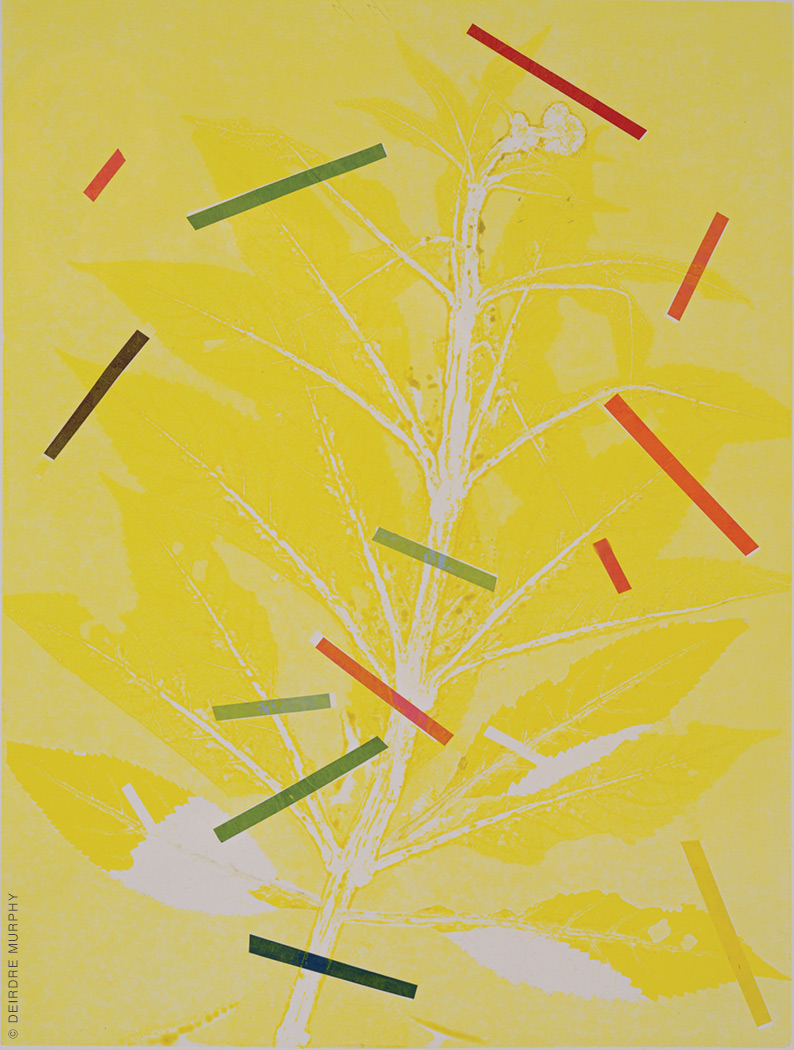
Finally, Murphy’s “Herbarium” series offers a “more tangential” view of avian life. By ripping up her lawn some years back and cultivating native pollinator plants in its place, Murphy turned her little home patch into a pulsing locus of fireflies, warblers, and even hawks. In her print studio, she lays selected plant specimens on a plate coated with colored ink, then presses the assemblage against watercolor paper. From intricately veined calycanthus leaves to delicate larkspur fronds, and busy smoke bush branches to ghostly impressions of bee balm, these monoprints reward close inspection with surprising depth of detail.
“My hope is that the viewer might have an inward pause to reflect on themselves and how they live,” says Murphy. Even short of transforming a lawn into a bird sanctuary, “what small thing can I do? Could I perhaps turn my porch light off in the spring and fall when it’s migration season, so these poor little dears don’t break their necks?” —TP