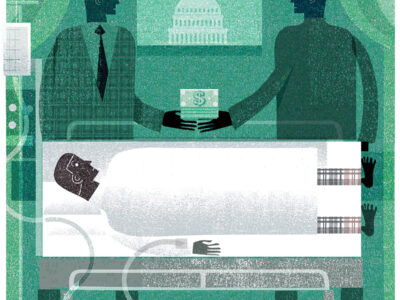

The interdisciplinary experts at Penn’s Leonard Davis Institute of Health Economics have seen a lot since LDI was created after the passage of Medicare and Medicaid in the 1960s, but nothing quite like the challenges roiling the US healthcare system now.
By Mary Ann Meyers
Illustration by Chris Gash
The healthcare landscape in America has undergone seismic shifts in the past 18 months. Sweeping changes in federal policy, accelerating healthcare workforce shortages (especially in rural areas), and rapid AI advances have affected us all. Penn’s Leonard Davis Institute of Health Economics (LDI) is drawing upon nearly six decades of experience and a University-wide network of experts to assess the impact on our health, including the cost and quality of care, access to it, and equity in its delivery. LDI researchers have produced evidence about patient outcomes that has shaped action at multiple levels of government.
When it was founded in 1967, two years after the Medicare and Medicaid programs were signed into law by President Lyndon B. Johnson, LDI was the first university-based interdisciplinary group in the United States devoted to healthcare economics. LDI’s mission was and remains to improve “health and healthcare by catalyzing collaborative, multidisciplinary research that influences policy and practice,” according to its executive director, Rachel M. Werner M’98 GM’01 GrW’04, the Robert D. Eilers Memorial-William Maul Measey Professor in Health Care Management and Economics and professor of medicine in the Perelman School of Medicine, who is the first woman and first physician-economist to head LDI.
The organization bears the name of the philanthropist Leonard Davis Hon’72, the founder of the Colonial Penn Group, which became one of the country’s largest insurance underwriters for older Americans. Davis—along with his wife Sophie—was instrumental in the founding of LDI in response to what he perceived as a growing national need for high-quality research and education to inform policies critical to the financing and management of the nation’s increasingly costly and complex healthcare system.
From the start, the institute sought to integrate the expertise found in Penn’s medical and nursing schools with the management expertise of Wharton faculty and apply these competencies to solving the healthcare issues of the day. Its founding director, the late Robert Eilers GW’57 Gr’61, a professor of insurance and a professor of community medicine, consulted with the Nixon Administration and helped draft the Health Maintenance Organization Act of 1973 that catalyzed the growth of managed care plans, which incorporated financing and delivery of healthcare services to individuals enrolled in a network, and introduced cost containment strategies that continue to influence the modern healthcare system.
LDI’s inaugural fellows included the economist Mark V. Pauly, now Bendheim Professor Emeritus in the Wharton School,who would later serve as LDI’s executive director. A research paper he published in the American Economic Review in 1968 became one of the most influential articles in health economics, one that still resonates in healthcare debates and set the high standard to which LDI has adhered in the years that followed.
Pauly’s key insight was that full health insurance coverage can lead individuals to take greater risks—a dynamic known as moral hazard—and therefore some medical care expenses should remain uninsured. It propelled an entire field of research into incentives and insurance coverage, serving as the impetus for the RAND Health Insurance Experiment, which estimated the impact of consumer cost-sharing on healthcare use, and was central to the thinking behind managed care, high-deductible health plans, and value-based insurance design. More than a half century later, Pauly’s work on moral hazard continues to shape law and regulation. It undergirds the differing out-of-pocket payments in the Affordable Care Act’s various plans and informs current debates about Medicare prescription drug coverage and home care benefits.
OBBBA’s Impact
Werner and her colleagues face what are arguably unprecedented challenges in 2026. The One Big Beautiful Bill Act (OBBBA) passed last year by Congress is projected to reduce federal spending on Medicaid, which accounts for about a sixth of healthcare spending, by nearly a trillion dollars over the next decade and significantly impact access to healthcare for millions of low-income citizens. The huge funding cut along with the expiration of the enhanced premium tax credits for Affordable Care Act marketplace coverage, which has more than doubled out-of-pocket premiums for some consumers, “elevate,”as Wernersays, “the importance of the work that LDI does in continuing to bring evidence to healthcare policy.”
Last summer Eric T. Roberts, an associate professor of medicine in Perelman, and fellow investigators used Medicare data on “dual-eligible individuals,” who rely on both Medicare and Medicaid, to calculate the effects of losing drug subsidies on beneficiaries’ mortality under the OBBBA. Their research showed that an estimated 18,200 vulnerable people with chronic conditions would die each year from the loss of Medicaid coverage if, as likely, states are forced to curtail benefits or adopt policies that limit the amount of time individuals can receive Medicaid.
The OBBBA also required a decade-long delay in a rule for minimum staffing at nursing homes, a safety measure issued by the Centers for Medicare and Medicaid Services (CMS) in 2024 that was intended to reduce the risks associated with low-quality care. In what it termed an “alignment” with the 2025 legislation, the Department of Health and Human Services rescinded the new staffing standards altogether. Based on studies of the relationship between nurse staffing hours and resident mortality, Werner and Norma Coe, director of research at LDI and a professor of medical ethics and health policy in Perelman, predict another 13,000 deaths a year.
The nation’s nursing shortage is a retention issue, not a pipeline issue, according to LDI Senior Fellow Karen Lasater Gr’15, the Jessie M. Scott Term Chair of Nursing and Health Policy in Penn’s School of Nursing. In hospitals and long-term care facilities, “organizational failures that are hindering nurses from doing their work effectively drive nurses to feel burnt out,” she says, citing a survey of nurses who said improving nurse staffing levels was the most important intervention that administrators could make. Lasater’s research on how nurses’ work environments, staffing, and well-being influence patient outcomes is transforming how health systems and policymakers understand the value of nursing—even as the Trump administration’s plan to redefine what constitutes a professional degree could exclude nursing and limit nursing students’ access to loans that, in turn, could exacerbate the dearth of nurses long term.
More recently, a study led by LDI senior fellow Linda Aiken, the Claire Fagin Leadership Professor and founding director of the Center for Health Outcomes and Policy Research (CHOPR) in the School of Nursing and professor of sociology in the School of Arts and Sciences, and Gary Rettberg, research project manager at CHOPR, showed improved nurse work environments led to reduced physician burnout and intent to leave, demonstrating the importance of nurse well-being to that of other clinicians in hospitals.
Can AI Help?
Some have suggested that artificial intelligence could offload up to 30 percent of the crushing administrative burden of documentation in clinical settings. But according to a January 2026 article in Health Affairs by LDI senior fellow Amol Navathe GrW’08 M’10, a professor of medical ethics and health policy in Perelman and a professor of health management in Wharton, and Sita Kottilil, a research coordinator in health policy, without policies that create financial incentives to improve care, there is a risk of stifling innovation and driving up costs without improved outcomes.
Noting that AI has the potential to create healthcare value independent of the time, skill, and resources of doctors and nurses, they also point out that “Medicare’s current structuring of reimbursement around human inputs has the potential to miscalculate the value of AI in clinical practice.” Navathe and Kottilil propose a classification system to distinguish between AI applications according to their implications for clinician time and cost. “By aligning AI reimbursement policy with desired outcomes rather than inputs,” they argue that “policy makers can ensure that innovators, clinicians, and patients alike benefit from novel AI technologies.” Navathe and Kottilil suggest that Congress may need to grant the CMS new authority to factor in clinical effectiveness in AI technology coverage and payment decisions.
Meanwhile, the LDI-Penn Medicine Research Laboratory, a partnership designed to advance LDI’s mission to produce generalizable healthcare knowledge and actionable evidence that can guide Penn Medicine’s operational decisions, invited this year’s applicants for awards to consider how generative AI can optimize healthcare delivery. The winning proposals include one to develop and test a hospital AI evaluation toolkit that drafts narrative overviews of patients’ medical journeys during their hospital stays, a second to refine and validate a large language model–based system capable of administering a test to screen for cognitive impairment in patients in clinical environments, and a third project to integrate conversational data collected from a novel AI platform with electronic health-record data to suggest care trajectories and facilitate identification of patients at high risk for pregnancy complications.
The use of AI to enhance human listening and interpretive skills in conversations around end-of-life care is a possibility that was explored in a study led by LDI senior fellow and Penn Nursing School assistant professor of biobehavioral health sciences Jiyoun Song. In collaboration with other scientists, including Kathryn Bowles Gr’96, professor of behavioral health sciences and the van Ameringen Chair in Nursing Excellence in the Nursing School, Song and her team used speech processing to identify palliative care preferences during discussions and decision-making in Medicaid-managed long-term care. Their work suggests that AI may help clinicians identify which seriously ill patients are ready for palliative care by analyzing the energy, pitch, and other subtle vocal cues in recorded group phone conversations among patients, caregivers, and healthcare providers.
Palliative care refers to pain management, psychological support, and quality-of-life comfort care for the most seriously ill. Song stresses the importance of the “initial communication process to engage patients or their surrogate caregivers in considering the possibility of palliative care,” which “too often remains underexplored, leaving a gap in understanding what makes it successful or unsuccessful.”
Controlling Costs
Healthcare affordability, a concern at the time of LDI’s founding, is an acute issue today—ranked by two-thirds of the American public as their top financial worry. In January some 24 million Americans saw their health insurance premiums increase by hundreds or even thousands of dollars a year. These are the self-employed or employees of small businesses and their families who, because they don’t get health insurance from employers, buy insurance on the exchanges created by the Affordable Care Act. The CMS projects that healthcare spending will consume more than 20 percent of the US economy by 2033. The institute’s fellows have examined costs in numerous studies.
Recognizing that the rising cost of care is unsustainable in the long run without a decidedly deleterious effect on the nation’s health, LDI, in collaboration with Penn Washington, the University’s policy engagement arm in the capital, organized a three-day symposium in March to highlight options for moderating the upward trend. It was part of the institute’s continuing efforts to bring its senior fellows together with policymakers at both the state and federal levels.
Werner chaired a panel discussion where Ezekiel Emanuel—Penn’s vice provost for global initiatives, Diane v.S. Levy and Robert M. Levy University Professor, and Penn Integrates Knowledge Professor with appointments in the Perelman School of Medicine and Wharton—and Brian Blase, a conservative health policy expert who served in the first Trump administration and subsequently founded a health think tank, agreed that hospitals were the principal drivers of cost and called for aggressive reforms. They recommended site-neutral payments, by which insurers would pay the same price for a procedure whether it took place in a doctor’s private office or a hospital-owned facility where, at present, Medicare and many private insurers pay significantly more. The discrepancy creates a powerful incentive for hospitals to acquire physician practices and establish outpatient centers. Monopolistic practices and a system that rewards volume and political lobbying, according to Emanuel and Blase, bear a huge share of the blame for escalating prices across the healthcare system.
But the system’s complexity, both in plan design and administrative processes, also is a factor that propels costs, leads to inefficiency, and harms patients. David Grande, LDI’s director of policy and a professor of medicine in Perelman, explained to the symposium audience of policy leaders and Hill staffers from a number of Congressional committees that the consequences of the choices consumers make among insurance plans “shape not only their own access to care, but also the overall cost of healthcare across the economy.”
Noting that the Medicare Advantage (MA) option costs the federal government 14 percent more per person than traditional fee-for-service Medicare, Aaron Schwartz, an assistant professor of medical ethics and health policy in Perelman, said the government needs to “invest in a robust research agenda and implementation agenda to understand how best to pay private insurers in the Medicare program.” His fellow panelist Michael Anne Kyle GNu’10, also a Perelman assistant professor of medical ethics and health policy, stressed that Medicare’s administrative tools, notably prior authorization requirements, led 30 percent of enrollees to delay or skip care altogether with attendant negative health consequences reported by half of them.
A targeted focus on whether MA is working brought Werner together with two healthcare experts from not-for-profit organizations in a virtual panel discussion a few days before the Washington event. Sachin Jain, CEO of the SCAN Group and Health Plan, one of the largest not-for-profit MA plans in the nation, and Cheryl Damberg, director of the Center of Excellence in Health System Performance and a principal senior economist at the think tank RAND, concurred that MA has created innovative and important protection for seniors with modest incomes with its lower premiums, a cap on out-of-pocket spending, and extra supplemental benefits compared with traditional Medicare.
But Werner says the plan “is not saving public money as was intended upon its creation in 1997.” The idea was that competition among private companies would drive down Medicare prices and improve the quality of care. Research on MA is challenging, the LDI executive director explains, “because of missing data and bias generated by payment incentives to capture and report a maximum number of diagnosis codes for each beneficiary. Using a strategy called upcoding, insurers make their enrollees appear to be sicker than they are to increase their reimbursement rates,” Werner asserts. “As a result, the federal government overpays for MA and these plans have failed to bring down costs.”
Rural Healthcare in Crisis
But cost isn’t the only problem. Access to healthcare depends on the availability of medical professionals and hospitals. The US currently faces a shortage of some 65,000 physicians, according to the Association of American Medical Colleges. The deficit, which is expected to balloon over the next decade as Americans live longer and doctors retire, is acute in rural areas. “Some 80 percent of rural America is designated as medically underserved,” Werner points out. Furthermore, “44 percent of rural hospitals operate at a financial loss.” Nearly 200 rural hospitals have closed in the past 20 years, and “when a hospital shuts its doors, rural Americans lose access not only to emergency care, but also to essential services like maternity care and cancer treatment. The obstacles rural Americans confront in accessing healthcare contribute to more sickness and shorter life expectancies compared to people living in urban areas.”
The collision between sweeping Medicaid cuts under the OBBBA and a lesser known part of the legislation signed into law by President Donald Trump W’68 last July, the Rural Health Transformation Program (RHTP), was the focus of a discussion featuring Werner and her colleague Paula Chatterjee, LDI’s director of health equity research and an assistant professor of medicine in Perelman, on the podcast Tradeoffs. At the heart of the issue is how states are expected to manage new federal policies that slash Medicaid spending by an estimated $137 billion over 10 years while simultaneously offering a $50 billion rural initiative spread over five years. Half the money was divided evenly among the 50 states. The rest was awarded based on a series of factors, including a competition for grants to pursue “transformative” strategies aimed at workforce development, technology adoption, and new provider partnerships in rural areas.
Now that the funds have been dispersed, LDI wanted to examine the chances for the program’s success. Noting that the RHTP explicitly bars states from using the funds to stabilize rural hospitals, the discussants acknowledged the irony that the legislation weakens the primary underwriter of rural healthcare while expecting transformation in the very system destabilized by the Medicaid reductions. There was a consensus that one of the biggest and most persistent challenges for rural healthcare facilities is recruiting and retaining physicians and other specialized staff.
Werner noted that the “rural healthcare crisis has been years in the making.” Chatterjee pointed out that an ongoing 50-year federal effort to incentivize medical professionals to practice in rural areas “has yet to produce evidence showing how to solve the problem.” She said there was strong evidence that “recruiting healthcare workers who themselves have rural backgrounds” or providing medical professionals from suburban or urban areas with “extended training in rural areas led to a workforce that stays in place.” But many healthcare providers leave rural settings upon fulfilling their initial obligations, and standalone financial incentives like extra pay to stay in a rural community don’t seem to be very effective. Nevertheless, Chatterjee views the RHTP as providing a “tremendous opportunity for rigorous natural experiments in rural areas. The challenge for the research community,” she says, is to discover “what works, what doesn’t, why, and where.”
Unequal Access
Equity in healthcare is not bound by geography. A study that Werner carried out with two of her LDI predecessors as executive director, David Asch GM’87 WG’89—Penn’s senior vice president for strategic initiatives; John Morgan Professor of Medicine in Perelman; and professor of operations, information, and decisions and professor of health care management in the Wharton School—and Daniel Polsky Gr’96—now Bloomberg Distinguished Professor of Health Care Economics at Johns Hopkins—found that although public release of quality information through “report cards” is intended to improve healthcare, there may be unintended consequences, notably physicians avoiding high-risk patients to improve their ratings. In that case, their analysis of data from nearly one million patients with heart disease showed that report cards could exacerbate existing racial and ethnic disparities in healthcare.
A 2025 LDI study in JAMA Health Forum substantiates that a key reason our healthcare system fails to treat everyone equally is linked to financial incentives. “We pay doctors less to care for some people than others,” Werner says. Research she conducted with Asch and Aaron Schwartz, shows that medical practices receive 8.8 percent less for visits with Black patients and nearly 10 percent less for Hispanic patients than for their white peers. For children, the gaps are even wider. Physicians got 13.9 percent less for visits with Black children and 15 percent less for Hispanic children. “Many factors explain that difference, but no factors justify it,” Asch says. “Sometimes a single finding encapsulates the problem.” It turned out that differences in insurance source explained 44 percent of the payment gap between Black and white patients and 43 percent of the payment gap between Hispanic and white patients despite similar visit content, geographic market, and time period.
The study by the three LDI scholars is the first to analyze physician payments for outpatient care. It combined several national databases, and once the data were assembled, the analysis included 152,336 outpatient visits from 38,772 patients of whom 63.1 percent were non-Hispanic white, 15.9 percent non-Hispanic Black, and 21.0 percent Hispanic. Among visits covered by fee-for-service Medicare, which standardizes payments for outpatient care, physicians experienced no payment disparities relative to the race of their patients. But when physicians saw patients on Medicaid—the sole insurance source for 9.1 percent of the white patients, 23.2 percent of the Black patients, and 30 percent of Hispanic patients—they were paid more for visits with white patients than for visits with Black or Hispanic patients.
“Narrowing the gap in payment generosity between Medicaid and other insurers would considerably shrink the payment penalty that physicians face when they treat non-white patients,” Schwartz says. Nonetheless a pattern of racialized payment disparities still occurred when doctors treated uninsured patients and those with other types of health insurance, excluding fee-for-service Medicare. “When we ran simulations to quantify how much these payment gaps explain differences in healthcare received by patients, we found that eliminating payment disparities could substantially narrow racial and ethnic disparities in healthcare use, particularly for children,” Schwartz says.
A Sustainable System
Sustaining a pipeline of students to carry on its work is of fundamental importance to LDI’s leadership. Founding director Eilers realized that an educational component was crucial to the institute’s success, both within the university and as a training ground for future healthcare leaders. He created an MBA major in 1970—one of the first MBA programs in healthcare management in the nation—and later undergraduate and doctoral concentrations, with the goal of training managers and analysts of healthcare systems.
In 2025 a $3.5 million gift paired with a $1 million challenge grant from the Leonard and Sophie Davis Fund enabled LDI to expand its Summer Undergraduate Mentored Research (SUMR) Program. The program offers a 12-week immersive-research experience for students committed to addressing inequities in healthcare access. Since its establishment in 2000 by LDI and Wharton’s Health Care Management Department, more than 425 undergraduates from a wide range of colleges and universities have participated in SUMR and 83 percent have gone on to have careers in healthcare. A recently established SUMR+ initiative extends the program to 15 months, enabling select scholars to deepen their expertise and try to translate research into practical interventions. “The Davis family’s extraordinary generosity underscores their commitment to expanding access to health insurance and to healthcare services,” Werner says.
Looking ahead, Werner believes the federal government needs a new strategy that moves from a short-term focus on testing new payment models for healthcare delivery to a long-term focus on models that are most likely to generate substantial savings and improve quality. She sees opportunities for simplifying administrative burdens, reforming the way performance benchmarks are set, and directly addressing issues of fairness. In a white paper she wrote with her colleagues Emanuel, Navathe, and LDI Senior Fellow Hoangmai Pham five years ago, Werner, who stepped down as LDI executive director on June 30 but will continue as a senior fellow, called for the CMS to chart a new direction “aimed at completing the transition to a healthcare system that pays for value and reduces health disparities.” Over the course of nearly 60 years, LDI has demonstrated that solutions are possible in this stunningly complex arena. Werner allows that the goal of “a sustainable healthcare system that pays for better quality, equity, and efficiency” may be audacious, but she insists that it is achievable.
Mary Ann Meyers Gr’76 is the author of Art, Education, and African American Culture: Albert Barnes and the Science of Philanthropy (2004 and 2006), among other works.