A new exhibition spotlights depictions of Philadelphia during early nationhood by some of the region’s most significant artists.
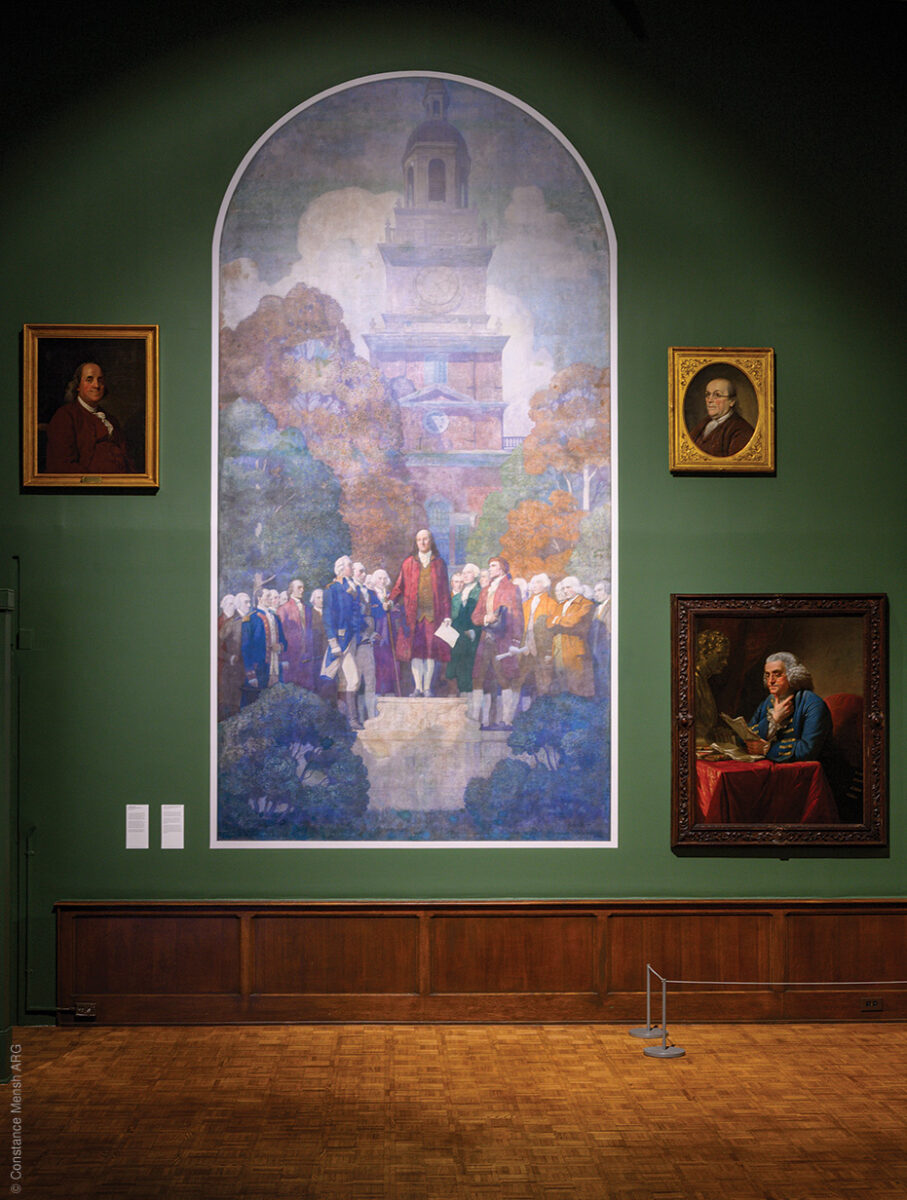
Measuring 16-by-30 feet and hung high on a wall in the Arthur Ross Gallery, An Apotheosis of Franklin certainly lives up to its name. N.C. Wyeth (1882–1945) completed the mural in 1926, when the country was celebrating its 150th birthday. Commissioned by Franklin Savings Bank for its New York headquarters, the work positions Benjamin Franklin literally on a pedestal, surrounded by patriots like Thomas Jefferson, George Washington, and Thomas Paine. A gauzy image of Independence Hall rises through the trees behind them.
Some five decades later, the University of Pennsylvania received the painting of its founder as a donation and it’s been displayed in the atrium of Hill College House ever since. Now, bracketed by three other paintings of Franklin and facing a bust of him across the gallery, it holds pride of place in At Liberty: Life in the City of Brotherly Love During the Early Republic (on view through December 13). The pieces join about 35 others culled from the Penn Art Collection and borrowed from Pennsylvania Hospital, the Pennsylvania Academy of Fine Arts (PAFA), Winterthur, and the Metropolitan Museum of Art.
Tied to America’s 250th anniversary, the exhibition examines the iconic and the quotidian in Philadelphia before and after the revolution. “There’s a particular focus on Franklin,” says curator Gwendolyn DuBois Shaw, the James and Nan Wagner Farquhar Professor of the History of Art, who became the gallery’s inaugural faculty director in 2024. “As America’s first international celebrity, he was not only pivotal to the era but he had a special relationship with the artists of the time, who produced about 60 contemporary portraits and sculptures of him.”
To portray the more everyday aspects of Philadelphia during the early 19th century, Shaw assembled a selection of prints by William Birch (1755–1834) and his son Thomas (1779–1851) along with watercolors by John Lewis Krimmel (1786–1821). The 13 works on hand from the Birches emphasize an increasingly built-out city, populated with tiny Blacks, Native Americans, and solo women walking amidst grand structures such as Christ Church and the South Street Headhouse. Krimmel’s pieces instead zero in on the citizenry, offering close-up portrayals of people of color, including an oyster vendor and a group of sawyers, going about their labors.
Krimmel has been a particular favorite of Shaw’s since she discovered him in graduate school. “He’s one of the first artists to paint Black people in the new United States,” she says, “and is very interested in the interactions of Blacks and whites in all kinds of situations and settings.”
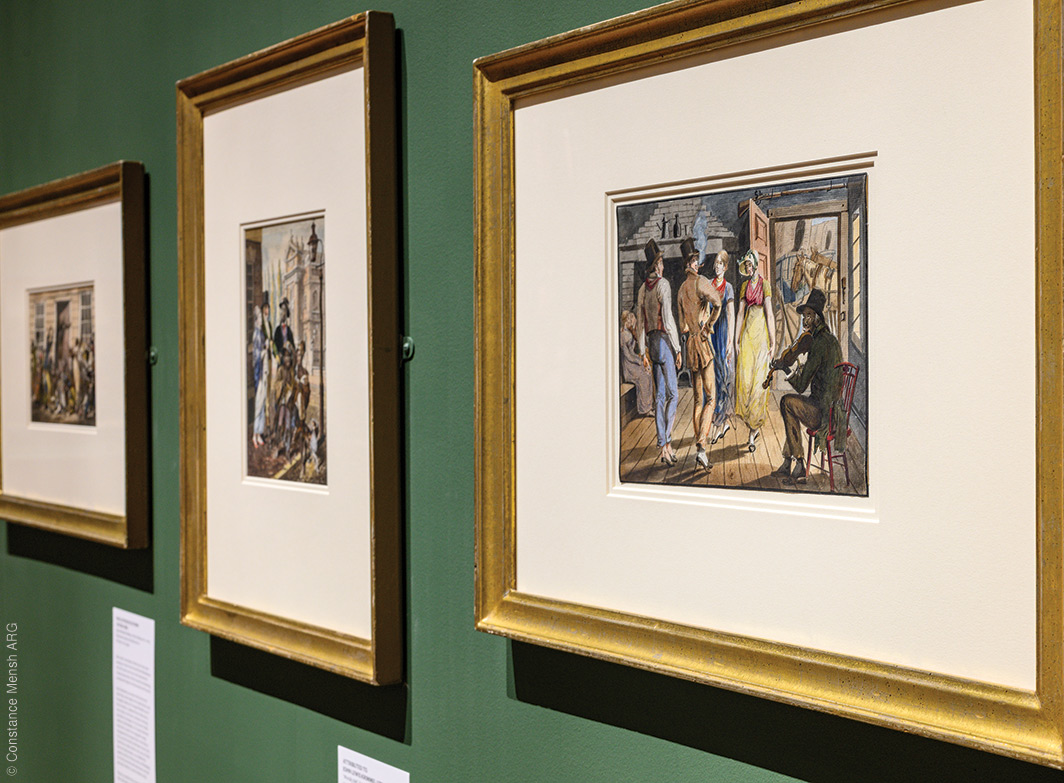
Krimmel’s 1813 oil The Quilting Frolic opens the exhibition. In it, a diverse group—including a cat, white children, and a Black fiddler—gathers at a middle-class Philadelphia home. A Krimmel watercolor displayed nearby, depicting another Black fiddler, is accompanied by a label exhorting viewers to consider how such portrayals may have “shaped later representations of African-American musicality.” The show makes frequent use of such labels to encourage viewers to link past and present.
A more high-tech attempt to refresh American antiquity is a video by Drexel University students that documents how they used artificial intelligence to sift through historic artifacts, portraits, drawings, and written descriptions to produce a 3D digital rendering of the lost museum of Charles Willson Peale (1741–1827), which was housed in Independence Hall from 1802 to 1827. Recreations of its contents include models of species like the blue winged teal; devices like the physionotrace, an 18th-century French invention that rapidly traced a subject’s profile to enable speedier production of inexpensive portraits; and even the shelves that would have showcased such objects.
Actual pieces produced by the famous Peale family are another highlight of At Liberty. “Few historical figures are as dynamic as Peale,” says Shaw. “He established one of the first museums in the United States, cofounded its first art school [PAFA], and raised both sons and daughters who became important artists in their own right. He was a naturalist who excavated mastodon bones and attempted to reconstruct these new world mammoths for the purpose of educating citizens, and he served in the army during the American Revolution.”
Charles is represented here by his 1785 portrait of Ben Franklin sporting bifocal glasses. Two oils by his son Rembrandt (1778–1860) are included: an 1838 portrait of Mendes I. Cohen, an early American traveler to the Holy Land; and an 1808 depiction of sculptor Jean Antoine Houdon. (A 1914 cast of a bust that Houdon created in 1778 of—who else?—Franklin appears elsewhere in the gallery.) Miniaturist James Peale (1749–1831), C.W.’s younger brother, shows up in a vitrine devoted to cut paper silhouettes and watercolors on ivory.
A second case displays a small sampling from a collection of snuff boxes amassed by David H. Badger WG’65. Carved from the fruit of the Brazilian coquilla tree, they were likely made and sold by sailors (many of African descent) who plied the waters between South America, Europe, and Africa. Adorned with glass eyes and inlaid buttons, they often assume the figures of contemporary heroes like Franklin and George Washington.
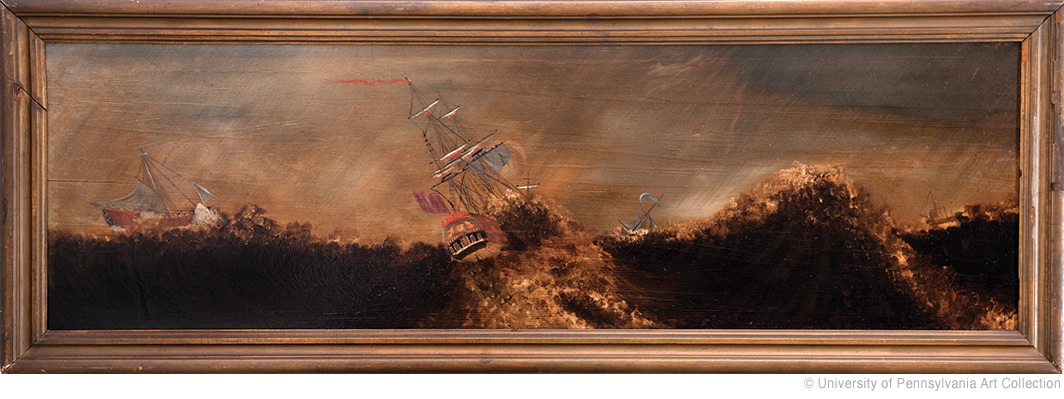
Three other paintings of note merit mention. The pastoral Primitive Landscape and the turbulent Storm at Sea were painted by Benjamin West (1738–1820)—who famously taught both Charles and Rembrandt Peale. Portrait of Sir Samuel Romilly, a British abolitionist, is by Gilbert Stuart (1755–1828), yet another tutee of West’s. All three come from the Penn Collection and have recently benefited from conservation efforts.
“We really wanted to highlight the University’s collection,” says Shaw. “It’s a great opportunity to place these wonderful works where people can come and spend quality time with them instead of passing them in a hall or lobby.” The gallery has also developed a set of teaching resources for students and faculty. Additionally, special events include a Homecoming Weekend conversation (November 14) between Shaw; Sylvia Yount G’90 Gr’95, the Lawrence A. Fleischman Curator in Charge of the American Wing at the Met [“Alumni Profiles,” Mar|Apr 2025]; and Jill Vaum Rothschild G’14 Gr’21, associate curator of fine and decorative arts at Mount Vernon.
—JoAnn Greco