
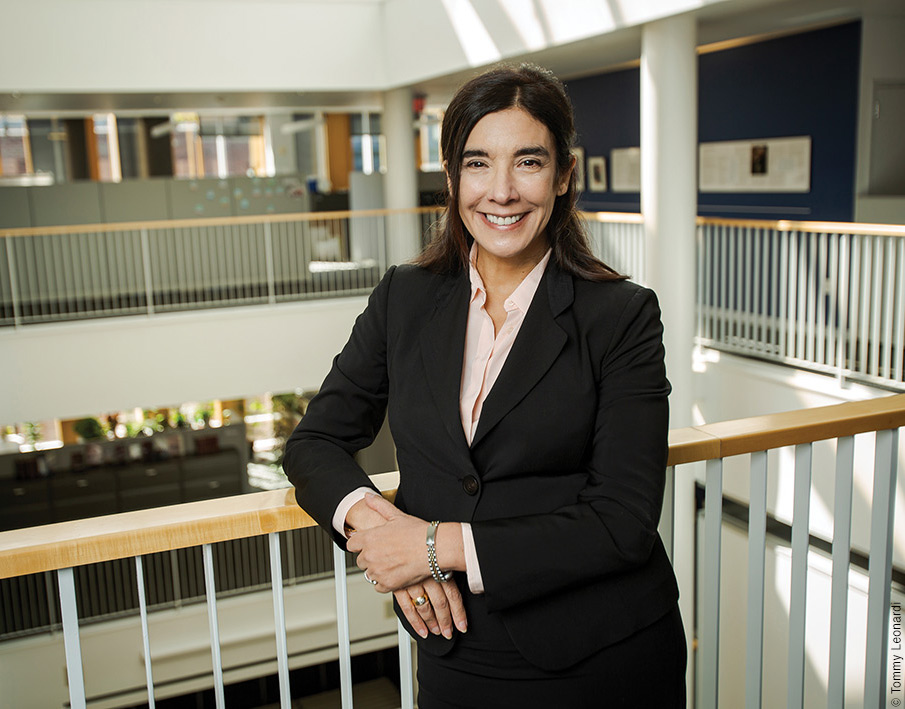
Dolores Albarracín takes the reins from founding director Kathleen Hall Jamieson.
It doesn’t look any different from the outside—same glass and aluminum façade, same lustrous wood panels layered beneath. But inside the Annenberg Public Policy Center (APPC), which fronts the 36th Street walkway between Locust Walk and Walnut Street, an unprecedented shift occurred this summer.
Since its founding in 1993, when it was housed within the Annenberg School before getting its own building in 2009, the hub for communication scholarship and public policy has had the same director: Kathleen Hall Jamieson. This past July, after 33 years at the helm, Jamieson stepped down from that role, though she’ll still remain at APPC.
Her successor is Dolores Albarracín, a social psychologist who focuses on policy issues at the intersection of psychology and communication and has been the Amy Gutmann Penn Integrates Knowledge (PIK) Professor since 2021.
“I’m very proud that the policy center is being led by Dolores,” says Jamieson, Penn’s Elizabeth Ware Packard Professor of Communication. “There’s not a person in the world who’s more qualified to address the nation’s needs at this moment in time with the resources we have available at the policy center.”
“It’s really motivating and interesting to have this opportunity to lead the center,” Albarracín notes. “I come with a unique background that feels really central and connected to all the issues that are covered within APPC.”
That includes her career-spanning research on what makes communication effective, and how it can prompt changes in beliefs and behavior. “In my work, I’ve looked at attitudes and persuasion from virtually every important angle,” she says. “I’ve dedicated significant time and effort to understanding how to create attitudes that have a higher probability of actually shaping decisions.”
The 200-plus articles and book chapters she’s written delve into those questions and many other subjects, too. Albarracín has also published three volumes of The Handbook of Attitudes, along with a book about how and why people create or believe conspiracy theories, and Action and Inaction in a Social World: Predicting and Changing Attitudes and Behavior (2021).
Her expertise is an ideal fit for APPC, Jamieson says—especially right now. “As we see this change in the political environment, she is at the top of her field, looking at how to address misinformation,” Jamieson says, “and figuring out how to use communication to implement policy.”
Albarracín has been directing APPC’s communication science division since 2021, which she’ll continue to do. It’s one of the policy center’s core areas, along with democracy, climate, health, and several other realms within a complex organizational chart that’s sprouted many new branches since APPC opened in the early 1990s.
Jamieson was already dean of the Annenberg School for Communication (ASC) in 1993 when she helped secure a major gift from Walter Annenberg W’31 Hon’66—then the largest in Penn’s history. Of his $120 million donation, $100 million endowed the ASC; the other $20 million created the policy center.
From the beginning, APPC prioritized public relevance. It aimed to help scholarship shape public policy, with a focus on four areas at first: political communication; information and society; children and media; and health communication.
By the mid-2000s, Jamieson had grown APPC into a larger enterprise—including establishing FactCheck.org in 2003.
“We wanted to provide a corrective in the political process to he said/she said journalism,” she says of the website. Reflecting on her 33-year tenure, Jamieson ranks FactCheck.org among her proudest achievements. “We helped found the fact-checking movement in the United States.”
The nonprofit site focuses on evaluating—and often rebutting—the accuracy of claims made by politicians. It’s always been aimed at journalists who are covering controversial topics on tight deadlines and desperately need trustworthy facts.
Independent experts have named FactCheck.org among the country’s least biased fact-checking sources. And while it’s now directed by Lori Robertson GL’19, herself an experienced journalist, Jamieson remains both invested and involved. “I continue to be the one who does the final check on everything that they put out before it’s actually posted,” she says. “And I’m continuing that role.”
As Jamieson molded APPC into a public policy powerhouse, Albarracín was fresh to the US from her native Argentina. She enrolled at the University of Illinois at Urbana-Champaign as a PhD student in social psychology. That’s where she began to study how communication and persuasion can impact human behavior.
Albarracín became a professor of communication and psychology at Penn in 2012. After leaving for several years, she returned as a PIK Professor in 2021. She holds appointments in both the Annenberg School and the Department of Psychology, and she also directs Penn’s Social Action Lab.
Once she settles into her new role, Albarracín plans to launch a policy communication initiative through APPC. “We know that public policy can have massive impacts,” she says. “But how should we communicate a new policy? What makes those communications most impactful? I think this is an area that really needs to be addressed.”
She’d also like the center to connect with more policymakers. Her goal is to establish boards for both policymakers and community members to help determine APPC’s priorities at the city, state, and national levels.
And within Penn, “we really want to branch out as much as possible and invite broad participation by faculty members across all sectors,” she says.
Jamieson, meanwhile, will focus on science communication. When the National Academy of Sciences awarded her its Public Welfare Medal in 2020—its highest honor—“I promised myself that I would spend the remainder of my career trying to be worthy of that award,” she says.
“Science is under threat right now from many fronts,” she adds. “It’s increasingly important that all hands are on deck trying to protect the integrity of science and the ways it’s communicated.”
But that’s not the only challenge APPC’s incoming and outgoing directors see. There’s the unpredictable trajectory of AI; an undermining of public health and vaccination trust; climate change denial; a political discourse so polarized that there are now scholars of polarization (one of them at APPC); and continued attacks on academia, research funding, and scholastic freedom. Still, Albarracín says she maintains optimism for her adopted country.
“I was born in Argentina during a military dictatorship, so I have firsthand experience with living where freedom of speech is suppressed,” she says. “I’ve always felt incredibly grateful to have come to a country where I felt all of that was protected.
“I feel a lot less certain of that today,” she adds, “but I continue to have hope and a significant degree of trust in American institutions.”
—Molly Petrilla C’06