
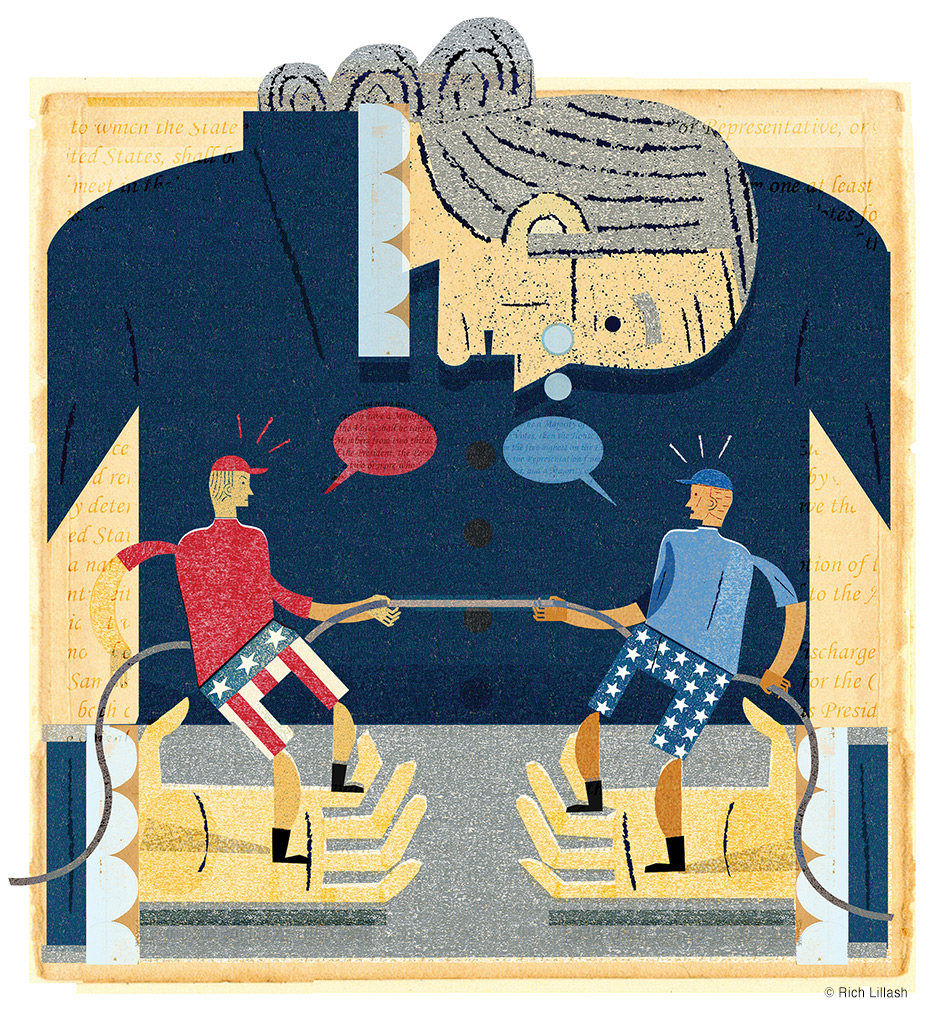
How the fractious group gathered in Philadelphia during the hot summer of 1787 managed to reach consensus on a constitution.
The Constitutional Convention could have disbanded in failure at several points. That was the consensus during the course of “Ben Franklin, the Constitution, and Civic Participation,” the second entry in Penn’s discussion series “A Republic If You Can Keep It” marking the nation’s 250th anniversary. At the Perry World House in mid-September, moderator Ezekiel J. Emanuel, Penn’s vice provost for global initiatives, and panelists Stacy Schiff, biographer of Franklin and Samuel Adams, and constitutional scholar Akhil Amar, agreed that the convention’s survival was due to the behavior modeled by its most famous and influential members, Franklin and George Washington.
Dressed for the occasion in colonial-era garb he referred to as his “Minuteman outfit,” Emanuel called Franklin’s speech, delivered before the delegates voted on the text, one of the “great American short speeches,” ranking it alongside Lincoln’s Gettysburg Address and Kennedy’s inaugural address. The speech started with Franklin reflecting that as he had gotten older, he had come to respect others’ opinions more; proceeded to note that all participants had had to give up some of their own ideas for government; and closed with a wish that “the spirit of compromise should prevail on this,” Emanuel said. He also quoted from the letter of transmittal that Washington, as president of the convention, sent to Congress, which referred to the “mutual deference and concession, which the peculiarity of our political situation rendered indispensable.”
“Why are they both at this moment, at the end, talking in these ways about compromise, about not getting everything you want?” Emanuel asked the panelists—whose responses, slightly edited and condensed, are below:
Schiff: Well, they know that ratification is still ahead, so this is the hard part. No one knows what has gone on in that room, and, you know, [the Constitution] says “We the people,” but the people have absolutely no idea what they’re about to sign up for or not sign up for [because delegates had been sworn to secrecy during deliberations]. So there’s a big leap that has to take place, and it’s Washington, I think, who says that how this is built, how this makes its way out into the world, is going to determine whether ratification succeeds. So they’re getting out ahead of the troops here.
Franklin’s speech starts out in this kind of lovely homespun way, but then it evolves essentially to the sense that government depends on the people believing that their government is good, and that the officials of that government are wise and have integrity, and that is the pillar on which government rests. And in between, there’s a little poison pill, where he basically says, “I think this constitution, which we’ve just devised, will last for a course of years”—which is an interesting locution—“until despotism sets in, which will only happen, essentially, if the people get to the point where they are so corrupt that they require despotism.” It’s a kind of discordant chime in the distance.
Amar: The first words, “We the People”—that is yet to come. That’s the ratification process. All these guys do is issue a proposal on September 17, 1787. And it’s been secret up to that point, but on that day the ban of secrecy lapses, and they’re allowed to now talk about [it]. Franklin’s speech isn’t just for the people in the room. It’s the beginning of the ratification process, and [Washingon’s] letter of transmission is the ratification process.
And this is the Big Bang of the modern world. They put the thing to a vote up and down the continent. They didn’t do that with the Declaration of Independence, or the Articles of Confederation, or any of the state constitutions in 1776. Rome never did that. Greece never did that. The Brits never did that. The Swiss never did that. More people are allowed to vote on the Constitution than had ever been allowed to vote on anything before in human history.
In eight of the 13 states, property qualifications for voting are lowered or eliminated. In New York, all adult free male citizens get to vote on the Constitution, pro or con—no race tests, no literacy tests, no property qualifications. Wow, those aren’t the ordinary rules for New York. So it’s an astonishingly democratic moment. Franklin is very proud of that.
And it could have been voted down. It passes by a very narrow margin in state after state—and yet the people who lose acquiesce. They don’t march on the national capital on January 6. And although Pennsylvania is a slightly different case, in almost all the other states the people who win let the opponents speak their piece. Intense emotion, but no one dies in this year in political fighting.
It’s astonishing that we did that, once. Maybe we could do it again, but we need to study how that happened before. And without Franklin and Washington saying, We vouch for this, none of us got what we wanted—even we didn’t, and without the spirit of conciliation, [it wouldn’t have happened].
And the biggest objections are that the House [of Representatives] is too small, and there’s no Bill of Rights. And so, when Washington gets elected, he says, “Well, let’s actually make sure that the House is bigger, and let’s give the opponents the Bill of Rights that they want.” The losers are not sore losers. The winners are not sore winners. They listen to the losers and bring them on board. —JP