A new paradigm will emerge for the free press, says one University professor and media historian. It’s just complicated.
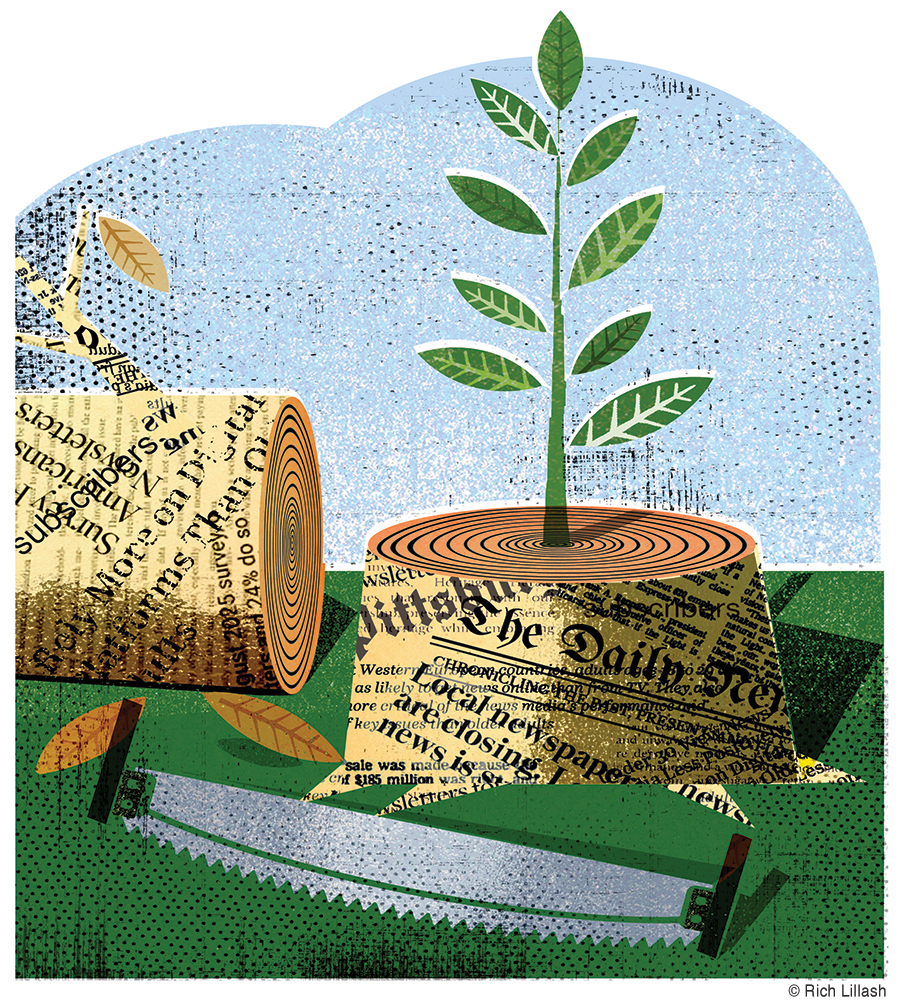
If newspapers and other media outlets are essential for democracy—but they can’t be funded or regulated by the government, and people complain about paywalls and subscriptions—how will news survive?
At a time when the public will often share photos, videos, and doctored social media memes before linking to news articles, media outlets are foundering and closing, leaving an average of eight local journalists for every 100,000 Americans, down from an average of 40 just a quarter century ago. And around 50 million people live in “news deserts” with little to no local coverage, researchers at Northwestern University’s Medill School of Journalism have found.
The puzzle of how to maintain a free press—one that will question public officials and unearth corruption—has plagued the American media ecosystem for 250 years. New challenges have emerged, and not just from internet competition. Deregulation over 30 years has squeezed out small outfits, with the US losing nearly 3,500 newspapers and more than 270,000 news jobs since 2005, including 136 largely independent outlets in 2024 alone.
“It wasn’t inevitable to have it this way, but inaction led us to this moment,” says Victor Pickard, the C. Edwin Baker Professor of Media Policy and Political Economy at Penn’s Annenberg School for Communication. But he sees hope and opportunity, believing there are ways to maintain and reinvigorate the American free press.
In December, Pickard coauthored “The Political Economy of the US Media System: Excavating the Roots of the Present Crisis.” Funded by the nonprofit Roosevelt Institute, the report examines actions from across the political spectrum that led to the decline of news availability, highlighting past safeguards and initiatives that could bring back a strong media.
While the report mentions the oft-discussed 1987 repeal of the “Fairness Doctrine”—a 1949 Federal Communications Commission [FCC] policy to ensure contrasting opinions and public interest reporting—Pickard also delves into the erosion of less obvious government safeguards due to the misguided belief that deregulation would keep the press free.
“I’d like to reframe [the discussion] a little bit,” he says.“Government is always involved in our media, our news, our communication infrastructures—in everything from managing the public airwaves, to intellectual property laws. So if we know government will always be involved, how should it be involved?”
Going back to the 18th century, the government has funded and regulated the press in obvious and subtle ways, Pickard notes, including through reduced postal rates for periodicals. By 1832, “95 percent of the weight of the post was newspapers,” he says. “We subsidize postage rates. Media subsidies are as American as apple pie. At the dawn of the republic, it’s something we were doing.”
Pickard grew up outside of Pittsburgh—a city that recently almost lost its daily newspaper, the Post-Gazette. (A new owner saved the paper but made significant layoffs.) He graduated from Allegheny College in 1995 and became interested in media policy when he traveled in Southeast Asia, he says, and saw disparities between international news coverage abroad and in the US. Pickard earned a PhD at the University of Illinois in 2008 with a dissertation on media survival after World War II. He came to Penn in 2011.
Pickard says the market can’t be the only arbiter of whether a free press survives, which is something he notes the country’s founding framers also believed. In addition to the repeal of the Fairness Doctrine and other weakened policies of the FCC—which was founded in 1934 to regulate media due to lawmakers’ concerns about limited space on the airwaves and a potential monopoly by the three main broadcast networks—Pickard’s report listed more changes that have hastened the demise of modern media.
Among them is a lack of internet regulation. Around 2024, social media owners loosened their content moderation policies. “Perhaps the most profound structural shift in the modern information economy is the rise of digital platforms as dominant gatekeepers of public discourse … the platform-
dominated advertising market has contributed to hollowing out the economic base of journalism, accelerating layoffs, consolidation, and the collapse of local news,” the report notes. “Big Tech powerfully influences the policy landscape through lobbying, litigation, and vast public relations campaigns.”
Inadequate funding for public media has also been an issue. The 1967 Public Broadcasting Act, “a critical step toward media democracy,” the report states, created the Corporation for Public Broadcasting, declaring that “the development and growth of public radio, television, and nonbroadcast telecommunications technologies are in the public interest.” But the CPB—which shut down in January 2026 when Congress zeroed out its funding—always lacked a guaranteed stream of income, and countries like Norway and Sweden spend about 62 times as much per person on public media as the US. Still, “CPB-funded public media reached almost all Americans—99 percent of the US population … [and] the corporation played an especially crucial role for rural, island, and tribal communities,” the report notes. “The refusal to adequately fund public media is often justified by overwhelming fears that federally subsidizing journalism will inevitably result in state-controlled media … [but] proper institutional safeguards can enhance, rather than undermine, press independence.”
And then there have been the increases in the number of media organizations that one company or person can own. The FCC’s “7-7-7” rule in 1953 prevented a company from owning more than seven AM radio, seven FM radio, and seven television stations nationwide. A separate 25 percent national audience reach cap was later introduced, which Congress then increased to 39 percent before the limit was lifted entirely in August by the FCC. But “rather than promote competition, it enabled corporate mergers,” Pickard’s report states. (One such potential megamerger, between Paramount and Warner Brothers, led Pickard to recently write on social media: “This is, of course, absurd for any democratic society worthy of the name.”)
Pickard insists that the market doesn’t always work in the public interest. Like libraries, he said, news outlets require public funds. They will also need safeguards, especially with emerging technology. “There’s always a mistaken assumption that we could just leave the internet to be dictated by Silicon Valley and various corporate interests, just like AI,” he says. “We can’t leave [media] up to the market and what a handful of billionaires think it should look like. There’s so much we’re going to have to do, figure out an entire regulatory paradigm.”
The past provides clues for how to do that. “The manifest failure of corporate libertarian media policy has created space for new approaches that treat journalism as essential democratic infrastructure,” the report states, “rather than a commodity whose existence is determined solely by its profit potential. The coming years will require a fundamental rebuilding and reinvention of such core institutions.”
One bright spot: A Pew Research report last October said 70 percent of Americans trust local news. While survey data show high levels of public distrust toward “the media” (along with all major institutions), Pickard says that “once you dig down a bit, when it comes to their local media institutions they still have warm-fuzzy feelings. That should give us some hope that people do still care and do trust local media.”
He also pointed to journalism nonprofits, and to new state government initiatives that fund reporting, as reasons for hope. For example, New York provides tax credits for companies that maintain and add journalism jobs.
“We need public support behind initiatives that not only salvage what’s left, but rebuild,” Pickard says. “This is a rare opportunity we have, to entirely reimagine what journalism should and could look like. What’s the cliché? Every crisis is an opportunity. We’re at a critical junction. We can create something better than what we had before.”
—Caren Lissner C’93