The forerunner to Penn Career Services was established 100 years ago, with student fees and an employer-oriented focus.
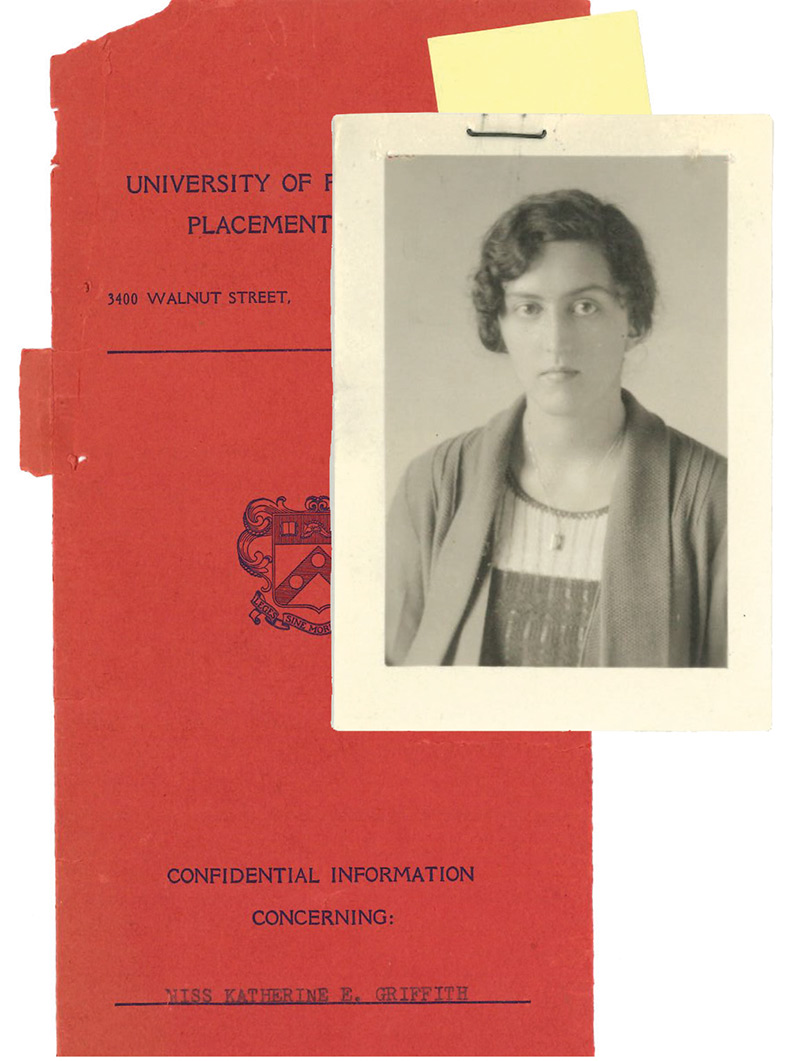
Katherine Griffith Faulkner Ed’32 GEd’36 was well educated for a woman in the 1930s and well prepared to succeed in her chosen field of physical education.
We know this because the University Placement Service—established 100 years ago in 1926 and renamed Penn Career Services in the 1990s—kept a summary of Griffith’s academic, professional, and personal background on file after she graduated.
In many ways, the summary is similar to résumés assembled by jobseekers today. It provides a headshot of Griffith looking appropriately serious and listed the two degrees she earned at Penn—a bachelor’s degree in health and physical education and a master’s degree in physical education. The summary included Griffith’s on- and off-campus athletic activities and affiliations, her four previous employers, and 10 succinct recommendations from professors and colleagues.
But certain content would never be included now. Notably, the summary supplied personal information about Griffith, including her nationality (American), age (28), marital status (single), church membership (Lutheran), height (five feet, five inches), weight (114 pounds) and “health” (excellent).
“It was much more of a placement mechanism to match students with jobs. The office actually got paid if it placed a student,” says Barbara Hewitt GrEd’02, who has been executive director of Penn Career Services since 2018 and at the University since 1998.
“That was interesting to me because it’s certainly not how we work at all today,” she adds. “We see ourselves as connectors, but we won’t even solicit particular students for jobs. We want to get the opportunities out there to everybody and we want all students who are interested to apply. Then the employer makes the decision. So it was a really different process there for sure.”
Penn has one of the oldest university career services offices in the country, behind Princeton University’s “Self-Help Bureau,” founded in 1912, and Yale University’s “Placement Bureau,” established in 1919. The personal information collected from Griffith and the department’s employer-oriented job placement process in the early 20th century illustrates how much Penn’s career guidance services have adapted to the times over the past century.
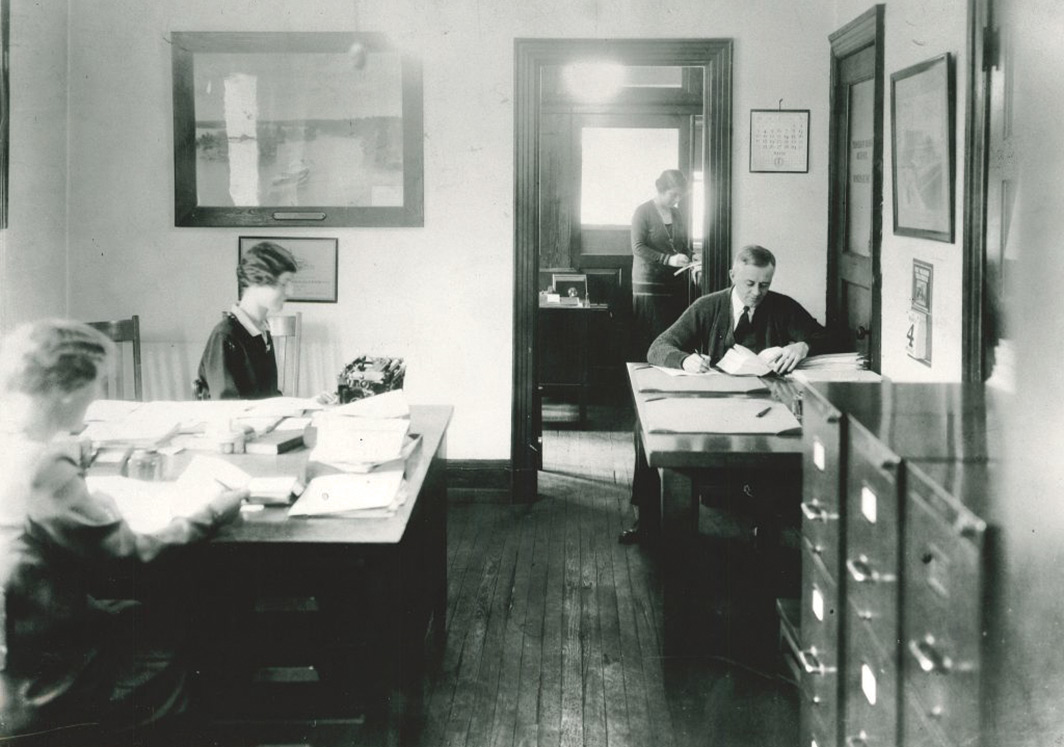
In September of 1926, Penn’s trustees voted to establish the University Placement Service, and named Clarence E. Clewell, an electrical engineering professor, as its first director. Clewell, who headed the office until 1950, explained the early progress of the new office in a 1930 Gazette article, boasting that in only a couple of years “contacts have been developed with more than 3,000 firms scattered throughout the country, and the qualification records of several thousand Alumni are in its files.”
At the time of the Placement Service’s founding, Penn had nearly 6,400 students, including 1,335 women, most of whom were enrolled in the School of Education, according to Penn Career Services research. Penn seniors and alumni like Griffith completed a form to create a profile of their credentials for the Placement Service to submit to employers looking to hire. Registration and placement fees were waived for seniors looking for their first job after graduation. “Our understanding is that the credentials were kept on file and sent to employers for consideration. The file was then sent back to the Placement Service by the employer after review, indicating whether they had hired the individual or not,” Hewitt says.
Alumni were assessed a $2 registration fee by the Placement Service, a $1 fee to renew their registration each year, and a placement fee once they accepted a position to help fund the office. Alumni hired for a full-time position paid the equivalent of “[o]ne week’s salary, based on 52 weeks in the year, payable within 30 days of the date of starting work,” according to a Placement Service document. Those hired for part-time and temporary positions paid “5 percent of the money earned, payable monthly during the first ten weeks.” Alumni accepting commission- based sales jobs paid “5 percent of the money earned during the first twenty weeks of work in the position.”
During the 1927–1928 school year, Penn students secured 587 full-time and 2,000 part-time jobs through the office. The 1929 stock market crash and subsequent Great Depression derailed some of the office’s momentum, but as students dropped out in droves, the Placement Service worked with the Student Aid Office to boost the number of students in work-study jobs.
As World War II, which helped reinvigorate the US economy, drew to a close, Clewell took charge of the University’s new Personnel Index to collect the occupational records of 13,000 alumni returning home from military service who would soon be looking for work. At the urging of Penn’s College for Women, the University agreed to hire a placement officer specifically for female students and alumni in the late 1940s. By the late 1960s, Placement Service counselors discussed the Vietnam War military draft and its potential impact on students’ career plans.
“We are so tied to the external world and what’s going on,” Hewitt notes. “You have to be pretty in tune with that to be a good career services office.”
Today, Penn Career Services takes an educational approach to working with students as the career resource center for undergraduate on-campus degree programs in the College of Arts & Sciences, Penn Engineering, School of Nursing, and Wharton. Alumni from those schools and programs have access to career-related digital resources, a job board, and career advisor appointments.
Staff talk with students about their interests, help them explore various career paths, teach them how to network, and assist in résumé writing, says Hewitt. The office holds approximately 10 career fairs a year and conducts information sessions with employers for students.
Hewitt says the biggest shift she’s seen in the past 20 years is the increasing importance of students gaining work experience through internships. “We used to say to students: ‘Don’t worry about what you do freshman year. Maybe you don’t even have to worry sophomore year.’ But now there’s a lot of very early recruiting by employers, and if they’re not thinking about it earlier, they might lose out on opportunities.”
To mark Penn Career Services’ centennial, the office held a celebration in late September and is seeking alumni input to create the “Career Advice from 100 Alumni Compendium,” a collection of insights from Penn graduates across industries, geographies, and class years. A description of the project and a link to a survey can be found at careerservices.upenn.edu/advice-from-100-alumni.
The compendium will be shared online. “It’s a way to bring the larger Penn community into this whole 100-year celebration,” Hewitt says.
—Samantha Drake CGS’06