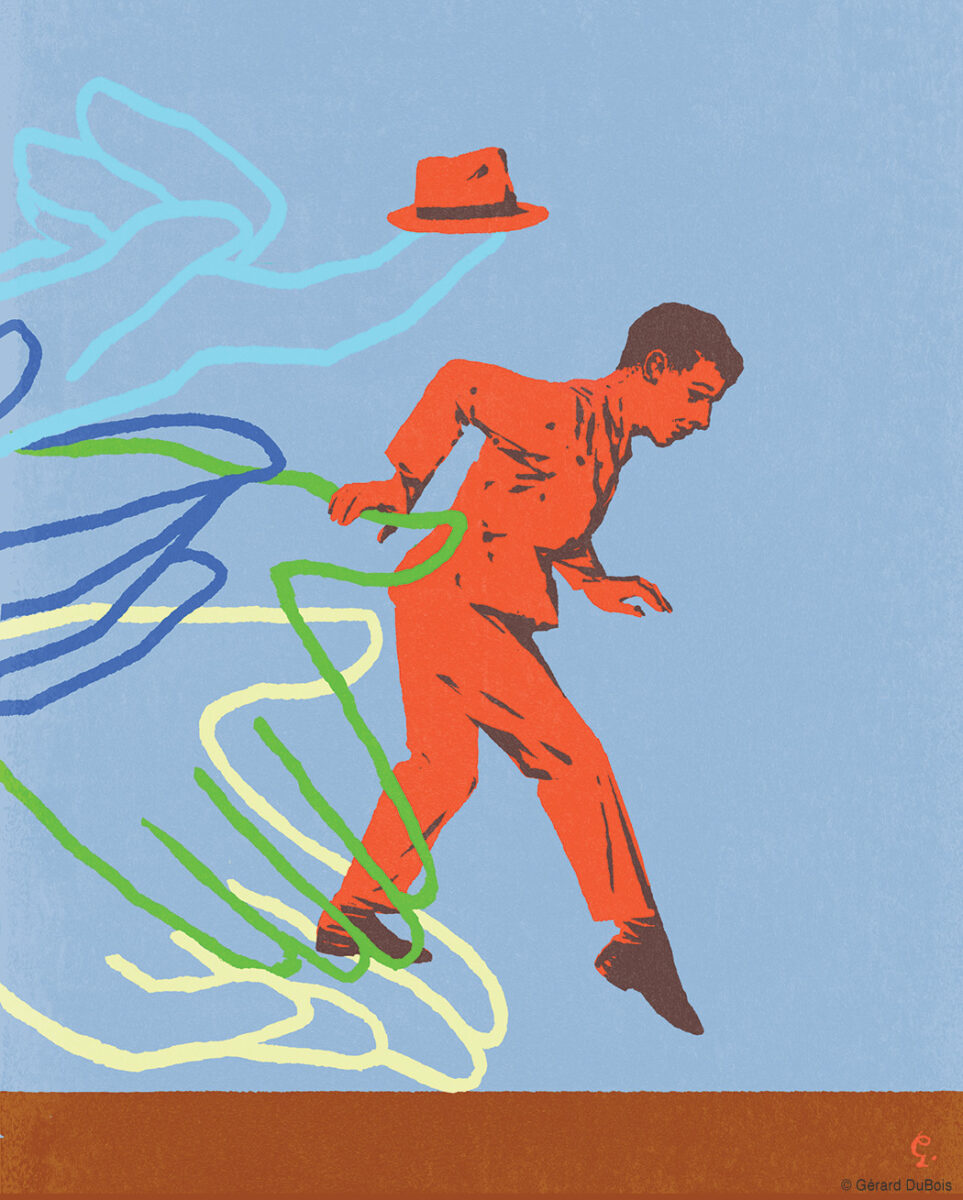
In new books, Penn psychologists offer their prescriptions for friendship and achievement and trace the impact of a can-do mindset on human history.
By Julia M. Klein
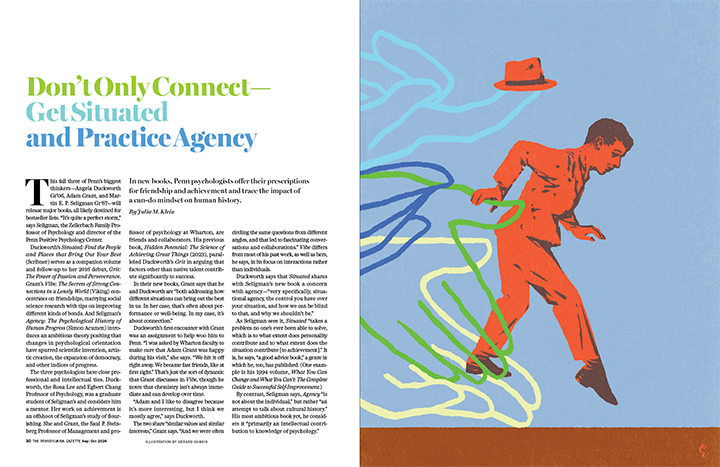
This fall three of Penn’s biggest thinkers—Angela Duckworth Gr’06, Adam Grant, and Martin E. P. Seligman Gr’67—will release major books, all likely destined for bestseller lists. “It’s quite a perfect storm,” says Seligman, the Zellerbach Family Professor of Psychology and director of the Penn Positive Psychology Center.
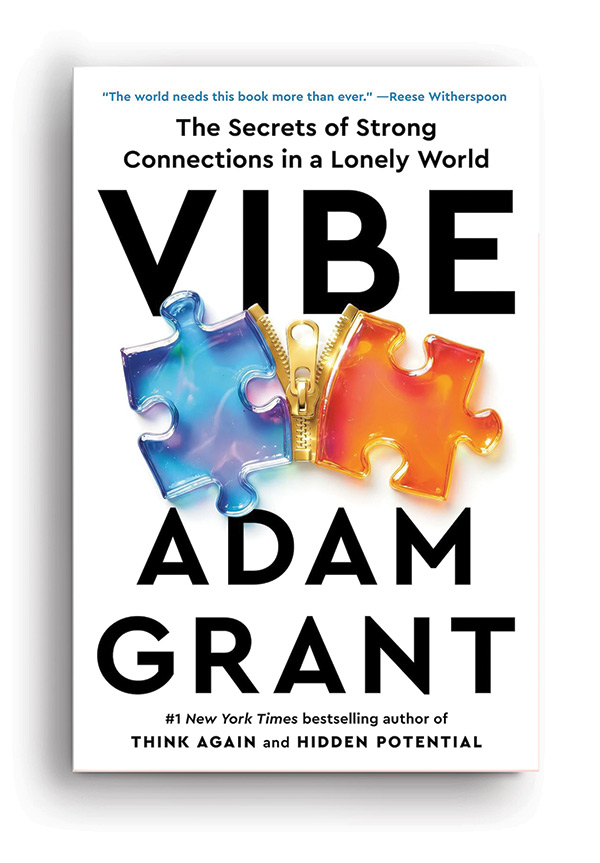
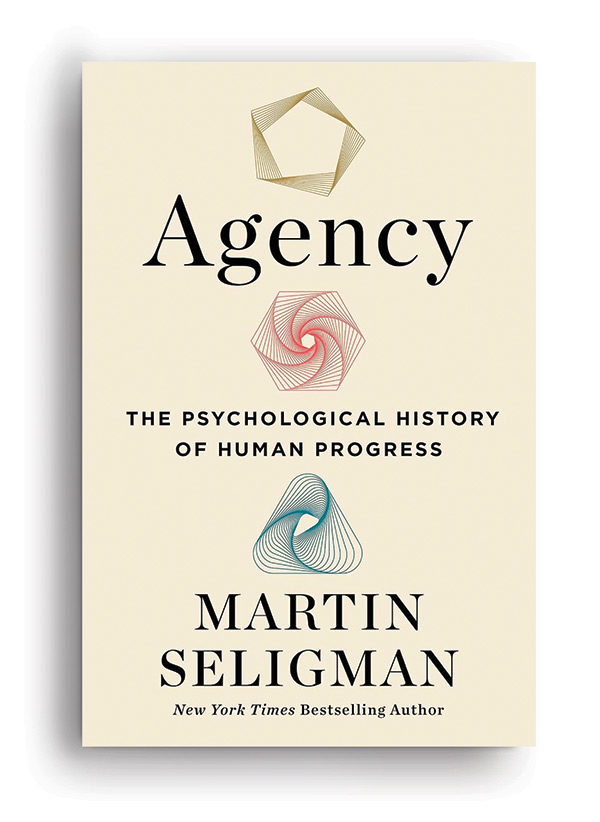
Duckworth’s Situated: Find the People and Places that Bring Out Your Best (Scribner) serves as a companion volume and follow-up to her 2016 debut, Grit: The Power of Passion and Perseverance. Grant’s Vibe: The Secrets of Strong Connections in a Lonely World (Viking) concentrates on friendships, marrying social science research with tips on improving different kinds of bonds. And Seligman’s Agency: The Psychological History of Human Progress (Simon Acumen) introduces an ambitious theory positing that changes in psychological orientation have spurred scientific invention, artistic creation, the expansion of democracy, and other indices of progress.
The three psychologists have close professional and intellectual ties. Duckworth, the Rosa Lee and Egbert Chang Professor of Psychology, was a graduate student of Seligman’s and considers him a mentor. Her work on achievement is an offshoot of Seligman’s study of flourishing. She and Grant, the Saul P. Steinberg Professor of Management and professor of psychology at Wharton, are friends and collaborators. His previous book, Hidden Potential: The Science of Achieving Great Things (2023),paralleled Duckworth’s Grit in arguing that factors other than native talent contribute significantly to success.
In their new books, Grant says that he and Duckworth are “both addressing how different situations can bring out the best in us. In her case, that’s often about performance or well-being. In my case, it’s about connection.”
Duckworth’s first encounter with Grant was an assignment to help woo him to Penn. “I was asked by Wharton faculty to make sure that Adam Grant was happy during his visit,” she says. “We hit it off right away. We became fast friends, like at first sight.” That’s just the sort of dynamic that Grant discusses in Vibe, though he notes that chemistry isn’t always immediate and can develop over time.
“Adam and I like to disagree because it’s more interesting, but I think we mostly agree,” says Duckworth.
The two share “similar values and similar interests,” Grant says. “And we were often circling the same questions from different angles, and that led to fascinating conversations and collaborations.” Vibe differs from most of his past work, as well as hers, he says, in its focus on interactions rather than individuals.
Duckworth says that Situated shares with Seligman’s new book a concern with agency—“very specifically, situational agency, the control you have over your situation, and how we can be blind to that, and why we shouldn’t be.”
As Seligman sees it, Situated “takes a problem no one’s ever been able to solve, which is to what extent does personality contribute and to what extent does the situation contribute [to achievement].” It is, he says, “a good advice book,” a genre in which he, too, has published. (One example is his 1994 volume, What You Can Change and What You Can’t: The Complete Guide to Successful Self-Improvement.)
By contrast, Seligman says, Agency “is not about the individual,” but rather “an attempt to talk about cultural history.” His most ambitious book yet, he considers it “primarily an intellectual contribution to knowledge of psychology.”
Duckworth stresses the commonalities in the trio’s academic projects. “I think that all three of us are interested in how psychological science can help people live better lives, whether that means being happier, or more successful and achieving our goals, or being connected to other people,” she says. “I think that’s one throughline that connects all of us.”
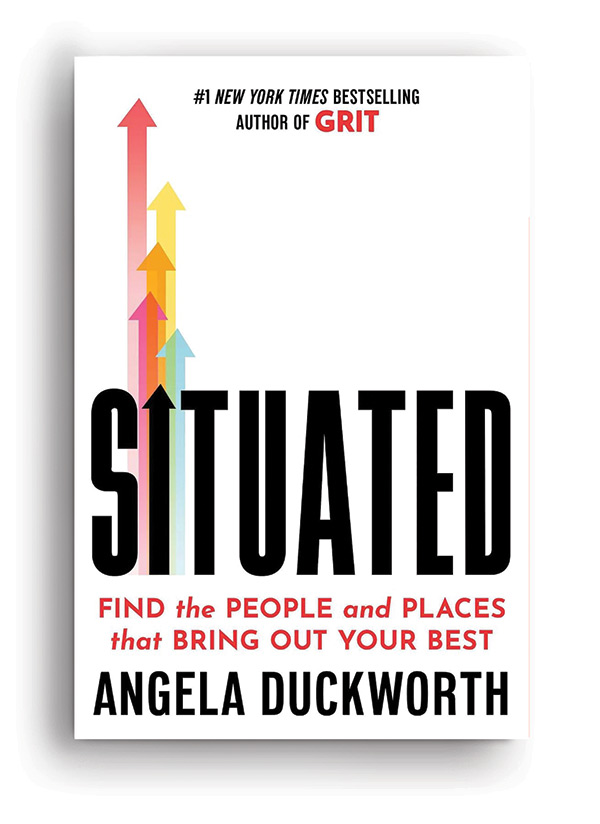
The big news from the popularizer of the concept of grit is that grit alone is not enough. To succeed, it seems, even gritty people need to put themselves in the right situation. Hence Situated.
“The first book, Grit, is really about the inside game of success—the positive, optimistic ways that really gritty strivers think about adversity, failure, challenge, growth,” says Duckworth, while Zooming in workout clothes from a treadmill desk. “I felt very compelled at the time, 10 years ago, to publish that book. And I feel as enthusiastic today looking back as I did the moment it came out about the message.”
But Duckworth has since switched her focus, to what she calls “the outside game of success.” She hastens to add: “It’s not a contradiction. I think it’s a complement. I see so much of what happens to somebody’s goals or their achievement, or their lack thereof, as dependent on the situation.”
That means, she says, “Who’s around you? Where do you work? Where do you live? What political system are you under?” It also embraces more trivial-seeming issues, such as where you keep your (endlessly distracting) cell phone when you’re working. “If there’s one important message of this book,” she says, “it’s that you have agency over some aspects of your situation.” And maybe more so than you think.
Was the new book influenced by criticism that Grit didn’t pay enough attention to social context and other factors? Is she now meeting her critics partway?
“That was one of the most salient critiques of Grit,” Duckworth says. But the criticism was hardly revelatory. “These critics are correct to point out that the situation is important. Also, they’re correct to point out that not everyone can change every aspect of their situation, or maybe nobody can. But I have always agreed with them.”
Duckworth’s current work incorporates tenets of behavioral economics, which introduced the idea of using situational “nudges” to shape behavior. (One classic example is automatic enrollment in 401(k) plans to encourage saving for retirement.) Also integral to Duckworth is cognitive behavioral therapy, whose great insight was that thoughts trigger emotions, and that changing cognitions could relieve depression and anxiety. Duckworth says that, in his later writings, Aaron T. Beck Hon’07, who conceived CBT, spoke of the need “to find our sweet spot where our passions come alive.” That, for Duckworth, “was foundational.”
In recent years, she has collaborated with James Gross, the Ernest R. Hilgard Professor of Psychology at Stanford University and director of the Stanford Center for Affective Science. Together they found that “of all the ways you can change your behavior, willpower is the absolute worst,” she writes in Situated, and both adults and adolescents “rated situational strategies as more effective—and less effortful.”
The high achievers that Duckworth has studied—world-class athletes, world-class business leaders, “world-class anything”—“surround themselves very deliberately with mentors and with teammates who bring out their best,” she says. “They don’t keep their cell phone right next to them when they’re trying to do very difficult work. They don’t put junk food in the pantry when they’re trying to stay on a diet.”
What’s more, she says, “the outside game changes the inside game because when you are with positive, can-do people who are looking for you to be your best, that changes what kinds of thoughts you have.”
Situated covers what Duckworth calls “situational awareness,” “situational agency,” and “situational responsibility,” which involves setting others up for success. The book offers guidance for readers in their roles as parents, leaders, and citizens. The situational citizenship chapter highlights the accomplishments of 1996 MacArthur Fellow Bill Strickland, founder of a nonprofit arts and job training program in Pittsburgh that serves both at-risk teenagers and adults in a beautifully designed setting. Strickland told Duckworth that the training center—inspired by his visit to Frank Lloyd Wright’s iconic Fallingwater house museum in Mill Run, Pennsylvania—allowed clients to “spend time in a bright, clean, nurturing place where it didn’t seem pointless to dream.” He added, “If you want world-class behavior, you need to begin with a world-class environment.”
Another of Duckworth’s case studies involves the relationship between Olympics swimming ace Michael Phelps and his equally dedicated coach, Bob Bowman. Phelps had passion and perseverance, the two components of grit. But that would not have sufficed, Duckworth contends. “There’s no way Michael Phelps would have won 28 [Olympic] medals, 23 of them gold, without having the best swimming coach in history as his swim coach from age 11 to when he retired at 31,” she says. Bowman crafted what he calls an “environment of excellence” at the country’s best youth aquatic center, in North Baltimore.
Another factor in Phelps’s success, says Duckworth, was his mother, Debbie Phelps, an educator and “the wisest, kindest person.” Despite her son’s struggles in elementary school—restless and unable to sit still, he was diagnosed with attention deficit hyperactivity disorder (ADHD) at nine—she “never stopped believing in his potential, never stopped figuring out what’s a great situation for Michael,” Duckworth says.
Other examples in Situated are drawn from Duckworth’s own life. She talks, for instance, about her mother, a promising artist whose career was interrupted by the demands of marriage, parenthood, and a needlepoint business. But her artistic production sparked when she was able to sell the business and rent an art studio, gaining the proverbial room of her own. At 91, Duckworth says, “she is now working in ceramics,” and her latest project involves representations of the traditional “bound feet” shoes that once hobbled Chinese women.
Duckworth even uses her own marriage, to the real estate developer Jason Duckworth, as a case study. (It was his idea, she says.)
After years of “fairy-tale romance” and two children, the trouble started in 2007 or 2008, when the US housing crisis and subsequent recession imperiled Jason’s business. At the time, both spouses were working impossibly hard. “In part it was because every time we had ever been challenged in life,” Duckworth says, “we thought the answer was inside us: get up earlier, stay up later, try harder.” But all that effort was leaving them exhausted, isolated, and unhappy.
The eventual solution, she says, involved “widening the aperture to look at the whole situation.” For a time, at considerable expense, they enlisted individual therapists, as well as a couples therapist. Instead of working solo, Jason found mentors by setting up an advisory board and peers by joining an organization for entrepreneurs. She, too, changed her approach to work, making her projects team efforts.
They’re still “strivers,” she writes, who “rise with the sun, share coffee and breakfast, and then disappear into our work.” But they find more time for each other. “We had a challenging situation, but we did not have a supportive situation, and you need challenge and support both to flourish,” she says.
Adam Grant—Wharton’s most popular professor, best-selling author, TED talker and podcaster—was once an introverted kid who struggled to make connections. So just how did he get to where he is now?
Turns out, Grant has wondered about that himself.
“I grew up as somebody who felt like a lot of my interactions were awkward. I was shy, I was introverted, I was nerdy,” he recalls in a phone interview. “And I often would leave an interaction or a conversation and feel like, ‘We didn’t click, we didn’t hit it off.’” He would ask himself: “What did I do wrong?” Or even: “What’s wrong with me?”
His current life could hardly be more different. “Something strange has happened,” he says. “I went from feeling like I couldn’t have a great conversation with as many people as I hoped to now having strangers tune in to listen to me talk to other people.”
He details the techniques that helped him, as well as clients such as the US Women’s National Soccer Team, in his latest book, Vibe. Debuting in October, it offers what Grant calls “a new language and a new lens for understanding our bonds with other people.”
Key to his approach is a typology of friendship, suggesting that different kinds of relationships entail different expectations. Melding social science research and anecdotes about the interpersonal challenges of various groups, Grant offers ideas about how to improve and deepen connections.
The story begins with a publicity tour for his last book, Hidden Potential. When his interview partner for a scheduled Los Angeles appearance contracted COVID and had to bow out, Grant scrambled to find a last-minute replacement. “The first person to respond with an immediate ‘yes’ was Jennifer Garner, the actor,” whom he had met just once, over Zoom. “And we had a conversation [in Los Angeles] that every single audience member I saw afterwards said was electric.” It was, he says, “a great experience of an unexpected sort of connection.”
Grant subsequently aired the conversation as a podcast, and another friend, Jessica Gelman, the CEO of a sports analytics firm, was struck by the chemistry of the interaction. “She encouraged me to study it,” Grant says. “And I could not get that out of my head. I teach entire classes about building and maintaining connections. But I’ve never really taken it on as a subject. And that was the original inspiration.”
Recent concern about a nationwide “loneliness epidemic,” prompted in part by a 2023 US Surgeon General’s report, lent the project more urgency, Grant says. “As a species, we are struggling with interaction and with forming and re-forming and maintaining connections. And so it felt like a topic that needs to be tackled now.”
In Vibe, Grant distinguishes four types of friendship. Associates have transactional ties; they trade favors and resources. Allies, often found at work, share a common mission. Pals form “alliances of amusement” around common interests and hobbies. Companions are confidantes who offer emotional support.
Of course, the lines can blur, and friendships can fall into more than one category. But problems arise when people mistake, or disagree about, the kind of relationship they’re in. In Vibe, Grant tells the story of a distant associate who kept asking him over for dinner. He kept saying no until the message finally got through.
For the most part, though, Vibe focuses on strategies for enhancing relationships: by, for instance, upping the intensity of shared activities, ditching small talk in favor of more meaningful conversations, expressing vulnerability, and identifying shared values. Grant notes that workplaces often spend too much time on forced bonding rituals, when colleagues need mostly to be allies focused on common goals.
In researching the book, Grant says he was guided by his own advice in Think Again: The Power of Knowing What You Don’t Know (2021). “I went in thinking, before I read the research, that chemistry either happens or it doesn’t—not that it can actually grow over time,” he says. He also believed “that it takes time to become close,” and discovered instead that “closeness can be cultivated overnight in some cases under the right conditions.”
But aren’t those insights contradictory? “I thought those were contradictory at first, too,” he says. “And I realized they’re not. Chemistry is the synchrony you have in an interaction, the feeling of clicking. Most people assume you either get it instantly or you don’t. But actually, it can take a long time to find that click, to get the common wavelength. On the flip side, closeness is the strength of a bond. And you can have that without chemistry.”
After writing Give and Take: A Revolutionary Approach to Success (2014), Grant was asked how he prioritized his own giving. “And I said, ‘Well, it’s really simple: Family first, students second, colleagues third, everybody else fourth.’ And it only hit me much later that friends were not even on my list. That bothered me.”
His insight now is that he was defining a friend as a pal, someone to hang out with, “not someone that you help.” He developed his four-part typology “out of being frustrated, not having the nuance I needed to describe different kinds of friendships—that I was close to people in different ways. And somebody who was really fun to spend time with was not always reliable.”
That distinction hit home when, about six years ago, his wife, Allison Sweet Grant, was diagnosed with breast cancer. (He says she has now been cancer-free for more than five years; her book on the experience, Lump: A Memoir in Ineloquent Reflections, is due out in September.)One friend, after learning of her illness, never followed up, and “I was really hurt,” Grant says. Now he realizes that the friend in question was an ally and pal, not a companion. “And I needed to have different expectations for that relationship.”
Vibe doesn’t have much to say about generational and gender variations, but Grant has pondered them. Surveys suggest that Gen Z (born between 1997 and 2012), digital natives who were severely impacted by pandemic isolation, is the loneliest generation. But that may be more of a “young people phenomenon” than a “birth cohort phenomenon,” Grant theorizes. (Time will tell.)
Grant says he was “very curious” about gender differences. They turned out to be clear in some cases, but “much less robust than I expected” in others. “Women expect to have more companionship than men, for example, and more frequent interaction,” he says. “What really didn’t turn out to be true was that men do side-by-side bonding and women do face-to-face bonding.” And while women also connect more frequently in pairs and men in groups, that may be changing.
“My overall takeaway is that a lot of our assumptions about gendered interaction and relationships are the fulfillment of our stereotypes, not necessarily the way things have to be,” Grant says. “I think men naturally gravitate toward being allies and pals more than companions. And women may do the reverse. And maybe each of those genders would benefit from balancing things out a bit.”
In his epilogue, Grant expresses some concern about the role of AI. Using AI can “build your social skills and exercise those muscles,” he says. “I think there’s a lot of potential benefit there. The problem is, what we see more and more clearly in the data is that people are using AI as a substitute for interaction—instead of building those muscles, actually allowing them to atrophy. That would be a massive social problem if it continues.”
This much has always been true about Martin E. P. Seligman: He takes big swings. From his groundbreaking experiments on learned helplessness, Seligman moved on to pioneer the theory of learned optimism, the field of positive psychology, and the science of flourishing. The former president of the American Psychological Association, he is the author or coauthor of more than 30 books, including a memoir, The Hope Circuit: A Psychologist’s Journey from Helplessness to Optimism (2018). His biography, disdaining false modesty, lists him as “the most influential psychologist in the world.”
Now, at 84, he has completed what he calls “the most audacious project I’ve attempted in 60 years of research,” one likely to embroil him in new debates.
The thesis of Agency, out in September, is that a causal connection exists between people’s belief in their power to act and historical progress. That belief, he posits, has waxed and waned over time, influenced by shifts in cultural, social, and economic circumstances, and transforming them in return.
The book promises, he writes, “to show you how one invisible force—human agency—has shaped the major turning points in our species’ history. How it sparked the Golden Age of Athens. How its collapse plunged Europe into centuries of darkness. How its resurrection created the modern world.”
Seligman discussed the project at his rambling Tudor-style house in Wynnewood, Pennsylvania, in what was once his poker room—until, he says, all his poker-playing buddies died. He shares the home with four dogs (not all of them friendly) and his wife, Mandy, a fine arts photographer, psychologist, and founder of a nonprofit that promotes well-being through photography.
The ground floor houses Seligman’s home office and shelves crammed with a lifetime accumulation of honors and awards. His wife’s mostly black-and-white images of swans, horses, roses, and horticulture decorate the walls. (Seligman says his “idea of heaven” is her photograph of a hayfield at harvest time near Adelaide, Australia.)
Seligman has been studying the idea of agency for years and reading history, too—in part to help homeschool his five youngest children. His undergraduate study of philosophy at Princeton University also informs Agency.
Dedicated to his two grandsons, the book begins by defining the concepts of agency and progress before selectively tackling the entirety of human history, beginning with the Bronze Age. In Seligman’s view, agency has three separate components. “Efficacy drives trying, optimism drives future orientation and perseverance, and imagination drives innovation,” he says. Together, he writes, “they’re the gears of progress.”
To prove his case, he explores manifestations of agency in ancient and classical Greece; ancient China (where agency was often collective); Judaism and early Christianity; medieval Europe; the Renaissance, Reformation, Counter-Reformation, and splintering of Protestantism; and the modern era. Seligman singles out the rise of agency for both Blacks and women in the 20th century, devoting a chapter to each.
He also lauds AI—he is a big enthusiast—for amplifying human agency. Large language models such as Claude and ChatGPT turn out to have been integral to his methodology. Their ability to analyze texts was indispensable in researching his claims and validating his thesis, he says. “I’ve never had a colleague like this before.”
One entry point to his subject, Seligman says, was trying to determine what triggered the transformations of different civilizations—the Hebrews, Chinese, Greeks, and Persians—during the period the German philosopher Karl Jaspers called the Axial Age. At around 1000 BCE, these civilizations were stagnant, but by 500 BCE, “all those four cultures are flourishing.”
Using AI to examine texts in multiple languages, Seligman found that in the earlier period, people lacked a vocabulary for human agency; in their writings, they attribute actions primarily to the gods. “But by 500 BC, all of these cultures have a rich agentic vocabulary,” he says. “And once you have new words, you can do things with the words. The invention of new words may have been part of what drove this new psychological history.”
Seligman doesn’t deny that improved material circumstances, affording people the leisure to consider new questions, are part of the story. “I think it’s reciprocally related,” he explains. “I think the material circumstances change our way of thinking, and the way of thinking changes our future material circumstances.”
Initially, Seligman used selective quotation to argue “that in the 200 years exiting the Bronze Age, the Greeks were discovering agency.” Then he called on AI for assistance. Provided with a list of agentic words such as “choice,” “purposes” and “freedom,” it made his hypothesis “quantitative and verifiable,” he says.
Seligman performed similar exercises with the Bible, comparing the (older) Torah, in which God commands and people obey, with other books of the Old Testament and the New Testament. “The Christian Scriptures make human intention, decision, and responsibility far more explicit than the Hebrew Bible, while still affirming divine sovereignty,” he writes. Agency arises in this period, he suggests, from “an urgent new need to navigate the treacherous waters of cultural change.”
Seligman attributes much of the stagnation associated with the Middle Ages to Saint Augustine, whose fourth century doctrine of original sin “casts a deep, almost fatal, shadow over the optimism of the classical world.” In declaring salvation wholly dependent on divine grace, Augustine represents “a new low” in the history of agency, Seligman says.
But even during the Middle Ages there were bright spots, among them the cultural efflorescence of the Carolingian Renaissance, during Charlemagne’s reign, and the achievements of Dante. In Seligman’s view, the poet balanced divine grace with an emphasis on human agency—and laid the groundwork for Renaissance humanism.
Seligman touches on the murderous impact of the Crusades. But he mostly skips over a litany of modern cataclysms, including the Holocaust, Stalin’s gulags, two world wars, and subsequent genocides around the globe. In our contemporary world, where agency thrives, can we really link it to progress?
Agency briefly acknowledges the conundrum. “The imagination that built cathedrals built Auschwitz,” Seligman writes. “The antidote is not less agency but wiser agency—efficacy paired with acceptance of what cannot be changed, optimism tempered by prudent planning, imagination disciplined by moral seriousness about consequences.”
Pressed on the moral issue, he says: “While I’m hardly blind to Stalin and Hitler and the Holocaust and the awfulness of things that have happened in history, I’m not trying to explain the awful stuff.
“I’m trying to take the notion of agency and see how that drives progress and how its absence produces stagnation. This does not deny that there are things like antisemitism and greed” that impact the course of history, too, Seligman says. “This is the story of one psychological trait influencing history.”
Julia M. Klein, a frequent Gazette contributor, writes for The Atlantic, The Wall Street Journal, Los Angeles Times, and other publications.