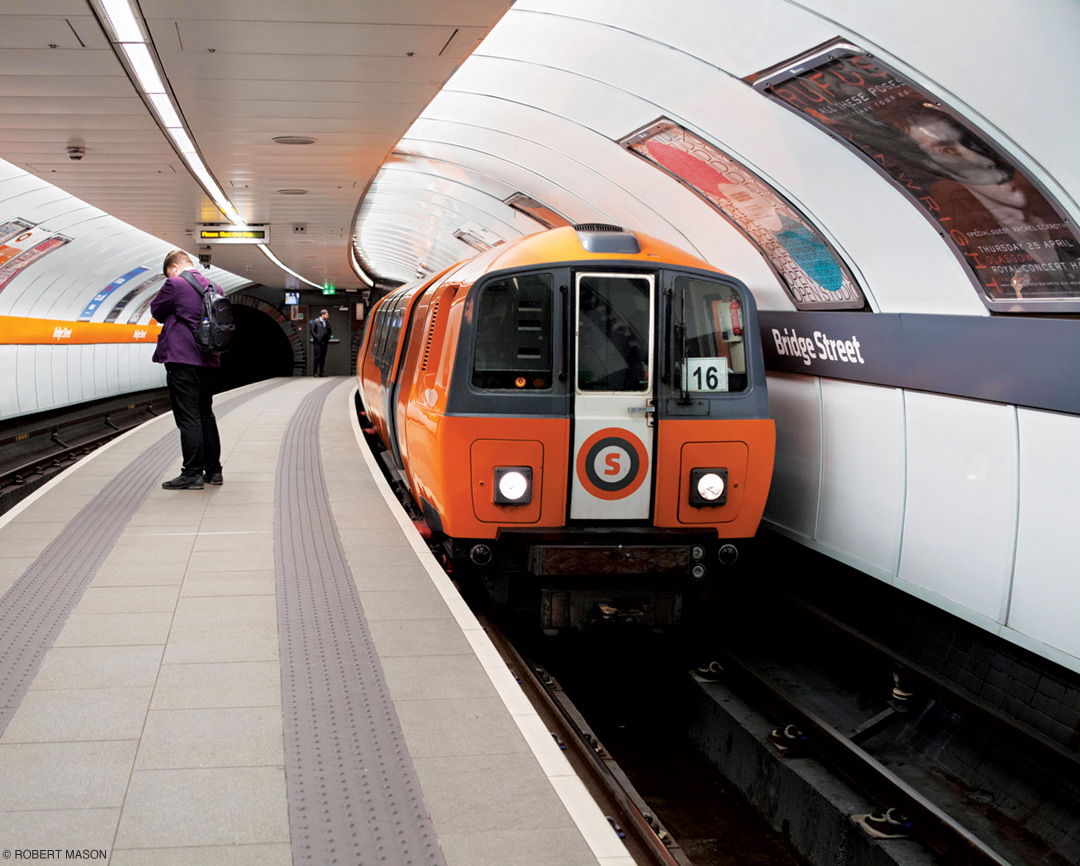
Riding the “world’s largest model railway.”
By David Seltzer
In many ways, Glasgow reminds me of my hometown of Philadelphia: it’s a gem with grit. Both cities are known for their quirky local character, self-deprecating humor, and unintelligible accents. And Glasgow, like Philadelphia, was once a huge shipbuilding and industrial center that experienced a painful decline in the second half of the 20th century but has more recently bounced back as a vibrant, hip, and youthful “small” big city. The two cities also share a fondness for strange delicacies: Glasgow has deep-fried Mars bars, while Philly has scrapple, which is an “everything but the oink” pork product.
Glasgow has a bonnie wee subway that perfectly befits its size and local character. (Locals call it the “subway,” and not the “Underground” or the “Tube,” as in London.) It consists of but a single circular line 6.5 miles around, and it’s entirely underground. The right side (“Outer Loop”) trains run clockwise, and the left side (“Inner Loop”) trains run counterclockwise. Sponsored by the private Glasgow District Subway Company, it opened in 1896, making it the third-oldest system in the world after London and Budapest. In most other cities’ subway systems, the radial lines are built first, and if there is a circle line it follows years or even decades later, to allow getting around the city without first having to travel to the center to change lines (as in Madrid, Moscow, Tokyo, and Beijing). In Glasgow, the circle came first, but despite on-and-off plans over the past century, no radial lines have ever been built.

In addition to its small scope, the Glasgow Subway is also rather diminutive in scale: it has been characterized as the “world’s largest model railway.” Everything about it seems tiny: the track gauge is a skinny four feet (15 percent narrower than standard gauge), the twin tubes are only 11 feet in diameter, the island platforms are alarmingly narrow, and the curved car interiors are barely six feet high. In circumference, sound, and shoogle (the Scots term for the distinctive sway and shake of the cars), riding the Glasgow Subway is not unlike sitting in a Whirlpool front-loading dryer, set on low tumble. As idiosyncratic a transit line as any I’ve ever ridden, Glasgow’s subway closely reflects the quirky, friendly, and funny character of the city it has so dutifully served since Queen Victoria’s reign. In terms of local character, this small subway runs circles around the much larger but blander systems serving Tokyo or Beijing.
The subway serves the heart of the central business district but also some toney neighborhoods to the northwest and some working-class neighborhoods on the south bank of the River Clyde. For example, one of the south side stations is Ibrox, adjacent to Ibrox Park, home stadium of the vaunted Rangers Football Club. On game days it is filled with high-spirited, singing soccer fans, a fair number of whom have had the Breakfast of Champions at the local pub. At such times, passengers are well advised to avoid wearing green and white (the colors of their archrival, Celtic Football Club).
When the Company decided to develop the subway in the 1890s, electric-powered trains were still a newfangled technology. Instead, they decided upon a cable-pulled system, powered from a central steam engine. But it had limited speed (12 ½ miles per hour), was capacity-constrained, and proved difficult to maintain. The line was eventually electrified in the mid-1930s after the city acquired it from the private operator, and it was renovated in the late 1970s with replacement cars that were painted a bright orange. Owing to the color of the cars and the configuration of the line, local wags immediately dubbed the subway “A Clockwork Orange,” and the name has stuck.
In preparation for the 2014 Commonwealth Games, the Glasgow firm Stand Design was hired to rebrand the old system with new wayfinding, car livery, maps, and marketing material, much as the Boston MBTA had done for its nearly-as-old system in the mid-1960s. The stations had been a series of drab earth tone ochres, tans, and browns, and are now fitted out in a very smart palette of orange, gray, and white. A brand-new fleet of driverless walk-through train sets entered service in 2024, to be followed by mid-height platform screens. But despite the cosmetic makeover, it would be prohibitively expensive at this point to try to expand the scale of Glasgow’s Victorian-era Lilliputian tunnels and stations. The contrast with another city’s circle line—Beijing’s Line #10—could not be greater. Glasgow’s circle line has 15 stations compared to Beijing’s 45; it takes 15 minutes to circumnavigate compared to 104 minutes in Beijing; and it carries 35,000 daily riders versus 1.9 million.
From street level, most of the station entrances are not standalone kiosks, but stairwells embedded in storefronts of commercial buildings or apartment blocks. As a result, the subway entrances are not that conspicuous from the street, and in some cases may even be a source of confusion, as in the Kelvinhall station’s entrance, in which the municipal subway entrance is a few steps away from a Subway sandwich shop.
However, there are several very impressive exceptions. St. Enoch has a delightful turreted Victorian folly by Scots architect James Miller near the demolished St. Enoch’s railway station. Immediately adjacent is a graceful and airy contemporary glass pavilion by AHR Architects, reminiscent of Norman Foster’s “fosterito” canopied subway entrances in Bilbao.
Glaswegians seem to take great pride in (and harbor great affection for) their Clockwork Orange; it is almost a mascot for the city. The system has its own official catchphrase, “My Glasgow, My Subway,” and Strathclyde Partnership for Transport’s website has a section where residents proclaim their devotion to it in video clips. At the new Zaha Hadid-designed Riverside Museum of Transport on the Clyde, one can walk through a full-scale replica of an old station with a vintage car. The subway even has its own music hall–style anthem, “The Glasgow Underground,” with such memorable lyrics as: “The train goes round and round / You’ve never lived unless you’ve been on The Glasgow Underground!”
My Glasgow tour guide was Andy Campbell of the aptly named Dress for the Weather Architects. He told me about a hallowed tradition among local college students: a pub-crawl called the Subcrawl, which involves alighting at each of the 15 stations and downing a pint at a nearby pub before heading on. His firm designed a tour guide pamphlet that maps out not only each station’s surrounding architectural and cultural attractions (the Glasgow School of Art and the Kelvingrove Art Museum, for example) but also local pubs with great character, such as the Laurieston, the Lismore, and the Horseshoe Bar. The good news is, if you’ve been “over-served” and find you’ve missed your stop, not to worry: It will reappear in due course—like clockwork.
David Seltzer WG’76 is the author of Transit Tourism: The Iconic Art and Design of 22 Subway Systems Around the World, from which this piece has been adapted with permission of Schiffer Publishing.