How a longtime movie buff has bolstered the Philadelphia Film Society.
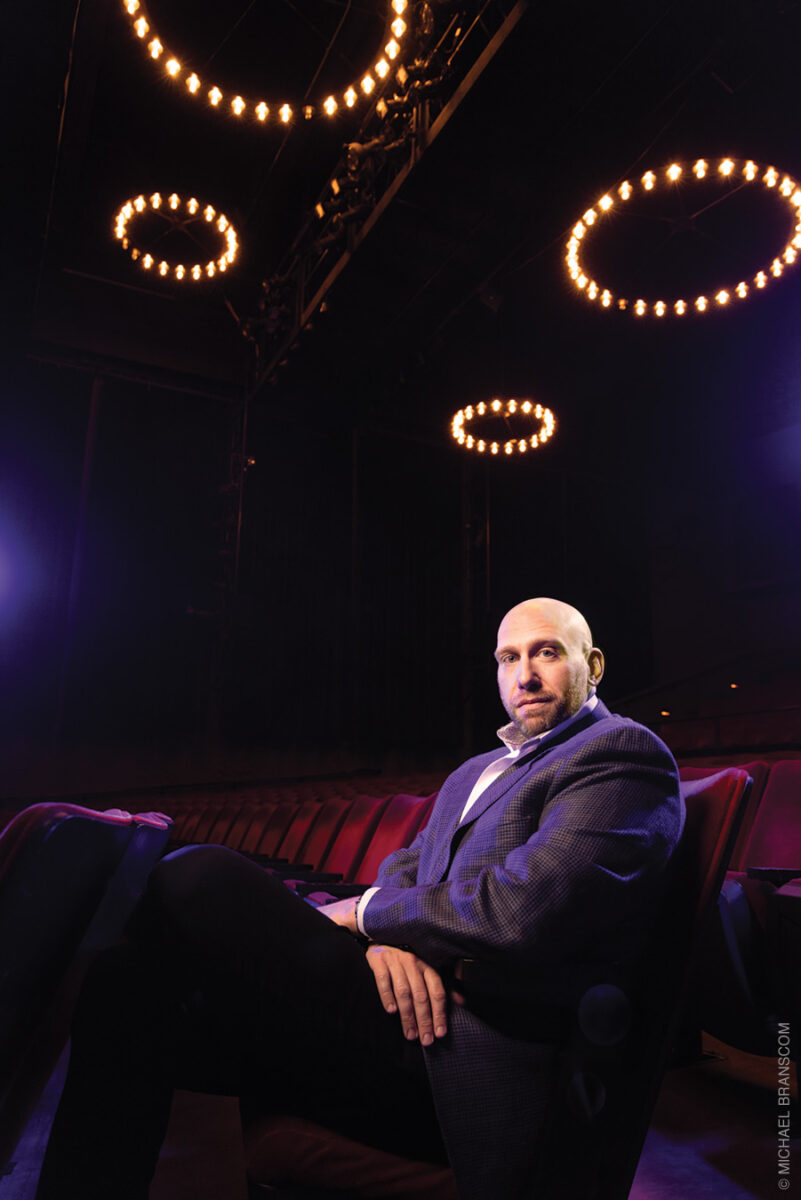
While other teenagers growing up in the mid-’90s may have covered their bedroom walls with images of sports stars or grunge rockers, J. Andrew Greenblatt WG’23 wallpapered his domain in the Philadelphia suburbs with movie posters. “There was a new generation of independent filmmakers coming along,” the 45-year-old says. “Quentin Tarantino, Steven Soderbergh, Kevin Smith. I was all in. I remember at Germantown Academy really looking forward to getting into a van with my classmates and our Latin teacher who took us into town every week to watch a movie. And I remember my dad bringing me to the Ritz Five to see Kenneth Branagh’s Hamlet—we got the last two seats. A four-hour independent film selling out in the middle of the afternoon? It was mind-blowing.”
These days Greenblatt is living the cinephile’s dream as the CEO and executive director of the nonprofit Philadelphia Film Society (PFS), which celebrates its 25th anniversary in 2026. And its signature event, the Philadelphia Film Festival (PFF), turns 35 this year—and keeps setting new attendance records.
Despite being a rabid film buff, Greenblatt never wanted to make his own movies. Instead, looking for something industry-adjacent, he landed on entertainment law. After obtaining bachelor’s and master’s degrees in political science at George Washington University, he stayed in Washington, DC, to go to law school at American University. He had a brief stint as a law clerk at an old-school firm, then clerked for a superior court judge. Those experiences “made me realize that I wasn’t interested in the practice of law,” Greenblatt says. “I was interested in learning how to think, write, and make arguments.”
When a friend asked him to head up business and legal affairs for a film production company he was starting, something clicked for the young lawyer. His three years there set the stage for a move to the Philadelphia Film Society in 2008. When he arrived, he found a small operation with just two full-time staffers, a budget of $350,000, and 300 members.
One of his first tasks was tinkering with the Philadelphia Film Festival’s timing. “It had become obvious that we needed to move the festival from April to later in the year because we were missing out on presenting new movies,” he says. “They had either started their national runs after debuting at SXSW or were waiting to premiere at Tribeca.” Moving it to the fall, at the start of awards season, “makes for a much stronger film festival,” Greenblatt notes, with more than 30,000 filmgoers attending in 2024. “We don’t strive to be the kind of festival that demands North American or international premieres but we do strive to put together the best programming possible and to show quality films that have not yet been distributed in Philadelphia or online.”
Highlights of the 2025 festival included regional premieres of Wake Up Dead Man: A Knives Out Mystery, with director Rian Johnson in attendance, and Sentimental Value, the Grand Prix winner at the Cannes Film Festival. Also noteworthy were screenings of Rosemead, followed by a Q&A session with the movie’s writer Marilyn Fu C’99 and star Lucy Liu, who received the festival’s artistic achievement award; and Gus Van Sant’s Dead Man Wire, starring two-time Oscar-nominee and Philadelphia native Colman Domingo, who accepted this year’s Lumière Award, given to recognize those whose cinematic achievements reflect their connection to the city.
The festival also saw record badge sales, which cost up to $500 and give holders access to all showings. “We’ve worked hard to gain the trust that we will live up to our promise and deliver something incredible,” Greenblatt says.
Along the way, PFS has become about much more than the festival. In 2024, for example, some 200,000 people came to its first-run and curated screenings. Most of those attendees belonged to the 18- to 44-year-old cohort, proof for Greenblatt that the idea of young people not wanting to get off their sofas is a “flawed scenario,” he says. “They do want to be with each other and feel a shared emotion—whether of laughter, tears or horror—and to put away their phones.” Plus, more attendees than ever—nearly 5,000 at last count—have shown their commitment by purchasing annual membership plans. “When we increased our programming beyond the festival, it really fueled membership growth,” Greenblatt says.
Today, its Curated Film Series at its recently renovated main venue, the Film Society Center (formerly the Prince Theater) near Broad and Chestnut Streets, spotlights arthouse favorites like David Lynch and allows viewers to bone up on cinema history by revisiting treasures from all eras, such as Barry Lyndon and Meet Me in St. Louis. Meanwhile, its two Old City movie theaters continue a full schedule of first-run offerings. Showings at the three theaters—which collectively offer nine screens—are just part of Greenblatt’s vision of PFS as a central clearinghouse for film in Philadelphia. Its full slate now includes community outreach efforts like a school program that invites nearly 1,000 children into town for free movies; a selection of free community screenings during the film festival; and the summertime “Movies on the Block” program, free pop-up showings throughout city neighborhoods. PFS also presents a mini-festival in April and for the last dozen years has hosted a red-carpet Oscars Night Party fundraiser.
That Greenblatt returned to school for a Wharton Executive MBA in 2021 after 13 years at the organization seems typical of his determination not to stand still. “It was something I had been kicking around for a while and the pandemic offered an opportunity,” he says. “Our organization had grown so much, and I felt I should fill in some personal gaps, like strategic planning and managing a bigger staff and budget [now at about 20 full-timers and $5 million, respectively]. Our board loved the program and really encouraged me.”
As he continues to push PFS to be bigger and better, he balances the achievable with the aspirational. “The thing I want most—to complete Phase III of our renovation plans at the Film Society Center with a rooftop bar and screening room—is furthest away,” he says. “But day to day, I want to make film more accessible for everyone and I want to build and encourage our local movie-making community. Film can do so much—it can inspire and engage and unite and entertain. My biggest accomplishment so far is to help make that contribution to Philadelphia.”
—JoAnn Greco