
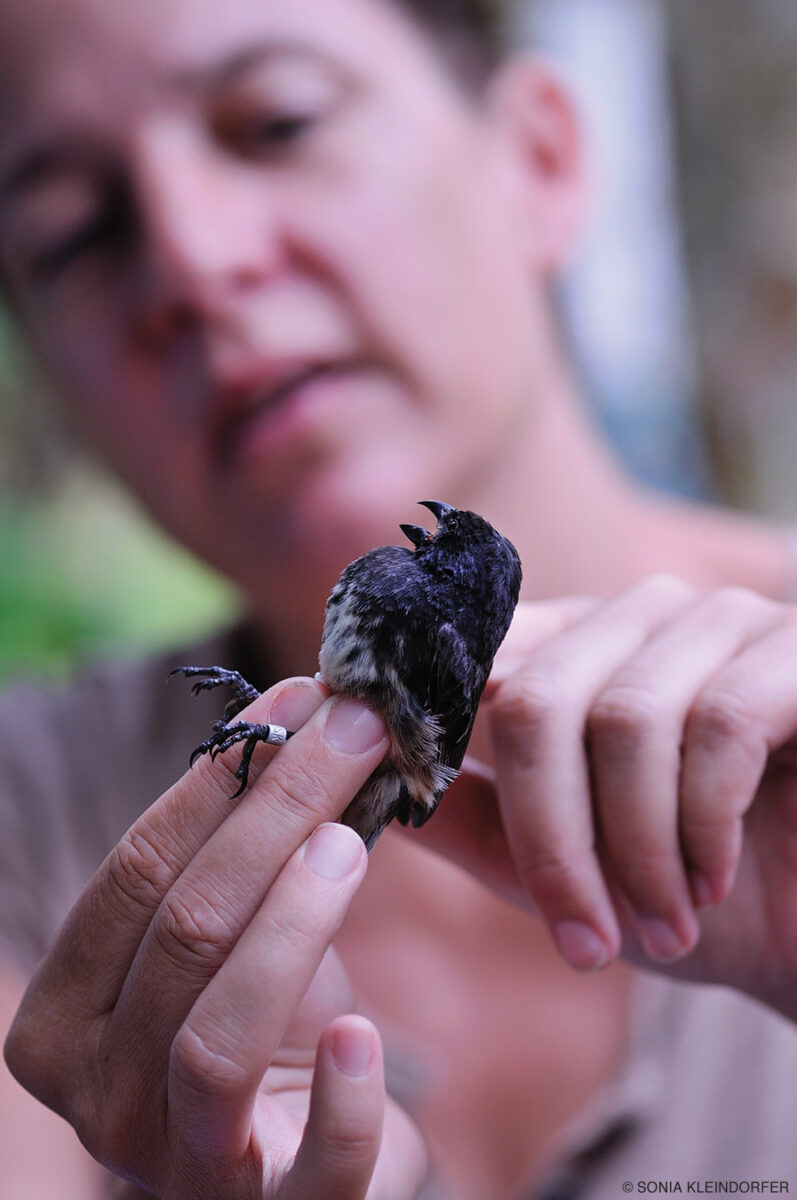
This avian ecologist has uncovered her “secret world.”
To have a bird brain, as Sonia Kleindorfer C’88 might see it, would be a compliment, not an insult. For more than 25 years, this avian ecologist has studied the surprising linguistic abilities and behaviors of birds, often with startling results.
Until she began wiring the nests of superb fairywrens with microphones and cameras, ornithologists believed songbird hatchlings learned songs from their fathers and that males were mostly the ones who sang. They thought females stayed mum, so to speak, to keep nest locations secret.
What these European scientists decades ago failed to consider, according to Kleindorfer, was that the objects of their studies had migrated there from Asia. “Now, after a 6,000-kilometer journey, the first thing on a female’s mind is not ‘Let me sing,’ it’s ‘Let me eat to produce eggs,’” she says. It turns out that females are more likely to sing in non-breeding grounds.
To her surprise, Kleindorfer recently discovered that mothers, each with their own unique “speech” pattern, vocally tutor embryos in their jellybean-sized eggs. When chicks hatched, she found that nestmates made a begging cry distinct from offspring of other mothers, a discovery that has been confirmed in other species.
Songbirds, she says, “have incredibly complex communication, and we’re just beginning to tap into it, because we’re finally shedding our biased view that only humans should have that trait.”
Kleindorfer is a migratory flier in her own right. She spends three months each year in the Galapagos Islands (where she has conducted research for 25 years), three months in Australia teaching at Flinders University, and the remaining time as director of the Konrad Lorenz Research Center for Behavior and Cognition at the University of Vienna in Austria.
“Sonia is a powerhouse,” says her University of Vienna colleague Tecumseh Fitch, a professor of cognitive biology. “She doesn’t seem to have a pause or stop button.”
Growing up in West Philadelphia, the furthest thing from Kleindorfer’s mind was a career studying animal behavior. “I felt sorry for people who studied birds. I was sure they didn’t have any friends. My association was people sitting on park benches looking rather forlorn and feeding pigeons.” With a chuckle, she adds, “Now, mind you, since then I’ve realized that pigeons are fascinating.”
A key aspect of Kleindorfer’s work is community involvement, not research in isolation. It’s a strategy she learned in 1989 from the late primatologist Jane Goodall when she was a grad student studying baboons in Tanzania. (Fascinated by evolutionary biology, Kleindorfer switched her focus from primates to birds because their evolutionary changes can be easier to see since they often reproduce once a year and have shorter lifespans.)
Today she is helping to lead a massive ecological restoration alongside residents and partner organizations on the Galápagos island of Floreana. Invasive rats and cats had decimated native species including the Darwin’s tree finch, Galápagos dove, and dark-billed cuckoo. Predator mammals have now been largely removed. So far 12 locally extinct species have been reintroduced from other islands. This year giant land tortoises are being relocated to Floreana.
“Jane taught me that humans are part of nature, and we have to work in partnership—that our mental health, our physical health, our economic prospects are enhanced when we are in partnership with nature and community oriented,” Kleindorfer says. “Partnership is a life-enhancing underpinning that taps into the indomitable human spirit.”
When predators ran wild on Floreana, few Darwin finch fledglings survived to adulthood. Now the endangered birds are experiencing huge reproductive success, a development that has dramatically changed the way young birds talk and behave.
“In the absence of predators we have a massive shift toward more exploratory, risk-taking individuals,” says Kleindorfer, whose behavioral experiments measure the finches’ boldness, aggressiveness, sociability, activity, and exploration. “It’s probably reasonable,” she speculates, “that you would innovate when there is no cost to explore. Remove the predation risk, and the cost of taking risks decreases. You’re not going to get killed if you venture to the periphery.”
Meanwhile, fledglings have simultaneously had a linguistic “innovation explosion.” Before predators were removed, the more aggressive male birds only sang a song designed to drive off intruders. Now young birds are using new syllables and combinations of syllables she and her team had never heard in the previous 20 years.
“Teenage hangouts” of mixed species are popping up. “Maybe they’re more open to learning from each other. If you’re more open to novelty, you’re more likely to copy and innovate song syllable types. Whatever the mechanism is, we will be studying these novel song types,” she says. As in human society, partnerships among animal species, according to Kleindorfer, can amplify each participant’s potential.
The new era of birding, in which hundreds of thousands of people can upload sightings and sounds to the wildly popular app eBird, excites Kleindorfer. “This information can be used in so many ways we have yet to imagine,” she says. “At a deep level, when we look at birds, we know that when there are lots of species, the ecosystem is intact, and we’re going to be OK, too.”
She credits her mathematician father Paul Kleindorfer, the Anheuser-Busch Professor Emeritus of Management Science at Wharton [“Obituaries,” Jan|Feb 2013], and actress mother Barbara with shaping her scholarly nature. “I’m a synthesis of my mother’s quest for understanding emotional depth and my father’s fondness for rigor, systematic inquiry, and data analysis.”
Her Penn professors left lasting impressions, too, especially Alan Mann, professor emeritus of anthropology. “He would reenact the evolution of life by crawling on the floor and ultimately standing up,” recalls Kleindorfer.
During her senior year at Penn, she fell in love with doing field work while on a study program under conservation biologist and Penn biology professor Daniel Janzen in Costa Rica. “I climbed a mountain, and I remember exactly where I was standing, looking at both the Atlantic and Pacific Oceans. The turtles were coming to shore, nesting. The grass was blowing. The wild horses were roaming, and I looked out and thought, ‘Oh, my God, you mean I could do this for the rest of my life?’ And that was it. No turning back. It was the feeling of walking through a door into a secret world that you did not know existed before, and, to me, that secret world was nature.”
—George Spencer
