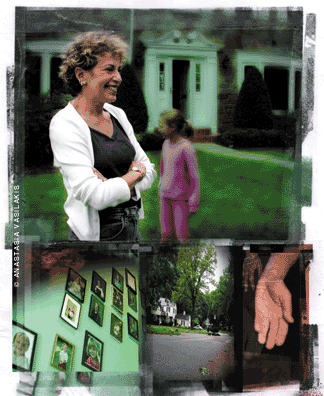
Diagnosed with an aggressive form of leukemia, alumna Ruthie Spector faced long odds but was saved by an experimental drug treatment that made a bone marrow transplant possible. The donor drive organized in her behalf will save many more lives in the years to come.
By Kristine Conner | Photography by Anastasia Vasilakis
A 20th Reunion year is perhaps unique in the way that it balances the impulse to reflect on the past with a sense of anticipation for what’s to come. Careers have been established, families often have been started, decisions have been made about how we want to live our lives.
Two years ago, as she approached her own 20th Reunion, Ruthie Spector W’82 had much to celebrate and anticipate. She had a successful career as an anesthesiologist at Long Island Jewish Hospital, a happy marriage with fellow Penn alumnus and physician Les Salwen C’74 M’80, and three young children, then ages one, three, and seven.
But instead of gathering with her class on Penn’s campus, in spring 2002 Ruthie was preparing to be admitted to Memorial Sloan-Kettering Cancer Center in New York City, where she would undergo an experimental treatment that could save her life—or end it. Just eight months before, with her community still reeling from the events of September 11, 2001, Ruthie experienced her own tragedy: diagnosis with a particularly aggressive form of leukemia.
Despite their medical training, Ruthie and Les found themselves in much the same position as any other people facing the news of a cancer diagnosis: they needed to mount a rather steep learning curve even as they coped with a level of anxiety and uncertainty they had never experienced.
“As doctors, we were able to look things up easily, and we were not intimidated to call up other physicians and medical centers,” Ruthie recalls. “But our professions were a disadvantage, too, because I think we understood the prognosis more clearly than other people might have. Within the first month I was told I would need a bone-marrow transplant to be cured.”
Tissue type is inherited, like eye or hair color, so one of Ruthie’s three siblings seemed likely to be the best candidate for giving her the healthy marrow that she would need to survive. But none of them proved suitable, forcing Ruthie and Les to confront a medical fact that was entirely new to both of them: Given Ruthie’s ancestry, a fellow Ashkenazi Jew would be her next best hope for a match, but such a person, they learned, would be very difficult to find. Like African Americans, Hispanics, Asian/Pacific Islanders, Native Americans, Alaskan Natives, and other ethnic minorities, Jews are underrepresented in bone-marrow registries.
And so began a search that would teach Ruthie and Les a great deal about being on the other side of the physician’s desk. They learned hard lessons about the frustration of receiving incomplete information, the terrible disappointment of not having things go well, and the challenge of balancing a realistic outlook with a sense of hope. They also would have to rely on the kindness of strangers during a desperate search for options in the face of a very difficult diagnosis.
Conventional wisdom says that doctors make the worst patients. They also can be so focused on others’ health that they overlook their own symptoms.
In fall 2001, when Ruthie Spector started experiencing persistent inflammation and tenderness in her gums, she made repeated visits to her dentist, who took a number of X-rays and prescribed antibiotics. An avid athlete since her days as a Penn cheerleader, she also found herself feeling more winded after a workout. “I remember losing a tennis final in a tiebreaker that fall and coming home and telling my husband, ‘My legs just couldn’t keep up with where I wanted them to go,’” she says.
Even when Ruthie decided to draw her own blood sample and send it to the lab at her hospital, she was not overly concerned—until a late-afternoon emergency page from the lab stopped her in her tracks. “My counts were so out of whack that I thought to myself, they must have made a mistake, or it must be some kind of reaction to the antibiotics,” she says. But a second blood test confirmed the results, and she knew that she would have to be admitted for further testing.
When Ruthie returned to her hospital that evening to check herself in as a patient, she could not have imagined that she would spend the better part of the next eight months there, undergoing rigorous treatment to keep her disease at bay—and, most difficult for her, missing all three of her children’s birthdays. Nor could she have imagined that her mother’s visit “just for the weekend” would extend into a year-long stay.
Through a bone-marrow biopsy, Ruthie was diagnosed with acute myeloblastic leukemia (AML), a type of blood cancer that occurs when the white blood cells called granulocytes stop maturing normally. These immature cells multiply quickly, crowding out the healthy blood cells and compromising the immune system. As the disease progresses, a person with AML becomes susceptible to infection and symptoms such as abnormal bleeding, easy bruising, fatigue, and joint pain.
Acute leukemias are different from chronic leukemias in that they tend to develop suddenly and progress quickly. According to the American Cancer Society, acute leukemias can be cured or kept in remission—meaning that there is no evidence of active disease—in roughly 20 to 30 percent of adults who are diagnosed. But every individual is different, and researchers have identified other factors that influence a patient’s prognosis. Younger age and good overall health are favorable factors, and both of these would work in Ruthie Spector’s favor. What would work against her, however, was her disease’s genetic profile.
Decades of research have shown that cancers are genetic in origin, meaning that they occur as a result of mutations, or abnormal changes, in the genes responsible for regulating the growth of cells and keeping them healthy. In cases of leukemia, physicians actually can visualize certain chromosomal abnormalities sometimes associated with the disease. Each of our cells has 23 pairs of chromosomes that encode all of the genetic information in our bodies. As the cells reproduce themselves, pieces of the chromosomes can switch locations, or “translocate.”
The first such translocation was discovered four decades ago here at Penn, when researchers found that a piece of chromosome 22 was missing in the blood cells of some people with a chronic form of leukemia. Their discovery came to be known as the “Philadelphia chromosome.” Additional research would show that the missing segment had moved to chromosome 9, a piece of which had in turn attached itself to chromosome 22. Because of this translocation, important genes that regulated cell growth and division could no longer function normally.
In most cases, a translocation suggests that an individual’s leukemia is likely to be more difficult to control. “Basically, a translocation raises a red flag that chemotherapy alone isn’t going to cure the disease,” says Dr. David Porter, director of allogenic bone marrow transplant at Penn, who counseled Les Salwen after he wrote to President Judith Rodin in search of any assistance available through the University.
Ruthie was found to have a rare translocation involving chromosomes 11 and 19—so rare, in fact, that she and her husband could find only a few studies that had been done on it. Genetic analysis also suggested that, even though she was only 41, her cancer possessed a multi-drug resistance gene more commonly seen in older people with hematologic cancers. This meant it was even more likely that her cells would reject the standard chemotherapy drugs. Therefore, her diseased bone marrow would have to be replaced with the help of a genetically suitable donor. She would need a transplant either of the marrow itself or of blood stem-cells, the “progenitor” cells that develop into the major components of the blood.
“We left the hospital with an industrial-sized prospectus on bone-marrow trans-plantation,” Les recalls, “and basically the punchline seemed to be that you didn’t have to worry if you were Caucasian because you have an 80 percent chance of finding a donor if none of your family members matched. You see that and you think, ‘Well, OK, I guess that is better news, we can deal with that.’ It didn’t let on that being an Ashkenazi Jew brought our chances of success down to about 15 to 25 percent.”
At that point, Ruthie says she was “absolutely convinced” that one of her three siblings would be a match. “I don’t tend to be a depressed person, and once I accepted I had leukemia, my attitude was, ‘OK, let’s move on, let’s go.’ And I had no doubt that my brothers or sister would be a match. My doctors led me to believe that, too—I mean, they gave me great care, but they never said there was a chance I might not match.”
Come Thanksgiving, however, the couple would be feeling anything but thankful. Testing showed that none of Ruthie’s three siblings nor any other relatives would be a suitable donor. In fact, a sibling, while statistically the best candidate, has just a 25 percent chance of being a match for the person in need. Most people seeking a transplant have to rely on the kindness of a stranger—an unrelated volunteer donor.
The legacy of the Holocaust is still very much with us, and for the Spector family its impact has been deeply personal. Ruthie’s mother Barbara, a native of Czechoslovakia, lost her mother at Auschwitz, and she assumes that her three brothers were killed in other concentration camps.
In taking the lives of an estimated six million Jews, many of whom were Eastern European, the Holocaust also took the lives of all of their potential descendants. This cutting off of bloodlines makes it much more difficult for a person of Jewish descent to find a genetically matched unrelated donor.
According to the National Marrow Donor Program, the main U.S.-based registry that is federally funded, Caucasians in the year 2000 (the most recent numbers available) had an 88 percent chance of finding at least one unrelated donor. For ethnic minorities, the numbers were lower, ranging from 58 percent for African Americans up to 83 percent for Native Americans. Because Jewish people are grouped in with Caucasians, there are no definitive figures about their likelihood of finding a match—although experience has shown that the chances are lower.
Few people consider this until they face the crisis of being diagnosed with leukemia, lymphoma, or some other blood-related cancer or immune disease. That certainly was the case more than a decade ago for Jay Feinberg, founder and executive director of the Gift of Life Bone Marrow Registry, the only organization dedicated to increasing the representation of Jewish people in the international donor pool. When Jay was diagnosed with leukemia in 1991, he says he had no idea that the search for a suitable donor would feel much like looking for a needle in a haystack.
Jay’s family and friends launched a four-year-long grassroots effort that recruited 60,000 people of Eastern European Jewish ancestry into the international marrow registry. Jay was near death when the very last person tested proved to be a suitable match for him. The campaign on his behalf also facilitated transplants for hundreds of other patients in need of donors.
“Because we had developed such an extensive network, we felt that we could not stop,” Jay recalls. “Everyone continued to feel invested in educating more people about this issue and registering more potential donors.”
Jay and his family turned that database of donors into the Gift of Life Registry, which is also part of Bone Marrow Donors Worldwide, an international collaborative registry of nearly eight million donors in 40 countries. This means that any transplant center that searches the worldwide registry also has access to Gift of Life donors, who are almost exclusively of Jewish heritage.
Jay says he first learned about Ruthie Spector’s situation from a contact at the Jewish women’s organization Hadassah, whose daughter was Ruthie’s neighbor. Through a fortunate coincidence, he happened to be at a conference in northern New Jersey and was able to visit with Ruthie and her family.
His first recommendation was to get more family members tested. But the loss of Ruthie’s mother’s family in the Holocaust had limited the size of her extended family. When no one matched, the next step was to look for an unrelated donor. A search turned up one person in the Gift of Life Registry who was a close match for Ruthie—close enough that the transplant center she had selected, Fred Hutchinson Cancer Center in Seattle, would request further testing.
The matching process involves looking at certain proteins on the surface of cells (antigens), known as Human Leukocyte Antigens (HLA), that have been found to play a role in tissue compatibility and transplant results. Doctors can increase the likelihood that a bone marrow or stem cell transplant will be successful by matching the donor and recipient HLA antigens. Initial testing typically looks at six different antigens, followed by four additional antigens if the match looks promising.
The poorer the match, the more likely the development of two complications: a reaction called graft-versus-host disease (GvHD) and a reaction in the opposite direction, host-versus-graft reaction. GvHD occurs when the donor’s immune cells, or T cells, attack the recipient’s tissue. Host-versus-graft reaction is the rejection of the transplant by the recipient’s body. Both are serious and potentially fatal.
A so-called “perfect match” offers the best odds when the donor and recipient are not related. Ruthie and her donor initially matched in five out of six key areas, but further testing revealed the match was actually just an eight out of ten. This suggested a high risk of complications, and Ruthie and her family were advised to find a more suitable donor. They faced daunting odds—highlighted by the fact that there was not even one other potential donor in the international registry of millions of people—but they decided to launch a large-scale recruitment effort to find that elusive match.
As Ruthie’s family and friends leapt into action, she would continue to face her own uphill struggle. Her leukemia would have to be in remission before she could receive a transplant, but standard chemotherapy drugs were not working. Her best hope was to try a new drug called Mylotarg, which works by targeting drug-carrying antibodies to a specific protein on the surface of leukemic cells. Although it was still considered experimental at the time and was more typically used in older, relapsed patients, Ruthie’s doctors recommended it for her because of her disease’s genetic profile.
It did work, and Les Salwen recalls that the statistics suggested that her remission could last about a year—valuable time that the family would use to look for a donor.
Conducting a donor-registration campaign requires two things: money and good publicity.
Typing potential donors is expensive, Jay Feinberg explains, and while Gift of Life can supply some funding, it asks patients and their families to share in the expense. He adds that the federal government does not subsidize efforts to recruit and test Jewish donors, as it does for other ethnic minority groups. Ruthie’s brother Warren Spector, co-president of The Bear Stearns Companies, stepped up to provide much of the funding for what Jay Feinberg describes as a “multimillion-dollar effort” to expand the registry with new donors.
Good publicity has two components: first, overcoming people’s misconceptions about testing and donation, and second, making the individual’s situation known to as many people as possible as quickly as possible.
Many people fear that joining a bone-marrow registry means undergoing invasive tests, when in fact all that’s needed is a swab of cells from the inside of the cheek. It is so simple that potential donors can request a donation kit online, at www.giftoflife.org, and return their sample by mail.
People also fear the donation process if they should ever be called. “Many people think that donating bone marrow essentially means having your bones cracked open,” Jay explains. In reality, a donor feels no pain during the procedure, which is done under anesthesia, but might experience some tenderness in the area for a few days. And in more and more cases, doctors don’t even need to take any bone marrow: all they need are the stem cells circulating in the donor’s blood, which can be used to regenerate healthy bone marrow in the recipient.
Yet another common misconception is that a donor drive is geared just toward helping the person currently in need. But in fact, each donor’s information remains on file until they reach age 60. Even if they do not match this particular person, they could match someone else months, years, or even decades from now.
“A drive is never just for one person. It’s really for everyone,” Jay explains. “The person in need just happens to be the current ‘poster child’ for the cause. As the mother of three young children, Ruthie was a particularly effective poster child.”
Ruthie’s friends and family members worked in tandem with the Gift of Life to organize drives in the New York area, New Jersey, Boston, Florida, Washington, Connecticut, Pennsylvania, Ohio, Florida, and Israel. Les Salwen also worked tirelessly to publicize his wife’s situation. After spending most days working at his own medical practice and most evenings with his wife in the hospital, he would return home to what had become his second full-time job: harnessing the power of the Web to let people know about Ruthie.
Among the many places he turned to was Penn. In addition to contacting President Rodin, he shared Ruthie’s situation in Alumni Notes, which prompted many supportive e-mails from classmates who chose to get tested. He also worked with Hillel, the Jewish student organization, which organized a drive that registered 225 people.
College junior David Perkel, just a freshman when he organized the drive at Hillel, says the experience was meaningful for everyone who participated. “I think that doing this for an alumna really helped a lot of us understand that there are people on the other side of that simple cotton-swab test, just hoping for a match,” he says. “Even though none of us proved to be a match for Ruthie, we could help someone next week or 10 years from now.”
Les and Ruthie also used the Internet to get answers and advice from some of the nation’s leading experts at places like M.D. Anderson Cancer Center in Houston and Dana-Farber Cancer Institute in Boston. They also researched treatment options exhaustively.
“The Internet allowed us to research the experience, success, failures, and protocols at many domestic transplant centers, to remain in touch with her marrow-search coordinators, to review available experimental programs offered through the NIH and other centers for resistant leukemias, and to pick the brains of medical colleagues across the globe,” Les recalls.
If this were a movie, this would be the point at which Ruthie finds her donor and is transplanted successfully. But life doesn’t always work out that way.
“There are many success stories,” Jay Feinberg notes, “but there are just as many people, if not more, for whom we cannot find matches.”
The drives conducted on Ruthie’s behalf did result in many success stories. During the first six months of 2002, more than 30,000 new people were registered in the Gift of Life Bone Marrow Registry—an unprecedented effort in the organization’s relatively young life. And since then, those new registrants have yielded 40 life-saving donations, a number that Jay Feinberg calls “astounding.”
But for Ruthie, time was running out by the spring of 2002. After only a three-and-a-half month remission, her leukemia had relapsed. This, on top of the fact that she could not find a better donor, prompted doctors at Fred Hutchinson Cancer Center to inform her that they would not be able to treat her.
The situation looked grim, but Ruthie continued to hold on to the belief that she would not die, which had sustained her from the very beginning. “Certainly I was reasonable. I got my affairs in order, I redid my will, I told my husband where everything was,” she says. “But I never really considered the possibility that I would die. I got myself out of bed every day to walk around the nurses’ station or, when I couldn’t leave my room, I would turn on MTV and exercise.”
Through her doctors at Long Island Jewish Hospital, she soon learned that there could be another option for her right in her own backyard. Doctors at Memorial Sloan-Kettering in New York City offered an experimental therapy that had helped many patients receive successful stem-cell transplants from mismatched donors. Before administering the transplant, doctors remove the T cells that play a critical role in orchestrating the body’s immune response to foreign invaders. This increases the likelihood that the transplanted tissue will take hold and regenerate in the recipient’s body.
“We’ve been doing this for more than 20 years, and we are improving the techniques of T-cell depletion and the management of complications associated with this type of transplant, but it is still considered experimental,” says Dr. Hugo Castro-Malaspina, the physician who accepted Ruthie’s case. “It is a continuing challenge to make mismatched transplants available to people who need them. We see a lot of minorities in this situation. America really is a melting pot, and multiethnicity makes finding a match even more difficult for many people.” Dr. Castro-Malaspina notes that the Memorial Sloan-Kettering Transplant Service has had many Jewish patients who were helped by a donor from the Gift of Life Registry.
In June 2002, her disease in remission thanks to more treatment with Mylotarg, Ruthie underwent the rigorous procedure. She and Les knew that it was a long shot, given her disease’s genetic profile, the quick relapse, and the mismatched donor. “Our understanding was that about one in three people don’t even leave the hospital after a transplant,” Les recalls.
After having her immune system destroyed during 10 days of intensive chemotherapy and whole body irradiation, she received the T-cell-depleted stem-cell transplant from the original donor found through the Gift of Life. The next stage was absolutely critical, as she remained in complete isolation while waiting for her blood counts to recover. Most patients are kept for eight weeks, but Ruthie was lucky: she had no major complications, and at six weeks she insisted on going home.
“Her willingness to be well and to be near her children was a great motivator for her, especially after spending six weeks in the same room!” says Dr. Castro-Malaspina. “She really did beautifully. Reaching a year post-transplant was a major milestone, and her long-term prognosis remains very good.”
In June 2003, Ruthie and Les celebrated that milestone by attending the Gift of Life’s annual Partners for Life Gala, where she met her donor—who, ironically enough, happens to live just two neighborhoods away—and spoke about her experience.
“Who would have imagined that a stranger who knew nothing about me or who I am would come to my rescue?” she said in an emotional address. “Thank you for letting me be here today with my family, to be able to watch my children grow, and to give back to the community that gave me life.”
Ruthie realizes that she is the exception rather than the rule. She met many other people in her position during her search and her transplant, but none of them has survived. So far, hers is a happy ending, and her family’s generous gifts of money and time have created many other happy endings for people who found a life-saving match through one of her donor drives.
Being saved through the kindness of a stranger has prompted Ruthie to add yet another hat to the many she already wears as a physician, mother, and wife. She is now a volunteer patient-advocate through the Gift of Life and the Leukemia and Lymphoma Society, communicating with leukemia patients throughout the country and the world and giving them the benefit of her experience. “My first piece of advice, based on my own experience, is to find a transplant center that will take you with the best donor you have, even if you want to search further,” she says. “But really I just want them to see that there are people who survive, even in the worst circumstances.”
At the end of September, after a two-year hiatus, Ruthie returned to work in a new position as an attending physician in a surgical intensive-care unit. Her next major milestone is spring 2007: if she reaches that five-year mark without a relapse, her leukemia will be considered cured. This just happens to coincide with her 25th Reunion year at Penn. Ruthie fully intends to join her classmates in Philadelphia.
Kristine Conner C’90 writes on healthcare, medicine, and education, and is the co-author of Ovarian Cancer: Your Guide to Taking Control.