
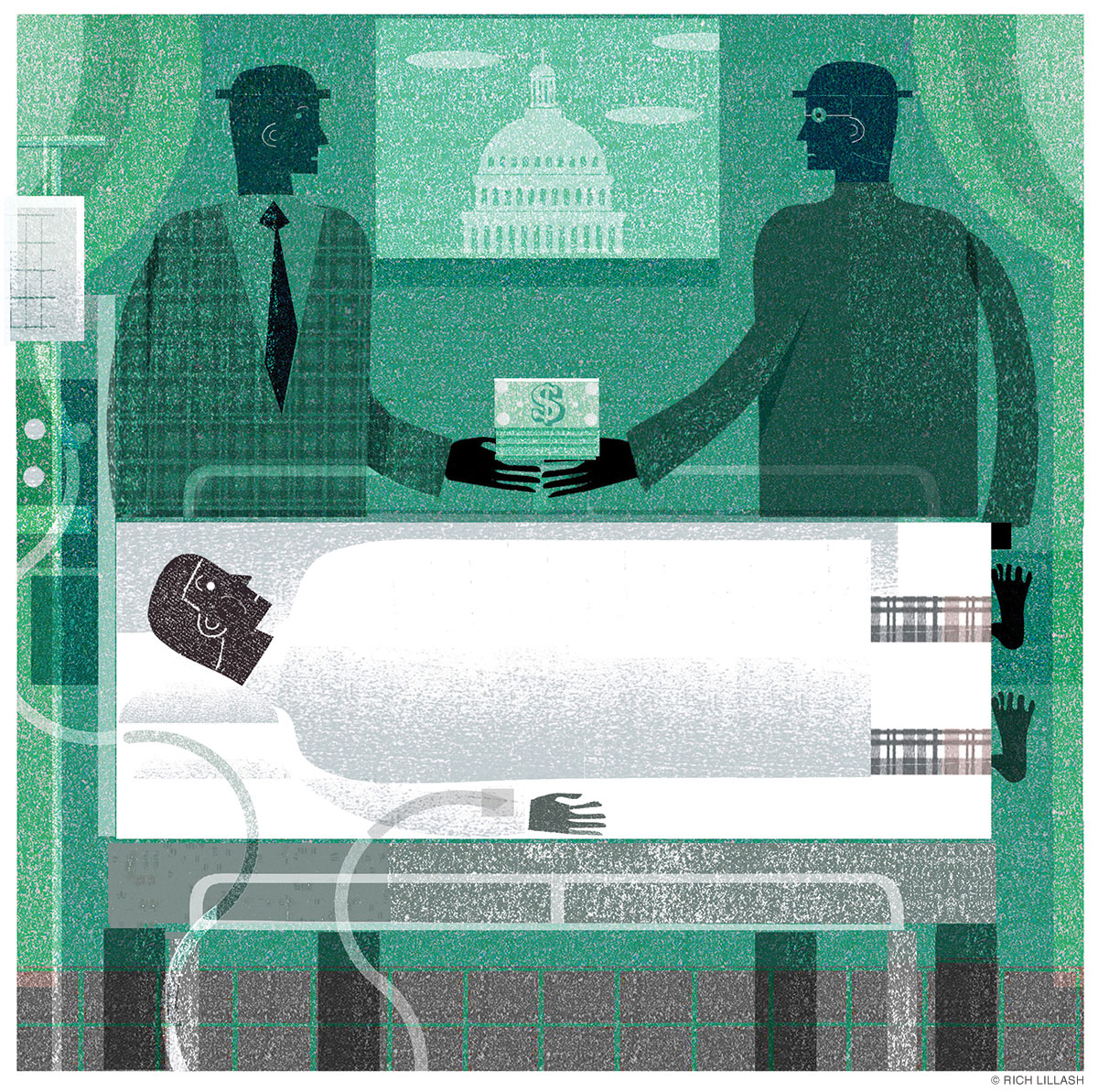
To address the “affordability crisis” in healthcare, beware of lobbyists and take lessons from the states.
By Alex Garlick
The leaders of both parties appear to agree that the United States is facing an “affordability crisis,” with healthcare at its core. In mid-January Democratic Senate Leader Chuck Schumer declared, “Americans are in the middle of a healthcare emergency.” The next day President Donald Trump W’68 basically agreed, saying that over the past decade or so Americans have “paid more money for healthcare every single year—more and more the premiums went higher and higher.” But there’s no agreement on how to make healthcare more affordable. According to Schumer, Republicans “have no plan to solve the health crisis that’s been brewing under their watch.” Trump, who has long blamed Barack Obama’s Affordable Care Act, has lately responded with concepts such as cutting kickbacks to Pharmacy Benefit Managers, imposing pharmaceutical price controls, and mandating increased transparency for insurance companies.
In my book Pre-Existing Conditions: How Lobbying Makes American Health Care More Expensive, I show that some of these ideas have already been tried in the states, with varying degrees of success. For example, in 2017 the Nevada legislature passed a bill to increase the transparency of the pharmaceutical supply chain, including the kickbacks to Pharmacy Benefit Managers. But following heavy lobbying from the pharmaceutical industry it was vetoed by Republican Governor Brian Sandoval. This is a consistent pattern. Cost containment policies such as these are routinely defeated or diminished in a similar fashion across nearly all the states, by the same culprit: lobbyists representing the healthcare industry.
How do they do it? Informational asymmetry plays a part. For example, when Massachusetts lawmakers looked to contain healthcare costs in 2012, they decided they could either address the prices of services or focus on whether certain healthcare services were being “overutilized” by patients. The major hospital network, now known as Mass General Brigham, held information about both of these issues—but their lobbyists only presented information to legislators about their preferred solution, “overutilization.” Sure enough, the lobbyists were able to steer them away from legislating on the prices of services.
Lobbyists can also win by making policy debates more complex, which discourages the media and public from engaging with the story. For example, in 2017, Wisconsin lawmakers looked to expand the “scope of practice” of nurse practitioners (NPs) in the state. Medicare reimburses NPs at 85 percent the rate of physicians for performing the exact same procedures, so it reduces costs. But the Wisconsin Medical Society and American Medical Association opposed the expansion of NP scope of practice because it reduces the revenue available to its members. This alliance managed to steer the legislative debate away from clear financial calculations toward amorphous claims of patient safety, despite a lack of evidence to support their claims. Cost containment reforms usually die in darkness.
Though the odds are stacked against them, advocates can find paths to reform. One issue where states have gained traction over the pharmaceutical industry has been on the pricing of insulin. This hormone and its purification method was patented over a century ago, but its price more than tripled in recent decades. In 2020 Minnesota passed a law on the back of a reform effort based on the case of the late Alec Smith, a 26-year-old diabetic man who died after rationing insulin in the face of high costs. His mother led a coalition in creating the Insulin Safety Net Program, which provides a one-time 30-day supply of insulin for no more than $35 to residents facing an emergency. While 28 states have enacted out-of-pocket caps for insulin, Minnesota’s ambitious insulin program made waves because advocates focused the debate on the tragedy of Smith’s death and linked it to the price-gouging of some pharmaceutical companies, giving the media and public a narrative that was more compelling than fiscal analyses. Lobbyists would rather operate in the shadows.
Second, states can use transparency in their favor. In my home state of Vermont, premiums have been rapidly increasing and jumped 24 percent in the last year alone. The state’s major insurer, Blue Cross Blue Shield of Vermont, recently launched a marketing campaign to inform Vermont residents of the exorbitant prices charged by the dominant hospital system in the state, the University of Vermont Health Network. For example, the average cost of an MRI is $6,520 in the network, but $1,799 when done by an independent facility. A vaginal childbirth costs $17,373 in the network, but just $2,870 at an independent facility. Patients rarely see these prices up front but feel the inflated costs in rising health insurance premiums. Although it’s unclear if this data will change where patients seek care, such price awareness could help build political support to then curtail predatory pricing strategies that accompany monopoly power—such as Indiana’s effort to limit “facility fees” or federal efforts to enact “site-neutral payments,” both of which prevent hospital networks from price gouging on outpatient procedures.
Third, states can increase the supply of healthcare providers. As in other sectors of the economy, prices in healthcare are affected by supply and demand, and increasing supply can lower the prices that consumers face. The earlier example of expanding the “scope of practice” of NPs fits this bill in two ways. Allowing NPs to provide more services can lower prices for primary care services—and the preventive care they provide may in turn reduce demand for more expensive health interventions.
State and national policymakers should bear two major lessons in mind. The first is that they should be willing to invest in their healthcare markets. The federal government is offering states grant funding to compensate for looming cuts to Medicaid, which presents a ripe opportunity. Lawmakers should consider using this one-time money to stabilize or expand community hospitals, particularly in rural settings. They could also consider bolder ideas to subsidize practitioners in less lucrative fields, like primary care. Massachusetts is considering a policy to roughly double the share of its medical spending that is devoted to primary care, with the hope it will keep residents healthier and reduce demand for expensive services.
Second, policymakers need to have an unabashed focus on prices. Prior efforts at reform have balanced a desire to expand access to care and reduce the cost of services, but as the healthcare scholar Jonathan Oberlander has observed, both Medicare and the Affordable Care Act followed the “all-American formula of expanding coverage without controlling costs.” That bill is now coming due. Socializing the cost of healthcare through insurance pools will no longer suffice to make healthcare affordable. Without lowering the price of individual services, access to care is going to be curtailed. This applies even for Americans with insurance, as the majority of medical debt is held by households with health insurance.
Ultimately, Americans need to acknowledge that some aspects of the affordability crisis are political problems that require political solutions. It will be hard work. Efforts to lower prices by increasing the supply of providers or regulating market design more vigilantly will be opposed by the healthcare industry and a cadre of lobbyists at every turn. But this affordability crisis demands a patient, detailed response, and there’s no time to waste.
Alex Garlick Gr’16 is Assistant Professor of Political Science at the University of Vermont. He is the author of Pre-Existing Conditions: How Lobbying Makes American Health Care More Expensive, published by Oxford University Press in 2025.