
By George E. Thomas
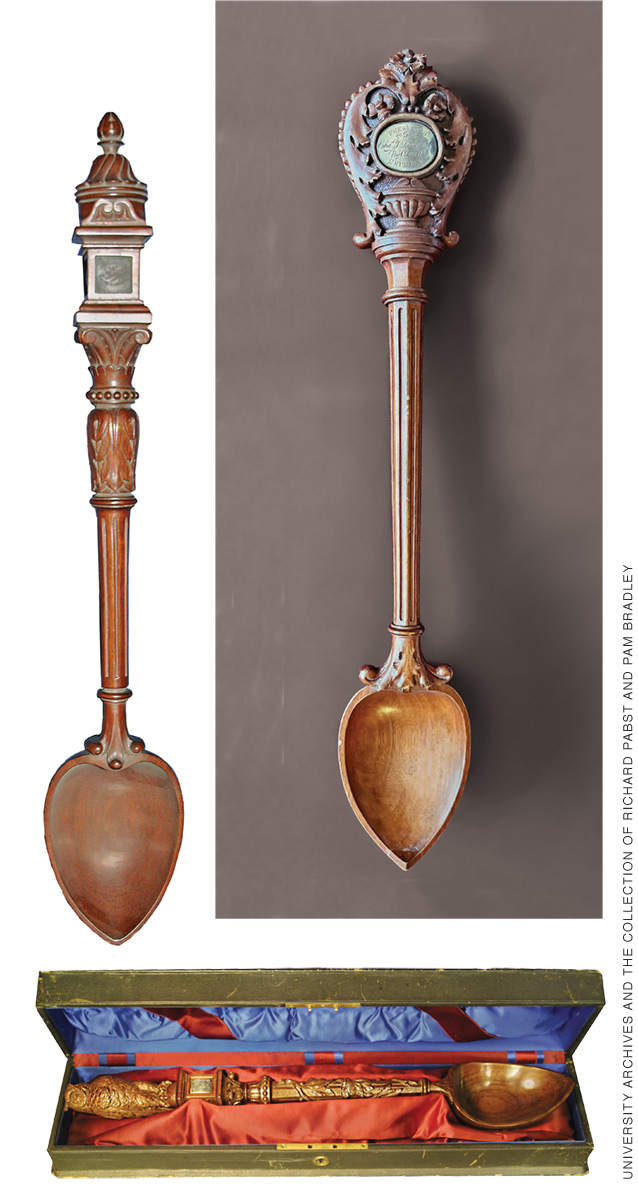
Penn’s 1890s song “The Red and Blue” proclaimed that “fair Harvard has her crimson, old Yale her colors too,” but in 1860, even before the colors red and blue were used on the cornerstone of College Hall in 1871, Penn had its honorific Spoon Award. The first spoon was created in 1861, when several sophomores awarded it as a silly prize to the lowest-ranked freshman student. The spoon was crafted by Daniel Pabst (1826–1910), whose cabinetmaker’s shop near Independence Hall was a short walk from Penn’s buildings at 9th and Market Streets.
What began as a prank was elevated in 1865 as the first senior honor. The Class of 1865 yearbook, The Record, reported that on the University’s first Class Day, the “Wooden Spoon” was awarded to the most popular student, John T. Lewis Jr. C1865 G1868. Team sports, class traditions, and other artifacts of the late-19th century, including the Bowl and bowl fights, marked the rising energy of student life that would soon propel the University to the West Philadelphia campus that has nurtured Penn’s growth ever since.
Today, Pabst looms large as the premier post–Civil War Philadelphia cabinetmaker and the choice of Frank Furness for many of the most remarkable interiors of Victorian Philadelphia. In an interview shortly before his death, Pabst stated that making the spoons was one of the great honors of his life. Between 1860 and 1910, he made 51 richly carved and ornamented wooden spoons for Penn’s “Spoon men.” The first spoons were carved as the Civil War raged, continuing past the nation’s Centennial, and concluding in the first decade of the 20th century. Coaxed by students, he continued to make their spoons even after he closed his business in 1894. In later years he also contributed a poem that was read at Class Day. While none of Pabst’s poems survive, the University Archives holds three of his spoons and several more are held by his family. When Pabst died, a Philadelphia jeweler continued making the spoons with similar artistry.
Surely, across 176 years there are more than these few survivors.
George E. Thomas Gr’75 is a former instructor in historic preservation and urban studies at Penn and has been profiled in these pages for his work as an architectural historian [“Arts,” Mar|Apr 2018].