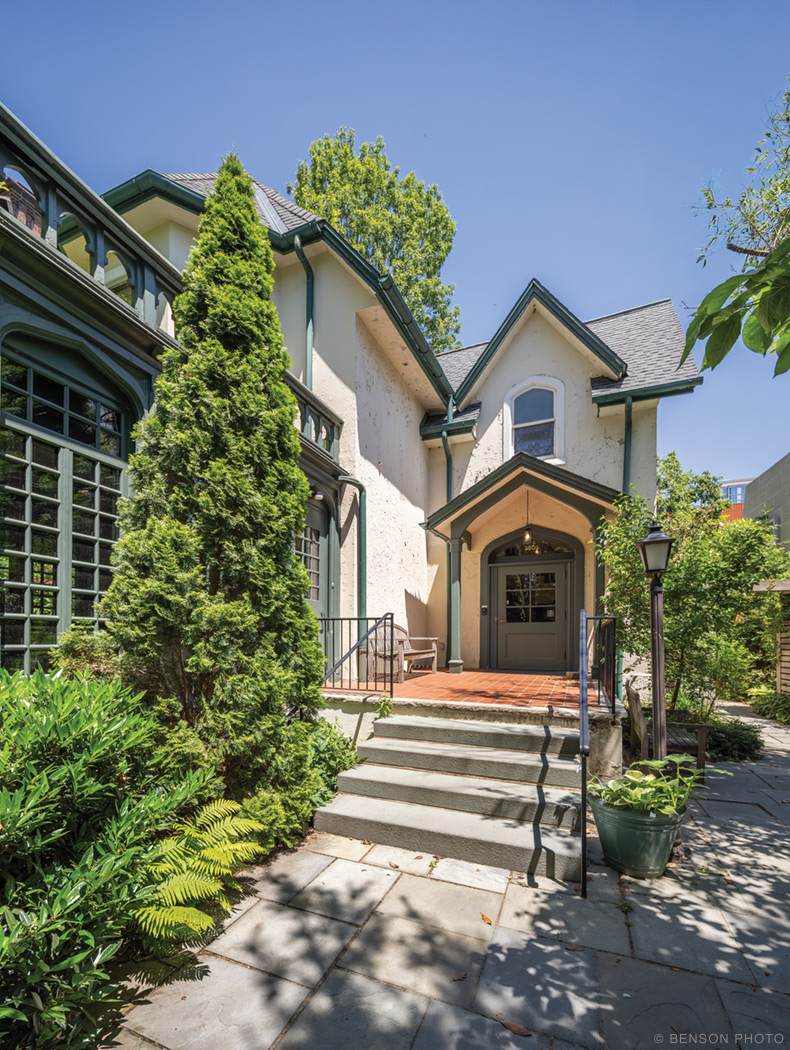
Three decades ago a “ragtag army of squatter-minded poets” took possession of a modest cottage at 38th & Locust Walk and conjured by candlelight a vision of a “house for writers.” Today Kelly Writers House is a University institution that hosts a dizzying variety of classes, readings, and other events and sits at the center of a constellation of affiliated programs whose impact stretches around the globe. But in a lot of ways it hasn’t changed at all.
By John Prendergast
Sidebar | “They’ll teach themselves” | ModPo’s story in The Classroom and the Crowd.
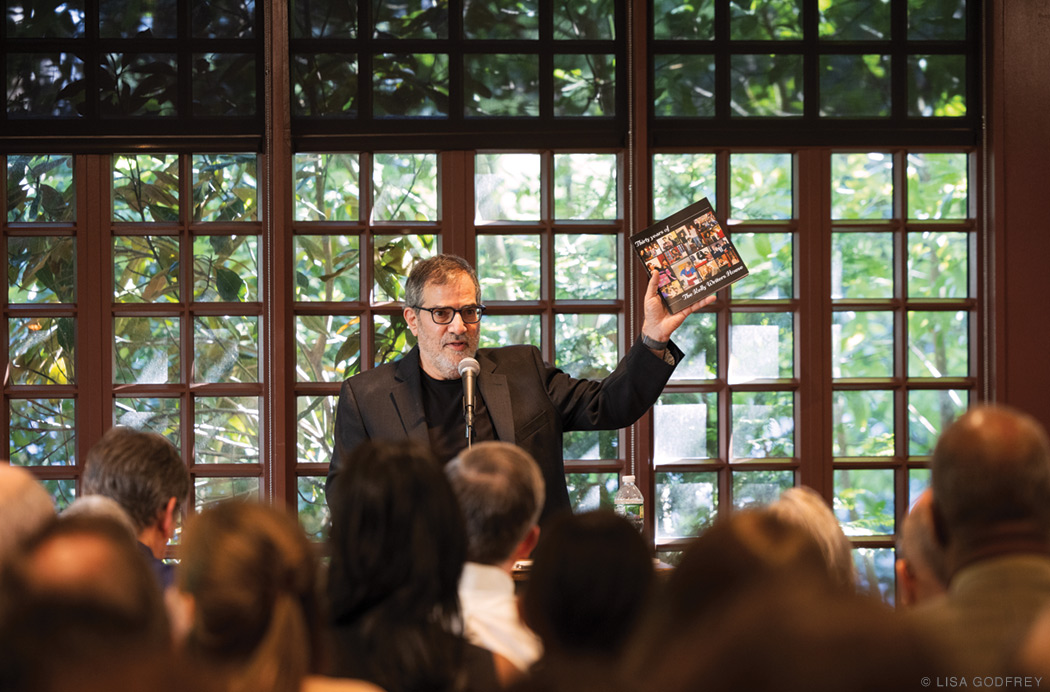
Al Filreis is telling—as he has many times before and will again—the Writers House Origin Story: how Penn’s then new president, Judith Rodin CW’66 Hon’04, wanted to strengthen undergraduate life at the University by creating the College House system and cultivate new non-department-based centers of power through thematic “hubs” that would draw students from across schools and reach out to the community as well. How she and then Provost Stanley Chodorow had launched the 21st Century Project for the Undergraduate Experience (“only in 1994 or 1995 could you have something called the 21st Century Project”) to advance those goals and appointed English professor Robert Lucid—Filreis’s inspiration and mentor—to help lead it. How, when the University came into possession of the onetime residence of former University Chaplain Stanley Johnson, Rodin had conveyed the property to Lucid—an experienced navigator of Penn’s institutional byways—with instructions to come up with a compelling use “before the school with the most money or the most power, whatever,” laid claim to it. How Lucid had turned to Filreis, then the English department undergraduate chair and an advocate for similar initiatives to enrich the noncurricular aspects of college life, who said he would “make a house for writers.”
All building to the best part, most evocative of what would become the Writers House ethos: how an initial group of faculty, student, and staff visionaries gathered in the house to shape what exactly that would mean on Sunday, October 15, 1995, trading ideas until the fall dusk fell, and they realized that the electricity was off, and continuing by candlelight, they “laid it out room by room by room.”
“Lucid was there that afternoon,” Filreis continues. “And once the candles were lit, Bob spoke to the group. He always spoke quietly and haltingly, but he spoke in aphorisms, always aphorisms. And he turned to us and he said, ‘Remember, the most important thing you have to know at a big university: architecture is destiny.’”
In January of 1996, Rodin arranged for Filreis and students involved in the planning to speak before the University trustees. “Probably with some trepidation, because we were squatting in the house. I had barely gotten the key,” he says. “We made a presentation that was so winning and so charming, I guess, that they said, ‘OK, go ahead with this thing.’” A year or so later, Paul Kelly C’62 WG’64 made a gift naming the house and making renovations possible. (Kelly, whose 2021 death from complications of COVID-19 [“Obituaries,” May|Jun 2021] was mourned at the house’s 30th anniversary celebration over Alumni Weekend in May, also endowed the Kelly Family Professorship in English, which Filreis holds.)
“The Writers House beckoned as a place where there was no curriculum, where all it was, was people who feel an affiliation, whether undergrads, grad students, staff, alumni, or neighbors. Now everybody could come. It was like a utopia. It was Lucid’s dream,” says Filreis, who has served as faculty director until stepping down on June 30 (but only as far as associate faculty director).
After additional renovations over the years, the old cottage boasts an expanded performance space and landscaped garden area, sophisticated sound and video systems, and its own recording studio. The number and range of events have grown, internships and other student opportunities have proliferated, and the advent of affiliated programs such as PennSound (a vast, varied, and constantly growing archive of poetry recordings, all available for free), the video podcast PoemTalk, the digital literary journal Jacket2, and the free online course in Modern & Contemporary American Poetry, better known as ModPo—all presided over by Filreis—have made the house’s footprint a global one. And the Writers House YouTube channel offers recordings of readings and other events stretching back to its earliest days. (For more information on all of those, visit the proudly old school KWH website at https://writing.upenn.edu/wh/.)
“But the purpose of the Writers House is what we’re doing to this day 30 years later, almost exactly,” Filreis says. “And 500 people a week enter this house. Some of them stay forever, and some of them think ‘this is cool,’ and then they move on. So architecture is destiny at the University, and we’ve proven it.”
There’s an echo of the campfire in that planning by candlelight story, which is appropriate for Filreis, who was powerfully influenced by his youthful experiences at Frost Valley, a camp in the Catskills with which he has stayed connected as an advisory board member and enthusiastic fundraiser ever since. He grew up in New York and mostly New Jersey, in “an immigrant, Jewish family, basically,” where there was “not a lot of thinking about tramping around the woods,” he says. “Fortunately, they sent me to camp.” He took on increasing responsibilities, becoming by 19 or so “the program director of this giant, 1,000-person camp. I learned everything I know about administration, everything I know about fundraising, everything I know about leadership.” He’s grateful to the mentors “who let me fail a bunch of times before I succeeded.”
After earning his undergraduate degree from Colgate University, he went to the University of Virginia for his master’s and PhD. “The people running the department were research and writing focused, not teaching focused,” Filreis recalls. He also was “very interested in the scholarly stuff and did well in it and have done well in it,” publishing a number of books over the years. “But the minute I got into the classroom, the first time as a graduate student, I realized, ‘Whoa, this is fun. This is really fun.’”
“With all due respect to the people [at UVA], whom I loved, I didn’t learn to teach there,” he says. “What I learned about teaching I learned from Frost Valley, particularly the progressive idea that education should be learner centered rather than teacher centered. People from my Frost Valley life have come to see the Writers House and they say, ‘Oh, I see what you’re doing.’”
Filreis’s pedagogy and that of the Writers House is built around “collaborative close reading,” he says. He wrote a whole book about how this works in ModPo (see sidebar), but a signature example of the approach inside the building is the Writers House Fellows course, in which students immerse themselves in the work of three prominent writers, who then visit the house to join the class conversation, give a reading and have a dinner specially prepared to their tastes with the students and other invited guests, and then are interviewed the next morning by Filreis and, in recent years, Simone White, a poet and associate professor of English who’s been associate faculty director at KWH since 2022 (and faculty director as of July 1). Among the many famous names to participate in the program are John Edgar Wideman C’63 Hon’86 [“Wideman on Campus,” Jul|Aug 2000], Edward Albee, Adrienne Rich, John Ashbery, Laurie Anderson, Rosanne Cash, Matthew Weiner, Jamaica Kincaid (twice), and Patti Smith.
Besides immersion in the Fellows’ work, another benefit for students, White noted at the reading by novelist and nonfiction writer Ayana Mathis, who closed out the course’s 27th year this spring, is “the possibility of actually learning that writing is a possible life,” which she called “one of the primary goals of Fellows—to introduce the prospect of a writing life, to bring living writers who are successful, excited, and also understand the challenges of having a life in the arts, and to bring that message to students.”
Mathis, whose novels include The Twelve Tribes of Hattie and The Unsettled, was introduced by a student in the class (a tradition), Serene Safvi C’26, a senior majoring in Philosophy, Politics, and Economics, who shared that, despite being about to graduate “with no English department affiliations,” she had “always loved the energy of the Kelly Writers House, often spending late nights here, studying and stealing tea bags, but really unable to explain to my roommate at the time” why she was there rather than “across the bridge” in Huntsman Hall.
“In studying Mathis through her two novels, personal essays, and interviews, my peers and I have inhabited fictional worlds so full of life, while mirroring our own realities of race, class, and migration,” she said. “Mathis builds worlds so fully realized that the reader does not simply observe them but inhabits and lives within them. This is the energy of Kelly Writers House. In journeying into an imagined world, we are somehow brought closer to our own, given the language to process what we have lived and the vision to imagine what might still be possible.”
“I’m kind of teary. Thank you, that was really tremendous,” Mathis responded, going on to call her encounter with the students earlier that day “profoundly lovely” for the “depth of reading” it showed. “What’s the word I want to say? Usually I would say engagement with the work, but I think a better word might be [their] participation with the work, was really astounding and moving.”
Besides readings by individual writers in all genres and of all degrees of fame, from Fellows to emerging, as well as by student and community writing groups, the house hosts plenty of practical-minded panels sharing experiences and insights for students interested in creative fields, like an annual panel on “Careers in Journalism and Media” featuring past winners of the Nora Magid Mentorship Prize honoring a beloved writing instructor [“The Nora Prize at 20,” Nov|Dec 2023]. Or focused on careers in publishing, or Hollywood, or writing about tech, business and economics, or food. There’s an annual singer-songwriter symposium. There has been a dance workshop, Filreis says.
Then there are annual rituals like a Thanksgiving party for the “Hub,” the KWH planning collective; the Mind of Winter, “where people do a reading about wintry cold in January”; a marathon reading of a book (this year Franz Kafka’s The Trial); plus programs for Homecoming and Alumni Weekend. The Writers House staff is “very conscious” of providing a wide range of programs, Filreis says. “It can be 15 people in the audience. It can be 120. So every possible variety of format and of featured visitor we’re into.”
All that presents an “interesting calendaring problem,” says KWH Director Jessica Lowenthal G’07 Gr’07, who describes herself as the “point person” for figuring out how to accommodate the 125 or so events the house hosts during an academic year. “If I could change anything about the universe, it would be to add more secret days in a calendar.”
Lowenthal has been director of the house since 2005. Looking back, “The structure of the year is the same, the cycle of events is the same, the pace of the calendar is the same,” she says. “But within that, of course, it’s always different. There are always new people with new ideas, new students, new alumni—because they graduate every year!”
The student and professional staff have grown significantly over that time, “which has been really helpful,” she says. “I think when I started, we probably had 15 to 20 student staffers, and now we usually have 35 to 40. Our full-time staff has similarly doubled, I think. It’s made my job in many ways easier, because we can spread it out.”
The students “really help with all aspects of Writers House operations,” she says, from working on the website, to assisting in the recording studio and posting materials online, to helping organize and staff events and provide the food and drink that are a mainstay of Writers House gatherings. “That means shopping for the reception and chopping vegetables and sweeping the floor and organizing the chairs and setting up the sound and recording, taking photos and greeting the guests. We really depend on our students to help with the mechanics of welcoming people into a communal space.”
Asked how the house is perceived now, Lowenthal says, “I feel like if you asked 20 different people—or 30 different people for the anniversary—you might get 30 different answers about what function the Writers House serves, but there would be some commonalities.” For students, besides being a place to encounter and celebrate writing (and score food and “the free and terrible coffee that we always have”), “it’s also a community space pretty centrally, where students come to find something that they might not be able to name, some third space, a space of belonging, where they might find others. I assume we would have predicted that at the beginning, but you can’t manufacture it. It has to become an organic thing,” she says.
Alumni, she adds, “come back and say it’s the same, even when lots of things are different. We’ve renovated two or three different spots. But they feel part of a continuity with the past, and so that sense of return I find is an important part of how we’ve built community. You are never needing to say goodbye. You can always come back and rejoin Writers House.”
Early on in the Friday evening party that kicked off the KWH 30th anniversary celebration, Filreis called on the attendees drinking and eating barbecue and chatting in the garden to “put your hands together for Judy”—former President Rodin—who was standing with him. “A lot of things had to happen before a ragtag army of squatter-minded poets could take a vital—location is important: Locust Walk, here we are,” Filreis shouted.
Rodin, whose decade as president was a transformational one in many ways [“The Rodin Years,” May|Jun 2004], called KWH “the anchor” for the vision of the College House system. “Kelly Writers House was the first example that we showed everybody of what Penn could become, where we weren’t only a university that had an educational program or residential colleges, but we had these communities that shared ideas, that shared bread together. It made it all work,” she said. “So, yes, I provided the house, but Al created the vision. So thank you, Al, for everything that you have done for this amazing place, and all of you for giving it life, fulfilling the vision. It is such a thrill for me to see.”
On Saturday afternoon, following an Open House warmup with more food and drink, the Writers House faithful settled in for a series of “Toasts & Reminiscences” by a dozen or so speakers across the house’s history. More reflections were compiled in a booklet designed by Zach Carduner C’09, who is also the house’s digital projects manager.
Filreis opened by calling on attendees to answer with “Hey!” and a raised fist salute (“a sky bump”) to a series of statements, including “if you believe that people who might want to become writers should have every bit as much support at this university as people who want to become lawyers, engineers, marketers, bankers, and managers” and that “the University of Pennsylvania, right smack in the middle of its campus, should always and evermore preserve and support a house for writers.” (Both got a rousing response, unlike “if you’ve taken an actual bath” in the second-floor bathtub, to which only Filreis gave a “Hey!”) He also announced that a fundraising campaign tied to the anniversary had added $10 million to the KWH endowment, bringing the total to $16.5 million—and urged everyone to “not stop advocating for what this is, just because it’s established” and “you can’t imagine anybody bulldozing this house.”
Before the speeches started, Filreis made a point of propping a box of tissues on the podium, and there was plenty of emotion in evidence—when he paused to memorialize Kelly and other important figures in the history of the house who “would have been among the speakers today” and in the presentations of those who did speak. But there was humor, too, especially from Myra Lotto C’99 Gr’12 about her experience over the past 20 years “cooking homestyle Japanese dinners featuring raw fish and other delicacies for the extremely famous Writers House Fellows” and the travails of accommodating their dietary requirements, from Mad Men creator Matthew Weiner’s devotion to hot dogs to journalist and commentator Charles M. Blow’s aversion to sushi and shellfish allergy. (A lot was in the delivery.)
Within the stream of praise for Filreis—as an inspiring teacher, committed advisor, trusted confidante, and lively drinking companion—a tribute by Writers House advisory board chair and supporter David Gross W’92 to his skills as a manager stood out. “He’s always got a plan and communicates it clearly. He’s on top of the details,” Gross said, while also contributing a picture, drawn from his student days taking as many of Filreis’s classes as possible for a non-English major, of early career Al “with his casual flannel shirts, his nearly Civil War-era furry beard at the time, and dynamic and irreverent teaching style.”
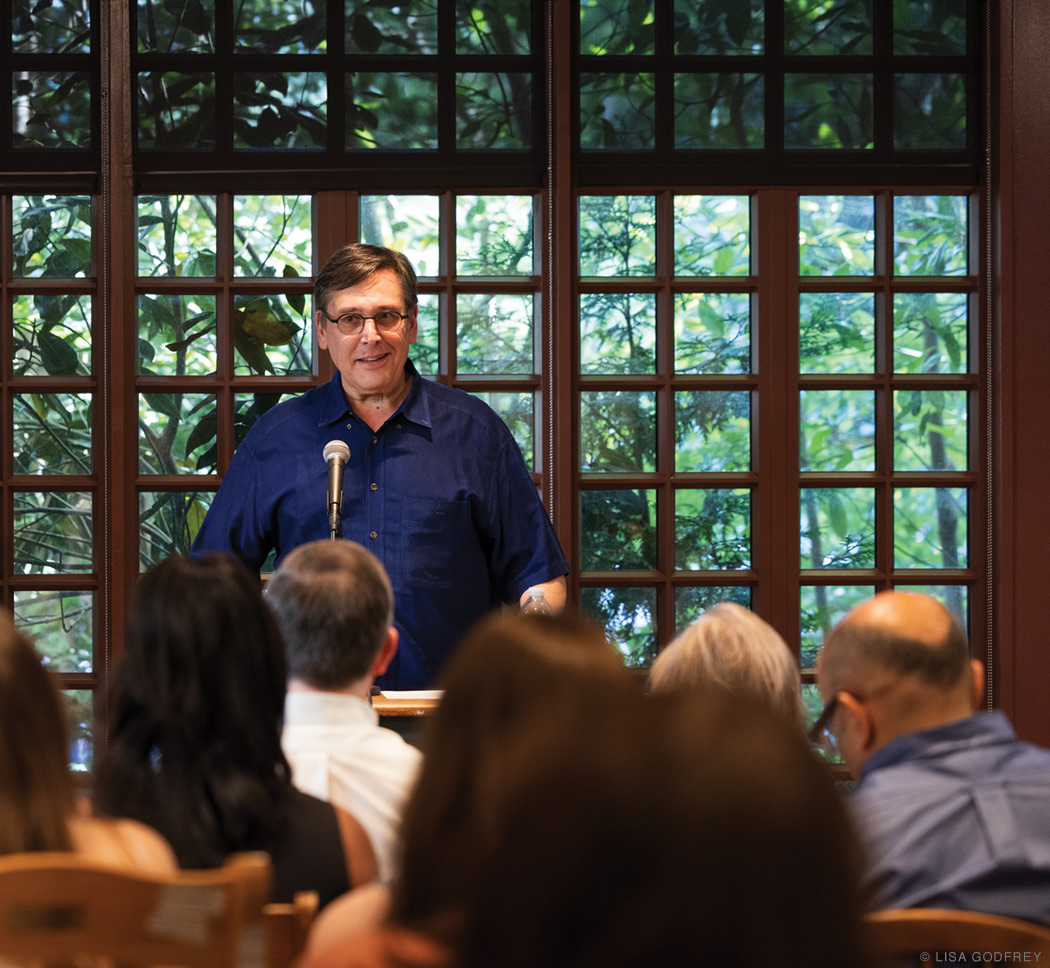
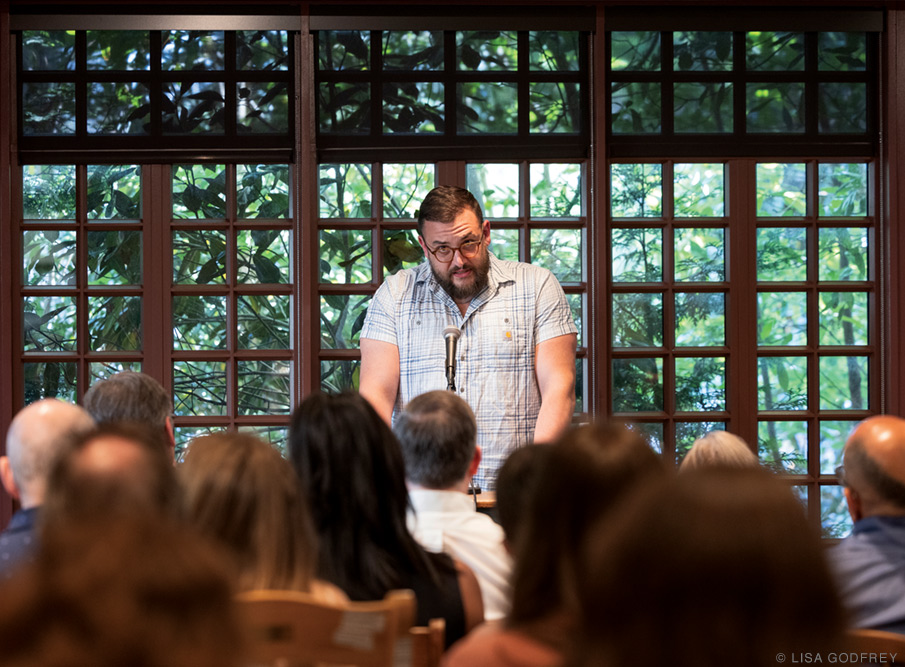
Among some of the other speakers, Harris Steinberg C’78 GAr’82 remembered wishing there’d been a Writers House when he was “a scared and confused kid from the Philly suburbs thrown into the big bad pre-professional cauldron of Penn in that hazy brown and orange decade of the ’70s,” and how “magic” happened when he and his wife Jane Stevens Steinberg GAr’82 were “asked to be the architects for the transformation of this charming 1850s Tudor cottage on Super Block into the Kelly Writers House,” he said. “We met Al in January in Bennett Hall as a post-blizzard snowpack melted into icy rivers. Thus began a journey rich in discovery and self-awareness that would take me to places I had never dreamed of,” along the way helping him craft a professional path “veering from traditional architecture towards city planning, civic engagement, and academia” that included serving as executive director of the planning organization Penn Praxis [“Penn Praxis at 10,” Jan|Feb 2012].
In what Steinberg called “the only intergenerational act today,” his son Henry Steinberg C’13 followed him at the podium. Though he probably visited the house for the first time when he was about five, he said, he didn’t really remember that beyond a “vague recollection of tarps, and sawdust, and the smell of construction.” He did remember his first time going on his own. “It was during new student orientation, my freshman year. I came to the Speakeasy [Open Mic] with a couple of hallmates and left buzzing, brimming with the energy of being surrounded by a group of students so excited about the possibility of language as I was. I immediately called my mom to tell her, ‘I think I found my people.’ I don’t think I understood in that moment how true that really was, and more than that, that it wouldn’t be a singular moment,” he said. “There is a gravity to certain places, they call to you, they open their doors and windows, and once you enter, it is as though you were always meant to be there.”
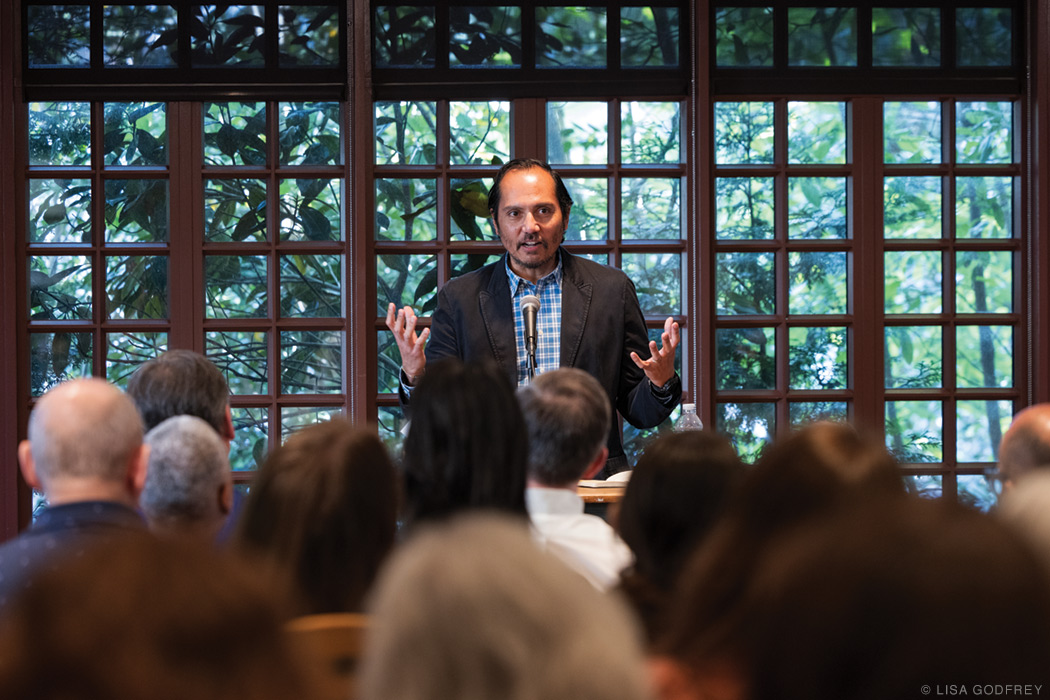
Music writer (and occasional Gazette contributor) Nate Chinen C’97 emphasized the enduring sense of possibility the house represents, and the eclectic personalities found within its walls. “I wasn’t at the first candlelight planning meeting, but I was here very soon after that,” he said, as a student, assistant coordinator, and drummer in the jazz band that played regular gigs there in the early days. “Very quickly I realized, this is a place where you stumble in at whatever time of day just to check in, and you fall into a conversation with a medievalist and an anarchist and a technologist, and maybe those are different people, and it might be the same person. … As someone who was maybe thinking about poetry and definitely thinking about music, it very, very quickly felt, as you’ve heard many others say, literally like a home.”
Chinen, who is editorial director at radio station WRTI, teaches a Penn course on podcasting. He sometimes stops in at KWH when he’s on campus, and “I see the kids, and they’re doing their thing, and they’re having their conversations, and some of them are studying, and some of them are definitely not studying, and it’s very familiar, even as it’s a whole different cohort, a whole different generation.”
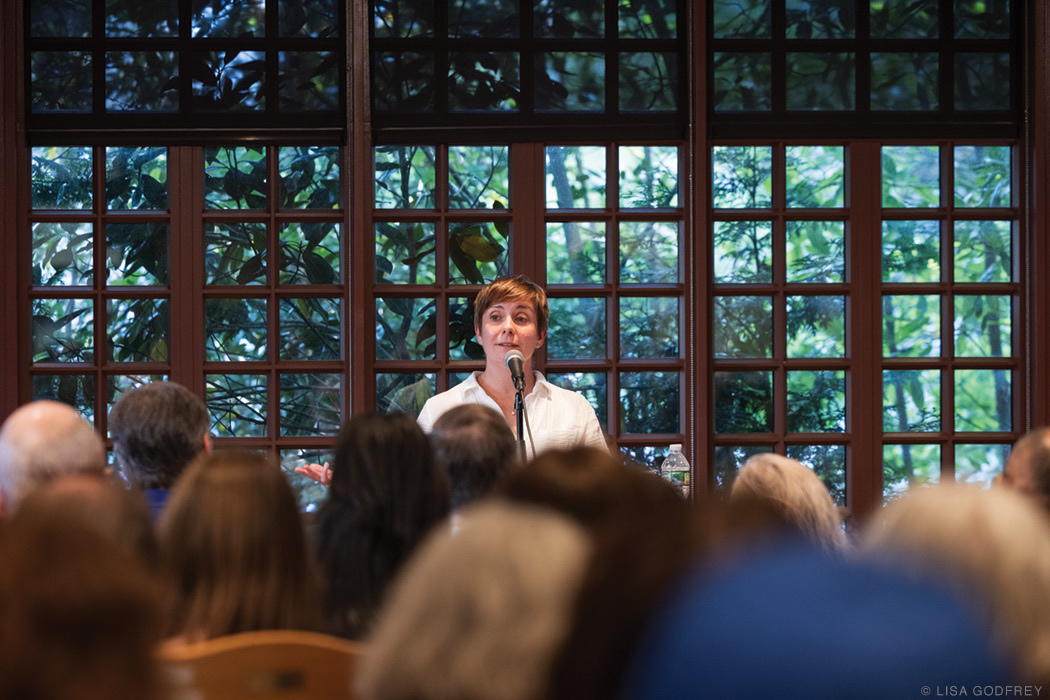
“I think everyone I’ve ever met is here,” began Jamie-Lee Josselyn C’05, noting that “26 years have now passed” since she first learned about Writers House from a Penn admissions rep visiting her New Hampshire high school. She read a message to her 17-year-old self (“Hey, turn down the Rent soundtrack for a second, I want to talk to you”) tracing her journey from an intimidated, shy student on arrival at Penn, to being Filreis’s advisee; becoming his first assistant after graduation; sticking in that position through earning her MFA; and continuing on to her current role as associate director of recruitment where “you get to go find the writer kids, some of them like you, some not,” and becoming the director of the house’s summer residential writing program for high schoolers. “Every once in a while, you’ll think about leaving, but you won’t,” she told teenage Jamie-Lee. “You won’t stay because it’s perfect—nothing is—but because you keep getting to try to make it better.”
“The Writers House is an anchor,” said the final speaker, Gwendolyn Lewis C’14, who recalled Filreis’s congratulatory email “Yeah!! I knew you could do this” when the English major got an internship offer from Google while working her shift at Writers House. “Every time I walk through those doors, it’s like I’m going through a portal where I’m coming home to the most authentic and ambitious version of myself. It has nothing to do with needing to feel like younger [me] or trying to relive the past. It’s a way of refueling my current self with a version of myself that knows exactly who I am, what I’m capable of, and who knows that all of it is possible.”
Filreis has always made it a point of pride that, unlike many other reading venues, Writers House events start punctually. There’s more flexibility about how long they last. “We’ll be here for a little more than an hour,” he said at the start, and it ran more like two. But no one was complaining, and Filreis wasn’t ready to stop celebrating. When the crowd gave him a standing ovation at the end, he called, “Now that you’re standing, you can go into the other room and out into the garden. Please stay, please hang out!”
“I’ll be around,” Filreis says, of his future role at KWH, emphasizing that he has “no plans to retire.” He’ll continue to teach and direct the Center for Programs in Contemporary Writing (CPCW), which is where the creative writing program and RealArts@Penn, which offers a variety of coveted summer internships in the arts, are housed. He’ll also remain at the helm of ModPo, PennSound, and PoemTalk, and serve as publisher of Jacket2. Becoming associate faculty director, he says, will allow him to hand off the Writers House administrative tasks, budgeting, and, increasingly, fundraising to Simone White, “who’s utterly fantastic and brilliant and a wonderful partner,” he says. “I’ll be available, but it’s time for somebody else to do all that. That’s really what’s going on here. I love the idea of putting everything into my teaching and being supportive.”
“Thirty years is a very long time, and he’s busy with a million other things,” says White, “so it seems only reasonable that someone would take some of the responsibility off his shoulders.” The author of several books of poetry, White joined the Penn faculty in 2018. She grew up in Philadelphia’s Mount Airy neighborhood and went to Wesleyan University for her undergraduate degree, then earned a law degree from Harvard before changing course toward academia with an MFA from the New School and a doctorate from CUNY Graduate Center. She was also heavily involved in the Poetry Project at St. Mark’s Church in New York, eventually running its marquee Wednesday night reading series and workshop programs, experience she’s brought to Writers House and hopes to expand in the future.
While a big part of her job, especially early on, will be tending to the house’s existing programs, “I have ideas about what we could do, particularly because I am so interested in curating, and have my own sense of how the Writers House can take its rightful place—because it really does have a national and international place—in the literary world as a convening center.” She has an interest in and connections to the art world as well, and would like to incorporate that into KWH programming, she says, and also forge some stronger connections with other Penn arts organizations.
Listening to the speakers and others at the celebration, “it’s a lot to think about being able to respect and honor their attachment to the place and their memory of the place—but every year Penn gets a new group of students, and I would like to be the person who introduces the Writers House to them as a fresh experience.”
KWH is “the place that Al built, for sure, but it’s also a place that operates on a daily basis, serving people who are not English majors, who are not writers. It’s a home for students and it’s my role to make sure that it continues. I mean, this is an institution now, and it should be able to live without” any one person, she says, “and Al knows that.”
“The Writers House is a symbol that reaches 500 people a week. There are probably 15,000 people in our mailing list,” Filreis replies, on being asked what Writers House means now. “It’s a small slice of what happens at the University. However, it is a symbol that, essentially, a house that some people squatted, survived, and thrives and has the word writers on Locust Walk. Imagine that—at the University of Pennsylvania, writers have a house. And it’s amazing, if I’m standing out there on Locust Walk, to hear people come by and say, ‘Wait, there’s a house for writers?’”
SIDEBAR
“They’ll teach themselves”
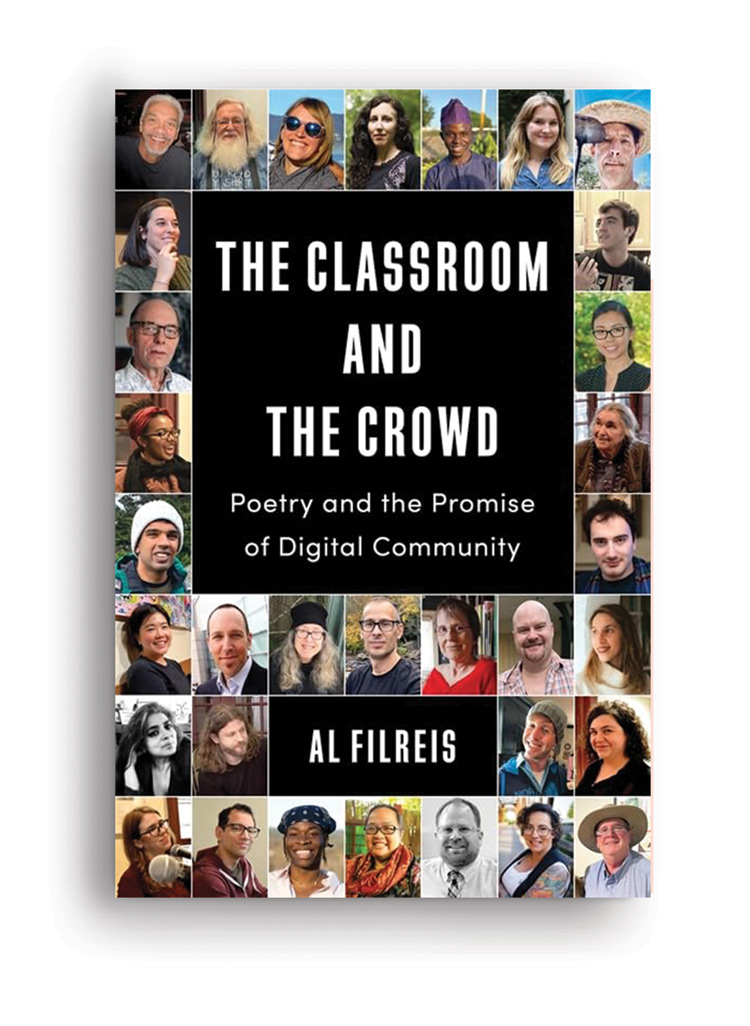
As Kelly Writers House marks its 30th anniversary (see main story above), its online offshoot ModPo (short for Modern & Contemporary American Poetry) is well into adolescence. ModPo had its first iteration in 2012 on the Coursera platform and was both a product of and reaction to the surge of interest in massive open online courses (MOOCs) of the early 2010s [“MOOC U.,” Mar|Apr 2013]. The free course has a current enrollment of nearly 100,000. But for many of the 435,000 people from 179 countries who’ve engaged with ModPo over the years, it’s a way of life.
The animating force for ModPo, as for KWH, is Al Filreis, the Kelly Family Professor of English and longtime faculty director. Filreis tells the story of ModPo in The Classroom and the Crowd: Poetry and the Promise of Digital Community (Columbia University Press, 2026), which combines a history and analysis of the development of online education, an argument for “reader-centered teaching” as opposed to the “sage on a stage” model of the traditional lecture, and a collective portrait of the worldwide ModPo community, many of whom remain engaged long after the nominal 10-week “class” has ended.
Filreis calls the lecture, which remains the template for lots of online courses, “an old technology,” that people mostly don’t learn from or retain. What does work, he adds, “is to go into a room and say, ‘Well, I’ve been reading this poem for 40 years, so I’m tired of hearing myself talk about it. What do you guys think?’ And believe me, after 90 minutes, they will do everything that I would have done in a lecture, and maybe more, and they will remember it because they were the ones who had to articulate what it was.”
The book also takes aim at commentators who dismiss online courses because of their high so-called “dropout” rates, citing ModPo members who because of limited time or difficult life circumstances may take years to finish, or never complete the course, but whose participation enriches them intellectually and emotionally and serves other participants as well. And as someone who has been leading online learning efforts since email had a hyphen, and who posts regularly on social media about, well, everything, Filreis takes sharp issue with the current trend toward “digital minimalism,” which counsels people to put away screens and “touch grass,” as the saying goes. He talks about a woman in ModPo named Anne Jongleux “who was in northern Florida on the West Coast, when [Hurricane Helene] hit and was suddenly nomadic for a couple of months,” whose story is recounted in The Classroom and the Crowd. “I don’t know where she went, but because she was in ModPo, and because she had a phone, she didn’t miss a beat. All of her ModPo people continued to be with her, and she continued to learn.”
He notes that the number of ModPo learners who describe themselves as having disabilities is disproportionately high compared to the general population. “Why? Because they can do it,” he says. “Minimalism is elitist. Some health outcomes from unplugging are good but tell that to the woman displaced for two months who wants to learn poetry. We really have to go slow on this.”
ModPo’s huge enrollment makes it impossible to “get my arms around what’s going on in the course, ever,” Filreis says. “If I were a digital minimalist, I would just cut it back and say, well, we can only have 100 people in this course at a time, because I can’t be a responsible teacher of 99,000 people, I don’t know who they are. But I call myself a maximalist. Bring them on, the more the better. They’ll teach themselves. It’ll be OK.”—JP