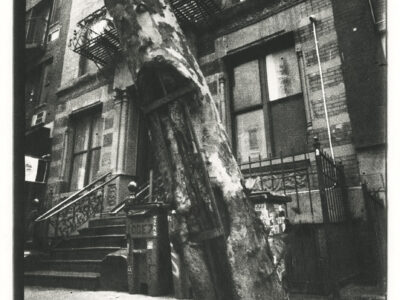
An arboreal campus history.

Penn’s Sylvania: The Campus as Landscape
Edited by Frederick Steiner GRP’77 GFA’86 Gr’86 and Ignacio F. Bunster-Ossa GLA’79
Penn Press, 200 pages, $49.95
The 95 representatives of Penn’s Class of 1971 who returned for their 55th Reunion this past Alumni Weekend found a campus utterly transformed since their own Commencement. From Levine Hall to Lauder College House, from the Neural and Behavioral Sciences Building to the Singh Center for Nanotechnology, the University has spent the past half-century building too many structures to list. But for members of the Old Guard parading between College Hall and Van Pelt Library, perhaps the most welcome change was one often overlooked in accounts of Penn’s development: the shade of so many stately trees.
It’s easy to take for granted now, but the proportion of Penn’s core campus covered by tree canopy more than doubled between 1970 and 2012—from 8.7 percent to 20.5 percent. And that doesn’t count the profusion of London plane trees, poplars, oaks, dogwoods, sweetgums, weeping willows, dawn redwoods, and other species that leaf out over Penn Park. With 6,500 trees and shrubs comprising more than 240 species, the University’s urban campus has been a certified arboretum since 2017. As detailed in Penn’s Sylvania, out from Penn Press in September, the path to the present idyll was long and frequently unshaded.
In his original 1749 Proposals Relating to the Education of Youth in Pensilvania, Benjamin Franklin envisioned “That a House be provided for the ACADEMY, if not in the Town, not many Miles from it; the Situation high and dry, and if it may be, not far from a River, having a Garden, Orchard, Meadow, and a Field or two.” Yet it was only in 1872, upon relocating from central Philadelphia to 10 acres of farmland west of the Schuylkill River, that the University of Pennsylvania came into real estate conducive to Franklin’s original conception, as Witold Rybczynski, the Martin and Margy Meyerson Professor Emeritus of Urbanism, observes in the first of six chapters authored by a collection of 10 Penn alumni and faculty.
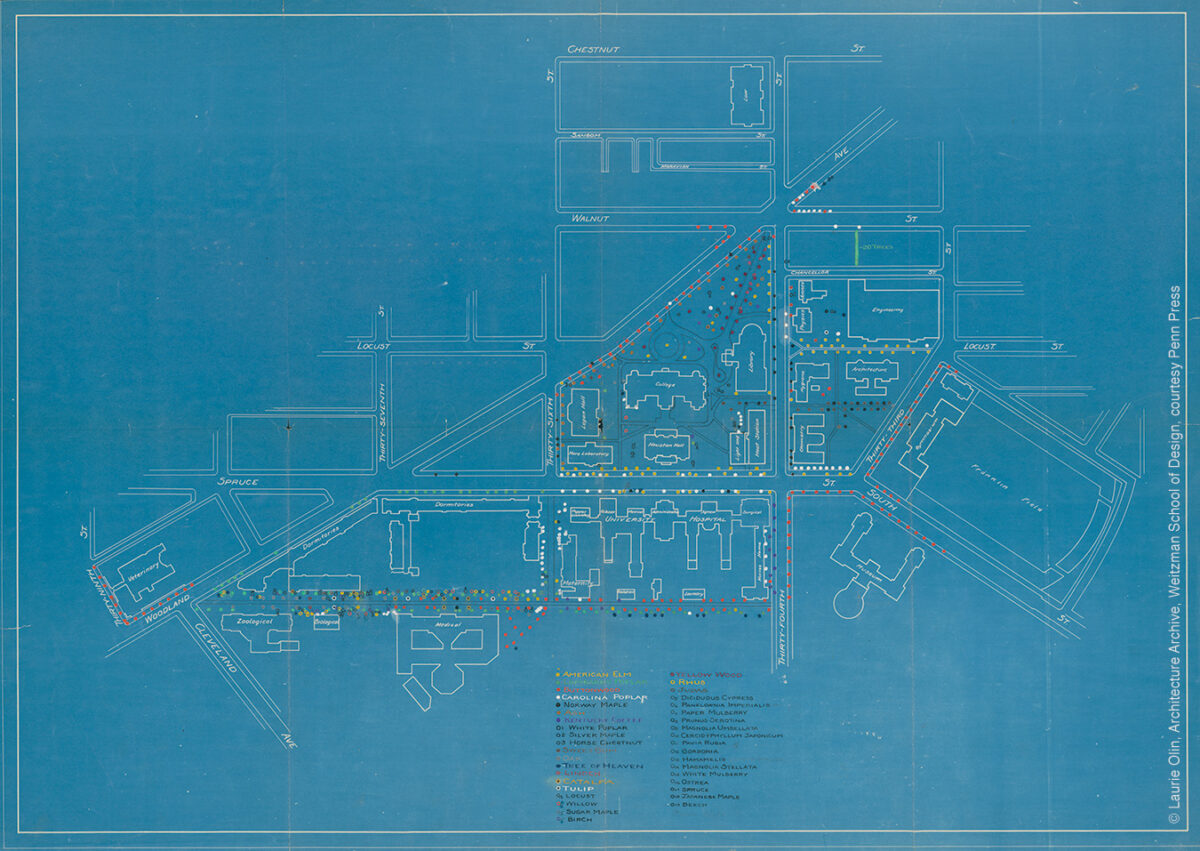
College Hall and Logan Hall (now Claudia Cohen Hall) went up in a flash, followed by Frank Furness’s University Library (now the Fisher Fine Arts Library) in 1890. But “except for a few poplars and an occasional struggling street tree,” observes Weitzman School of Design practice professor emeritus Laurie Olin Hon’19, period photographs show that “there was barely a twig near any of the buildings.” That changed after the 1894 appointment of Charles Custis Harrison C1862 G1865 Hon1911 as provost—thanks to his wife, Ellen Nixon Waln Harrison. Over the next 18 years, Olin writes, “she directed and supported—largely with her own money and that which she raised from others—the planting of the entire campus.” Consulting with biology faculty to breathe arboreal life into spaces including Hamilton Walk, Smith Walk, and the BioPond (now James G. Kaskey Memorial Park), “she transformed the university.”
Yet as Rybczynski observes, when the trustees commissioned a campus-planning report in 1913 from Paul Philippe Cret, the eminent Penn professor of design issued a scathing verdict. “Growth has proceeded without plan and through mere accretion,” he wrote, “into an ever-increasing confusion.”
Cret’s proposal, a thousand-foot-long grassy mall extending from College Hall north to Chestnut Street, never came to fruition. Campus development ground to a halt nationwide during the Great Depression and only sprang back to life after the Second World War with the advent of the GI Bill.
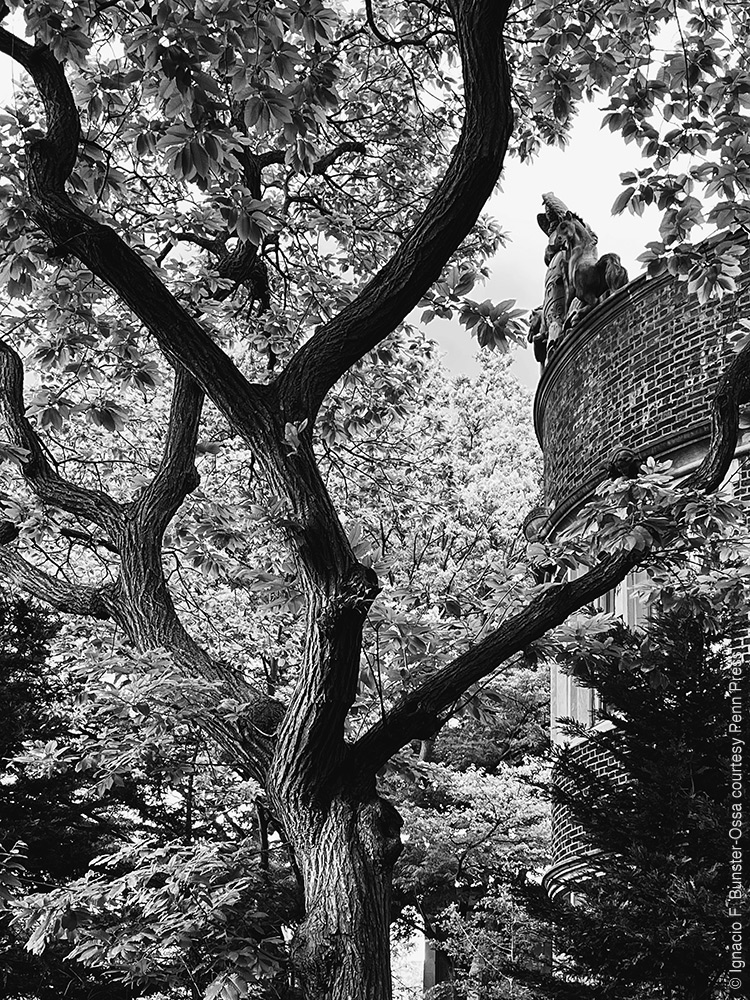
Photo by Ignacio F. Bunster-Ossa courtesy Penn Press.
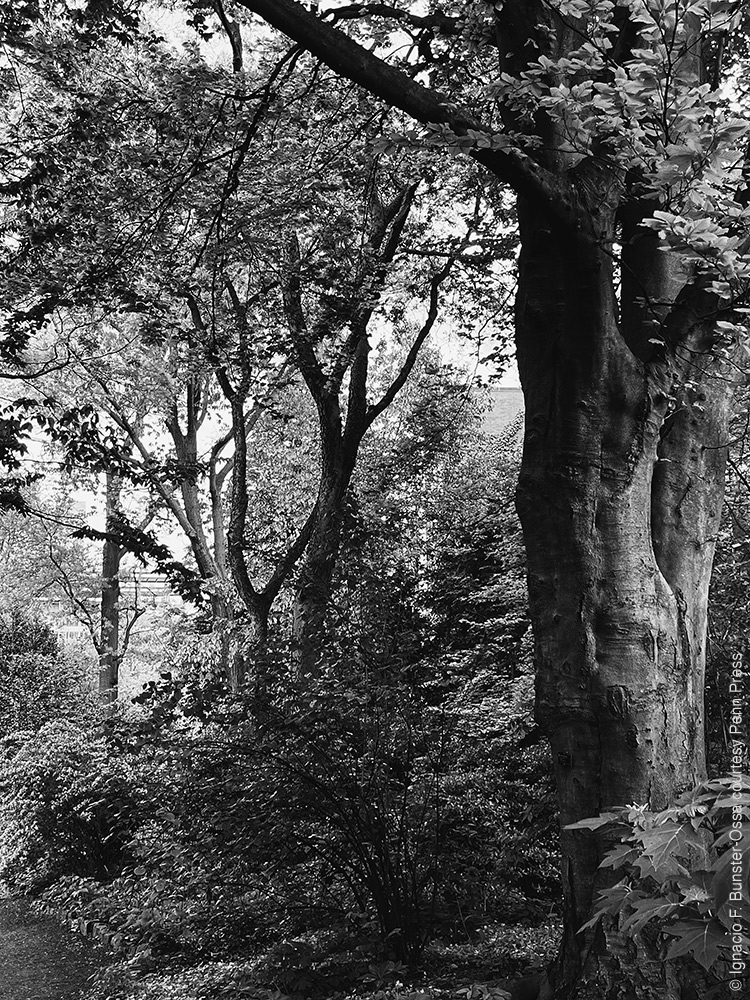
Photo by Ignacio F. Bunster-Ossa courtesy Penn Press.
Penn’s subsequent landscape development owed much to two men who joined Penn’s School of Fine Arts faculty in the mid-1950s. Ian McHarg, who re-established the University’s Department of Landscape Architecture, produced a plan to transform Woodland Avenue between 36th and 37th streets into what Olin calls a “series of interlinked garden rooms” planted with magnolias, London plane trees, and Korean stewartia. Then, in the early 1960s, landscape architecture professor George Patton converted a trolley-tracked asphalt thoroughfare into a cobblestone walkway lined with Japanese zelkova trees. Locust Walk was, in Olin’s estimation, a “master stroke that almost instantly transformed the campus from a near-random assortment of buildings on city streets into a campus with an interior.”
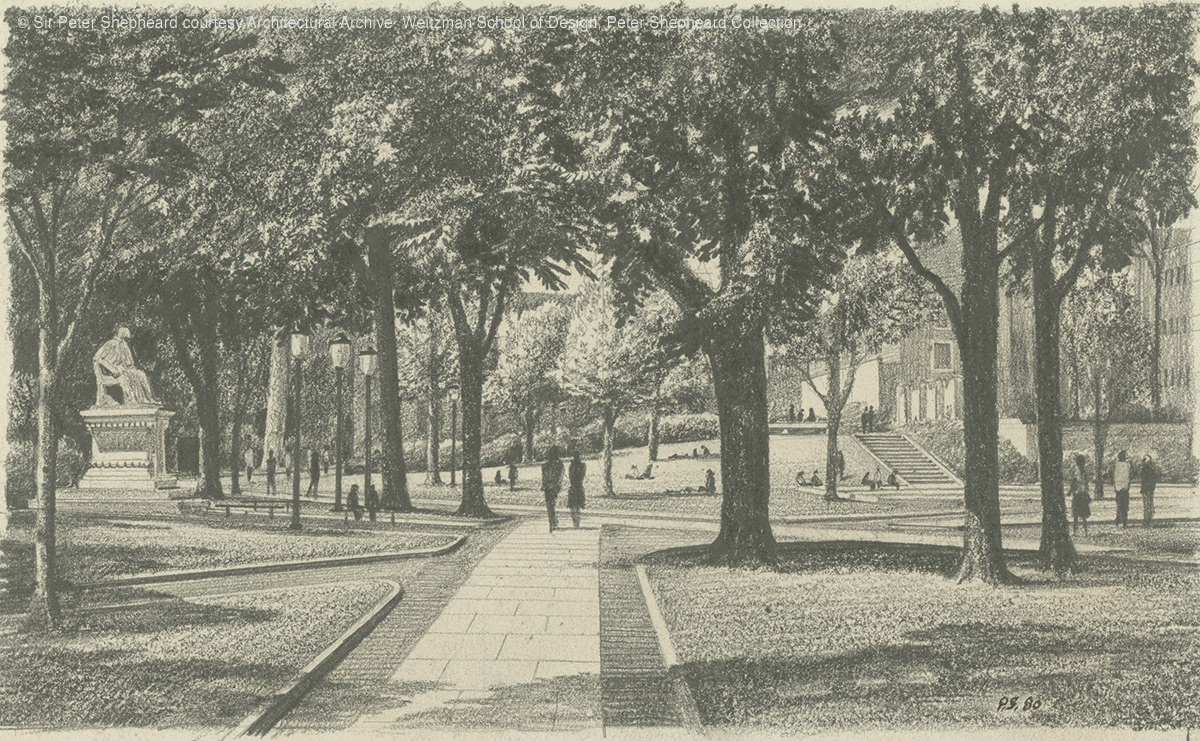
But as the building boom of the 1960s proceeded, and the maturation of Ellen Harrison’s plantings gradually left “many once magnificent trees now diseased or dying,” as Graduate School of Fine Arts dean Peter Shepheard observed in a 1977 report, “no major replanting efforts had been undertaken to recapture this great exterior canopy.”
Penn’s Sylvania pays ample tribute to the sustained efforts to reinvigorate the campus landscape since then. The 1977 report catalyzed the redevelopment of College Green into Blanche Levy Park, which enriched the preexisting palette of historic trees with plantings of native red oaks, tulip poplars, Kentucky coffeetrees, red maples, Sargent’s cherries, and other species under the supervision of Shepheard, Olin’s design practice Hanna/Olin, and Andropogon Associates (founded by Penn landscape architecture faculty members Colin Franklin GLA’67, Carol Franklin GLA’65, Leslie Sauer CW’69, and Rolf Sauer C’67 GA’71). Chapters by Olin and Susan Weiler GLA’83 detail the development of additional landscapes.
Lara A. Roman C’04, Theodore S. Eisenman Gr’15, Robert Lundgren GLA’82, and Chloe Cerwinka C’00 LPS’19 tackle the question “Who Cares for the Campus Trees?” in a chapter that doubles as an ode of gratitude to the University’s Division of Facilities and Real Estate Services (FRES). After all, trees are ever vulnerable to death and disease, and climate change adds to the stressors. Yet “Penn campus trees rarely die in place,” the authors marvel. Between 2003 and 2014, for instance, slightly more than a third of all trees were removed, and an equal number replanted under the supervision of FRES personnel.
Catherine Seavitt, the Martin and Margy Meyerson Professor of Urbanism and current chair of the landscape architecture department, contributes an idiosyncratic homage to the pawpaw tree, whose swiftly perishable fruits can be harvested by people who know where to find them on campus (or know how to use FRES’s online Penn Plant Explorer map). Ignacio F. Bunster-Ossa GLA’79 adds a 50-page black-and-white photo essay to the volume he coedited, and his fellow editor Weitzman School Dean Frederick Steiner bookends the text with an introduction and afterword.
And the new cohort of undergraduates joining the University community this fall will make their own small contribution to the landscape that now offers such rich shade to spring reunion-goers. Since 2011, each freshman class has helped to select and plant a tree on College Green. The Class of 2029 planted a cucumber magnolia near the entrance of Van Pelt Library, a few paces away from the Carolina silverbell selected by the Class of 2028. After conducting their own vote, the Class of 2030 will plant a new set of roots on Homecoming Weekend.—TP