Fran McCaffery’s prized transfer propels Penn back to the NCAA tournament with a championship performance for the ages.
When Yale made two free throws to go ahead by four points over Penn with 12 seconds remaining in the Ivy League men’s basketball championship on March 15, the Quakers’ season looked to be over.
Top-seeded Yale—the regular-season Ivy champs and two-time defending Ivy tourney champs—had a greater than 90 percent chance at that point to return to the NCAA tournament for the fourth time in five years.
But Penn junior forward TJ Power wasn’t thinking about the odds.
“I’ve been telling people I had this weird feeling, like an absence of fear,” Power says. “I was just like, Somehow, we’re just not going to lose. We had so many close games this year, and we were building up to something special. And I was like, Something’s gonna happen here.”
Something indeed happened.
First, Power dribbled down the court and drilled a three-pointer with seven seconds remaining to pull the Quakers within one. Then, after Yale made two more free throws, Power delivered a moment that will forever be enshrined in Penn basketball lore, burying another three-pointer just before time expired to force overtime.
Power had expected Yale to foul him before he could attempt a game-tying basket. But the Bulldogs instead opted to cover him one-on-one with Casey Simmons, the Ivy League Defensive Player of the Year. “I had to kind of pause in the air and let him flow by a little and then put a lot of arc on the shot,” Power recalls. “But I knew if I could get one off, I was in a state where it just felt like everything was gonna go in.”
That climactic trey gave Power a whopping 40 points for the game. He scored four more in overtime to help seal an 88–84 victory, clinching the Ivy’s automatic NCAA tournament berth for the Quakers, who hadn’t been there since 2018. Power’s 44-point game (to go with 14 rebounds) tied him with Hassan Duncombe C’91 for the third-highest single-game total in program history, behind only Ernie Beck W’53 (who had 47-point and 45-point games in 1952).
Penn head coach Fran McCaffery W’82 has “seen a lot” in his more than 40 years on the sidelines, but Power doing what he did “in a championship game, that’s what separates it,” McCaffery says. “With everything on the line and what we needed him to do late in regulation to win the game, I haven’t seen that.”
Power may not have expected to deliver arguably the greatest performance in program history, but he knew that he had to be “super aggressive” to make up for the absence of offensive costar Ethan Roberts, who was ruled out of the Ivy tournament due to concussion symptoms. “I kind of had that green-light feeling where it’s just like every time I touch the ball, I’m looking to score,” Power says. “And I think toward the end of the year, I felt like I was capable of these kinds of games.”
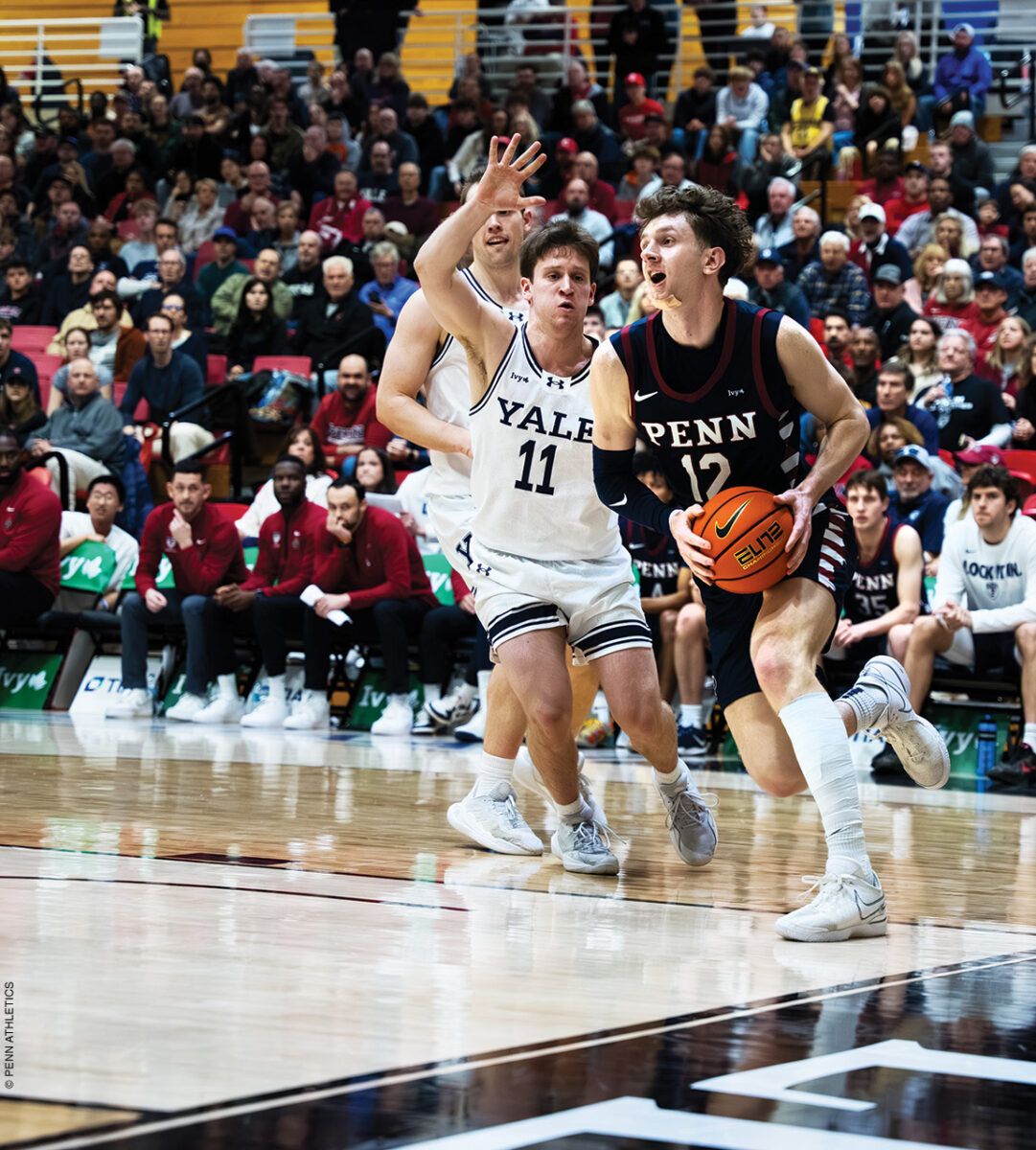
Power had indeed showcased his lights-out offensive ability before. It’s why McCaffery’s first big move after getting hired last year [“Full Circle,” Jan|Feb 2026] was bringing in Power, who had spent the previous two seasons at NCAA powerhouses Duke and Virginia (where playing time was at a premium) after being ranked among the best high school players in the country. It took Power a little time to settle in at Penn, but the 6-foot-9 forward scored 29 points against La Salle earlier in the season and, more recently, dropped 38 on Dartmouth. “When you have a special player like that, you just trust him at the end of the game to make the right play,” says McCaffery, who also calls Power an “elite rebounder” as well as a good ballhandler and defender. “I’m really happy for him, because as you watched his season unfold, he just kept getting better and better.”
His teammates also rose to the occasion. Starting in place of Roberts—who McCaffery notes “carried us a lot early in the season” before his initial December concussion slowed him down—senior Cam Thrower had 19 points in the title game and delivered the knockout blow with a huge stepback three-pointer in overtime. Before the game, “I told Cam, ‘Ethan’s out, it’s unfortunate,’” McCaffery recalls. “He said, ‘Coach, don’t worry about it, I’ve got it.’” Sophomore point guard AJ Levine stepped up too, driving for the game-winning layup in the previous day’s Ivy semifinal matchup against Harvard—another dramatic overtime Penn win.
Winning both of those games in overtime, after winning seven of their last eight regular-season games to qualify for the four-team “Ivy Madness” tourney held this year at Cornell, was emotional for Power. “It was kind of bigger than that weekend; it was like the culmination of my college basketball experience so far, and all of the lows and the hard moments,” he says, noting he “was crying in my room” when they got back to the hotel.
One of the hardest parts, Power says, was convincing his teammates that they were capable of a title after losing three straight Ivy games in late January. The team snapped back with a road win at Cornell, and Power thought about leaving a sock behind in the locker room to pick up when they returned for Ivy Madness, which felt to some like a long shot at the time. “We had just lost at Columbia, and we were going up to Cornell, and it was just hard for the guys to picture themselves back in that gym playing for an Ivy League championship,” Power says. “I was trying to tell them, This changes so fast.” For the players who’d finished near the bottom of the league in the previous two seasons, “it’s hard to shift culture,” adds Power. “But I was so happy for these guys once we won. They never have to doubt themselves again.”
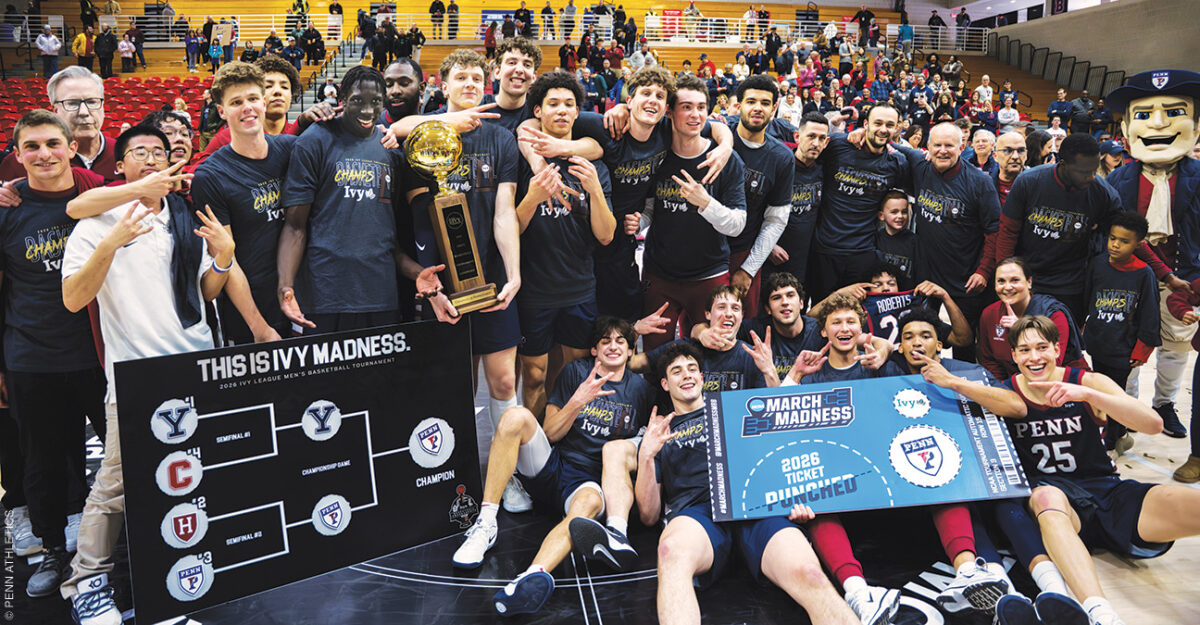
Instead they got to watch Penn’s name pop up during the NCAA tournament selection show on a hotel TV, hours after their championship. “I always hope that at least one time—hopefully it’s more than once—everybody I coach gets a chance to do that,” says McCaffery, who’s now led five different schools to the NCAA tournament. By the time they made the four-hour trip back to Philly—“a fun bus ride to say the least,” the coach says—it was after midnight, and walking down Locust Walk “felt like a movie-scene type of moment,” Power says. On their way back home, Power paused at the Ben on the Bench statue to let the University founder hold the Ivy League championship trophy. (The Quakers won’t need to get on a bus for next year’s Ivy tourney. It was recently announced that the Palestra will host the event in conjunction with the building’s 100-year anniversary.)
Spirits were high on campus for the next two days, with classmates congratulating the Quakers ahead of their trip to Greenville, South Carolina, to take on Illinois in the first round of the NCAA tournament. Then, things became decidedly less fun for Power, who came down with a stomach virus so nasty he “was on the toilet for like five days straight.” The Penn star needed five rounds of IV hydration to suit up and felt in a fog when he got onto the court, “like I was just out there trying to survive.” Power finished with only six points as the Quakers, seeded 14th in their region, were blown out by 35 by a dominant third-seeded Illinois squad that went on to the Final Four.
McCaffery felt terribly for Power, “especially because he willed us there,” the coach says. Had Power and Roberts (who was again ruled out for what would have been his final game in a Penn uniform) been healthy, “it would have been a much different game,” says McCaffery, who called sharpshooter Michael Zanoni’s 20-point performance “incredible” given all the attention he was getting from the Illinois defense. “I go over in my head, what would have happened,” adds Power. “It’s obviously a tough matchup, but it’s March.”
Power hopes a March upset could be forthcoming for the Quakers, who haven’t won an NCAA tournament game since 1994. “March Madness is an experience of a lifetime and selfishly I didn’t get to enjoy it this time around,” he says. “I want to go and I want to enjoy it and I want to make a run.” And he wants to do it in a Penn uniform, saying he never entertained thoughts of going back into the transfer portal even though he certainly could have scored a big pay day to return to a power-conference team. “I found something special here,” says Power, who notes that McCaffery “means a lot to me” and that Penn’s environment, where you’re not “isolated as a basketball player,” has “brought me out of my shell” as a student and a person.
Now, Power says, “I want to build on it even more. And I think next year can be even better.” —DZ