
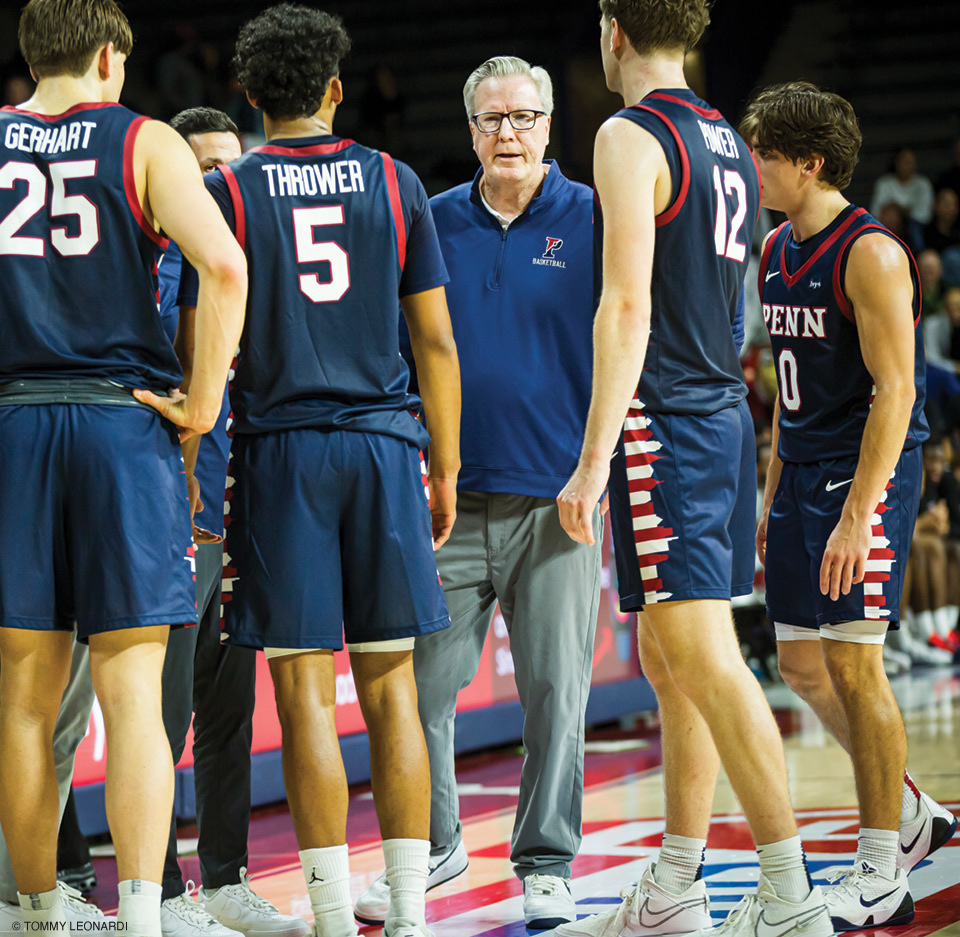
Over five decades and across five states, Fran McCaffery W’82 has been a winning college basketball coach. Now back at his alma mater, does the 66-year-old once known as “White Magic” have enough magic left to overcome significant NCAA obstacles and restore Penn to its former great heights?
By Dave Zeitlin
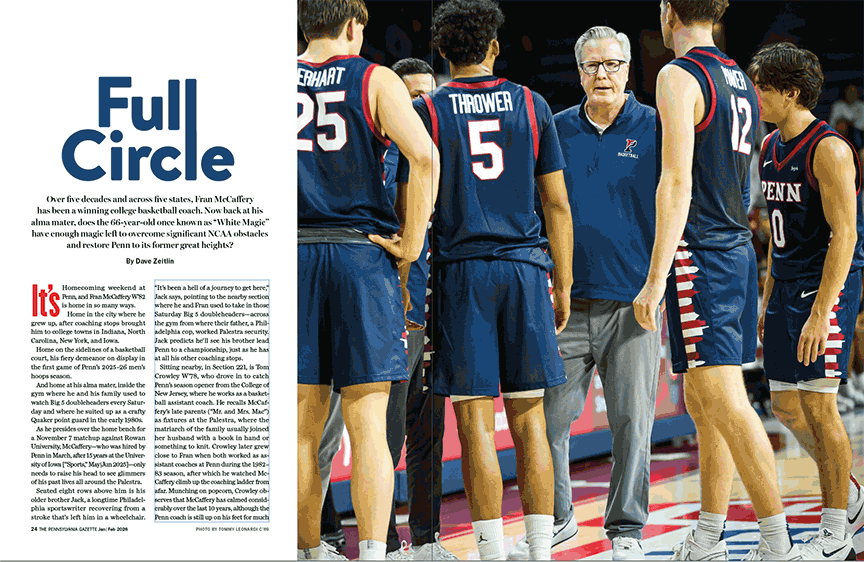
It’s Homecoming weekend at Penn, and Fran McCaffery W’82 is home in so many ways.
Home in the city where he grew up, after coaching stops brought him to college towns in Indiana, North Carolina, New York, and Iowa.
Home on the sidelines of a basketball court, his fiery demeanor on display in the first game of Penn’s 2025–26 men’s hoops season.
And home at his alma mater, inside the gym where he and his family used to watch Big 5 doubleheaders every Saturday and where he suited up as a crafty Quaker point guard in the early 1980s.
As he presides over the home bench for a November 7 matchup against Rowan University, McCaffery—who was hired by Penn in March, after 15 years at the University of Iowa [“Sports,” May|Jun 2025]—only needs to raise his head to see glimmers of his past lives all around the Palestra.
Seated eight rows above him is his older brother Jack, a longtime Philadelphia sportswriter recovering from a stroke that’s left him in a wheelchair. “It’s been a hell of a journey to get here,” Jack says, pointing to the nearby section where he and Fran used to take in those Saturday Big 5 doubleheaders—across the gym from where their father, a Philadelphia cop, worked Palestra security. Jack predicts he’ll see his brother lead Penn to a championship, just as he has at all his other coaching stops.
Sitting nearby, in Section 221, is Tom Crowley W’78, who drove in to catch Penn’s season opener from the College of New Jersey, where he works as a basketball assistant coach. He recalls McCaffery’s late parents (“Mr. and Mrs. Mac”) as fixtures at the Palestra, where the matriarch of the family usually joined her husband with a book in hand or something to knit. Crowley later grew close to Fran when both worked as assistant coaches at Penn during the 1982–83 season, after which he watched McCaffery climb up the coaching ladder from afar. Munching on popcorn, Crowley observes that McCaffery has calmed considerably over the last 10 years, although the Penn coach is still up on his feet for much of the game—yelling, scowling, cursing, gesticulating, encouraging. “Fran has just injected us with a huge surge of energy,” Crowley says. “I think we have a chance to get back into the thick of this thing.”
Across the gym is an era-spanning constellation of Quaker stalwarts whose paths have intersected with McCaffery in one way or another. There’s Tim Smith C’79, a starter on Penn’s famed Final Four team whose last year as a Penn student was McCaffery’s first. A few seats over on press row are former players and current broadcasters Vince Curran EAS’92 W’92 and Stan Pawlak C’66, who’ve known McCaffery for ages and, with the coaching change, are feeling their own surge of energy to provide color commentary for another season. Sitting a few rows up is Justin Windheim C’03, whose family has a multigenerational history of avid Penn fandom and who proudly possesses a vintage photo of himself as a baby, being held by McCaffery in the Penn locker room during the 1981–82 season. “This is what I’ve been waiting for,” says Windheim of the coaching change he hopes will reignite a program that had been drawing fan consternation for falling from its once-proud perch atop the Ivy League.
When the game ends in an easy 119–72 victory against the Division III opponent, McCaffery walks to the other side of the court to embrace some alumni and friends he’s known for decades, and then partakes in “The Red and Blue,” the swinging arm motions slowly coming back to him. After returning to the locker room, players spray him with water to mark his first Penn victory. Still drying off from his unexpected shower, his white hair slicked back, he makes his way to the press conference room, telling reporters he tried not to think about the emotional resonance of his debut as Penn’s head coach, instead putting “total focus on the game itself.” He says he’s proud of his players, 14 of whom scored as the Quakers set a program record for most points in a game. Though the competition will be stiffer from here on out, the head coach had still come away impressed with the number of free throws Penn attempted (49) and how many more rebounds the Quakers had than Rowan (30). “This was a great game for us,” says McCaffery, whose notoriously fast-paced and exciting brand of hoops had already begun to give Penn fans reason to hope.
Ten days later, in front of an electric Palestra crowd featuring many more of his former teammates and his old coach Bob Weinhauer, that hope would be given a dose of rocket fuel with the kind of win over a city rival that resembled the glory days of old.
Scan the roster of Penn’s famed 1978–79 men’s basketball team and you won’t find Fran McCaffery’s name. But “he was still very much a part of that team,” says Tom Leifsen WEv’82, a freshman reserve on the squad that shocked the college basketball world by making it all the way to the NCAA Final Four [“The Outsiders,” Mar|Apr 2019].
McCaffery had transferred to Penn from Wake Forest, where he played as a freshman in 1977–78, and had to sit out due to NCAA rules at the time—though he still practiced with the Quakers, lived with other players, and helped them develop a “mental toughness” that would carry into March. “You don’t go into North Carolina in the NCAA tournament and beat North Carolina unless you have a certain mindset, and that’s what that team had,” says McCaffery, who traveled on his own to games that year, including riding a bus to Raleigh, North Carolina, with a future mayor and governor named Ed Rendell C’65 Hon’00 (who was honored at midcourt for his longtime devotion to Penn basketball before McCaffery’s second home game this season). While Penn’s second-round NCAA tourney win over North Carolina, in Raleigh, may have shocked almost everyone that day in 1979, McCaffery—who knew that Tar Heels team from having played them the prior season with Wake Forest—saw it coming. “That’s why you came here,” McCaffery says, noting that he would have come to Penn right out of high school, where he starred for La Salle College High as an explosive point guard nicknamed “White Magic,” had freshmen been eligible to play varsity back then. (That Ivy League policy, ironically, was changed the following year). “You knew the Palestra was going to be full, you expected to compete for a Big 5 championship, you expected to win the Ivy League, you expected to beat anybody that was on your schedule. That was the mindset we had.”
McCaffery carried that attitude into his sophomore campaign, though it was quickly derailed when he tore his Achilles tendon, forcing him to sit out a majority of another season. But he returned from his injury the following year and “didn’t lose a step when he came back,” says Paul Little W’83, a former Quaker star who played alongside McCaffery. “I was always amazed by his speed on the court. He ran as fast dribbling the ball as anybody else would run without the ball.”
By his own admission, McCaffery “wasn’t the best scorer” in college, but he made up for it by getting Little and Penn’s other scorers the ball, while “playing defense and prioritizing winning.” As a result, McCaffery led the Ivy League in steals and assists as a senior. “The weakness in his game was probably his jump shot, and I think that was sort of the knock on him,” recalls Leifsen. “But he could certainly distribute and defend. I think he leaned into that. And he was kind of a gym rat, a scrappy kind of guy, with the talent to find people and make it look a little flashy too.”
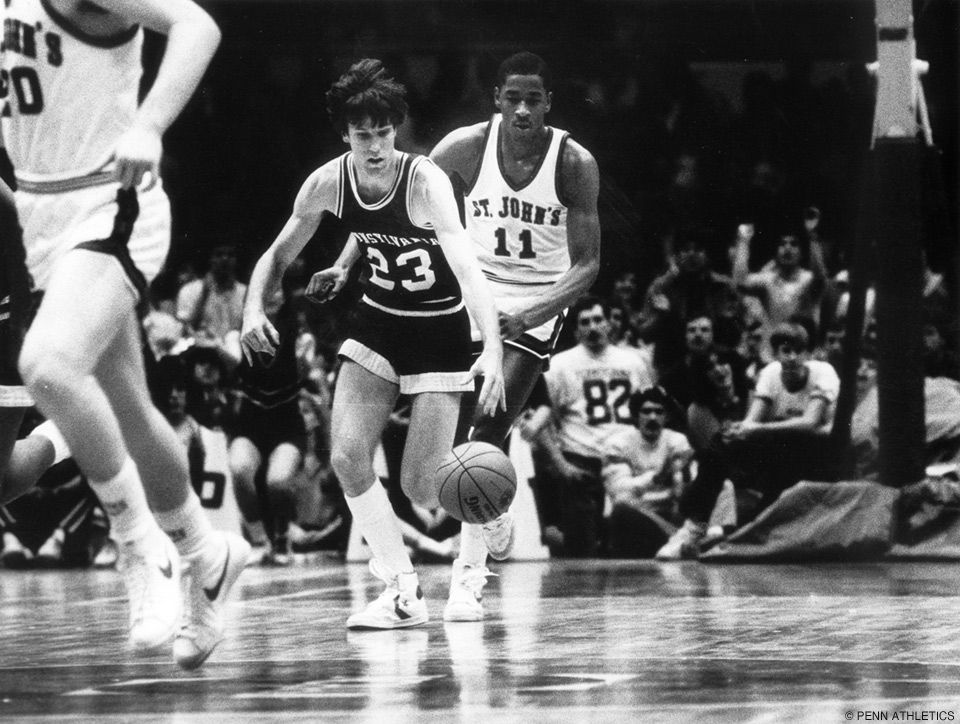
As the only senior on the 1981–82 squad, McCaffery also leaned into his role as a leader and floor general, navigating the Quakers through what he calls “one of the most interesting seasons in Penn basketball history.” After winning three straight to start the season, including a win at Stanford, the team lost nine in a row, while traveling to far-flung stadiums in Albuquerque and Tokyo, before reeling off 14 consecutive victories to win the Ivy League and make the NCAA tournament.
“It was a great sense of accomplishment, because we never gave up on ourselves,” McCaffery says. “You know, you lose nine in a row, and there could be a lot of finger pointing and blaming. But we hung in there and battled and kept competing.”
Although Penn lost its 1982 NCAA tourney opener to St. John’s, it was a sweet moment for McCaffery, who had gone to the NIT the previous season (after Penn lost to Princeton in a one-game playoff) and had to watch Penn’s 1979 and 1980 NCAA tourney runs from the sidelines.
It would also be the first of many memorable March Madness moments for him.
Throughout his time playing at Penn, McCaffery had no intention of getting into coaching, figuring he’d go to graduate school or use his Wharton degree to work on Wall Street. “It was just when it came to an end,” he says, “I didn’t want it to end.”
Others weren’t surprised that McCaffery immediately began coaching after graduating. “If you could be prophetic and say, ‘This guy is going to be a coach someday,’ you could say that about Fran,” says George May W’84, a former Penn teammate and fellow Philadelphian who knew McCaffery from their days playing in the city’s Sonny Hill League, where McCaffery earned his “White Magic” nickname. “He was very intellectual on the court.” Leifsen—who used to hang out with McCaffery in his highrise dorm, along with Fran’s brother Jack, and talk hoops over crappy late-night pizza—adds that “it was clear he was going to be somehow involved in the game, and he made that happen rather quickly.”
Weinhauer wasn’t surprised, either. McCaffery’s coach throughout his time at Penn and his biggest inspiration once told the Gazette, “He was always a student of the game. He was head and shoulders above other college kids in terms of thought process [“Profiles,” Jan|Feb 2011].” But Weinhauer left Penn for Arizona State in 1982, ceding head coaching duties to Craig Littlepage W’73, who gave McCaffery his first job, alongside fellow assistant coaches Tom Schneider and Crowley.
It wasn’t exactly a glamorous foray into coaching for McCaffery. The third assistant was “a strict volunteer,” so he had to get another job on campus as a mail courier for the psychology department. “I basically worked with all the professors in the psychology department,” he recalls. “I’d get them all their mail and do favors for them. It was a lot of collating tests.”
Among his tasks on the court was coaching the junior varsity team, which came with the added responsibility of driving players to road games in a questionable van. “It wasn’t the safest vehicle,” McCaffery says. “The steering was a little off. It felt like I was driving a boat.” Other menial tasks included “picking up the towels after practice, mopping the floor,” remembers Crowley. “That’s what you do if you want to try to get into coaching.”
But that 1982–83 season, Crowley adds, was a “good learning experience” for them both. And he could tell right away that “Fran had it—he had the gift.”
The next season, Schneider left Penn to become Lehigh’s head coach, taking McCaffery with him. Two years later, when Schneider returned to Penn, Lehigh offered McCaffery the head coaching job. The promotion made him, then only 26, the youngest Division I head coach in the nation, but “I felt like I was ready,” he says. That bore out on the court when, in McCaffery’s third season in charge, Lehigh won its conference to earn its second NCAA tournament berth in school history, the first having come three years earlier when Schneider and McCaffery were on the sideline together.
As a 16 seed matched up against top-seeded Temple in the first round of the 1988 NCAA tourney, Lehigh “went into the game feeling confident that we could beat them,” McCaffery says. “We had a lot of shooters and [Temple] Coach [John] Chaney played zone.” Lehigh buried 10 three-pointers and hung with the Owls until the end before ultimately falling short in its major upset bid. “We had a confidence about us,” McCaffery says. “We weren’t intimidated at all, nor should we have been. We won our way there.”
That March mantra—and the expectation that his teams could beat anyone, no matter rankings or seeds—would continue for McCaffery over the next decade as an assistant coach for Notre Dame, which he helped transition into the mighty Big East while working under the tutelage of John MacLeod and Digger Phelps, one of the architects of Penn’s famed 1971 team [“Almost Perfect,” Mar|Apr 2011]. At his next stop, as the head coach of UNC Greensboro from 1999 to 2005, he again went into the NCAA tournament as a 16 seed, where his team in 2001 fell to a dominant Stanford squad. And then, as Siena’s head coach from 2005 to 2010, he broke through with the kind of March Madness success most mid-major coaches only dream of, guiding the little school from upstate New York to back-to-back first-round NCAA tourney upsets in 2008 and 2009 (though McCaffery doesn’t like the word “upset”). The first was a convincing demolition of fourth-seeded Vanderbilt, which Siena followed the next year with a dramatic comeback win over Ohio State, in the state of Ohio, after it had “looked like the game was over,” McCaffery says.
The star of that win was point guard Ronald Moore, who ascended into March Madness lore by drilling a game-tying three-pointer at the end of overtime and then the winning three in double overtime. Legendary announcer Bill Raftery boosted Moore’s fame by yelling his signature catchphrase for a clutch shot, “Onions!” after Moore’s first one and then “Onions! Double order!” after his second.
Now one of McCaffery’s assistants at Penn, fresh off a long professional career in Europe, Moore credits his Siena coach and current boss for preparing him for that moment. “He really gave me the ultimate confidence and just put the ball in my hand and let me just be me,” Moore says. “You know, at a lot of other places that I played after that, it’s always been a struggle.”
Even though Penn’s players were too young to have watched Moore’s NCAA tournament heroics live, they often refer to him as “Onions.” Moore says the nickname serves to remind him of his goal to help those players create their own March memories and help McCaffery not only guide Penn to an Ivy League title but to the program’s first NCAA tourney win since 1994. (Once a perennial Ivy frontrunner and mainstay of March Madness, with 22 NCAA tourney appearances between 1970 and 2007, the Quakers have only been there one time since, in 2018, having fallen behind other Ivy programs since former coach Fran Dunphy’s departure almost 20 years ago.)
“I’ve got two dreams,” Moore says. “One is just to be able to get to the Dance with this team, as a coach, so these kids can experience what I experienced—because I’m still close to that [Siena] group to this day. My second goal is to get to the Sweet 16. I want to do that for him as a coach, because I wasn’t able to do it for him as a player. It would be icing on the cake.”
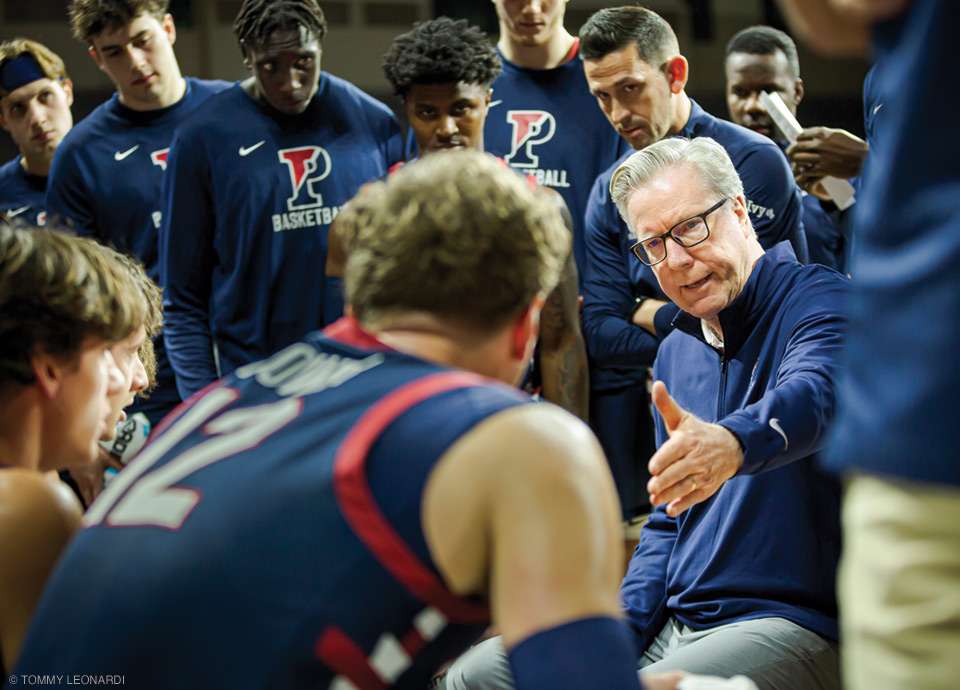
At the University of Iowa, which hired McCaffery in 2010 after his wildly successful stint at Siena, McCaffery continued to win a lot of games—297 to be exact. He became the Hawkeyes’ all-time winningest coach and one of just 14 Division I head coaches to take at least four different programs to the NCAA tournament, guiding Iowa there seven times with four tourney victories. He turned a program that had been sputtering before his arrival into one ranked as high as No. 3 nationally in multiple seasons and consistently ranked as the top scoring team in the Big Ten.
But McCaffery never managed to win a second-round NCAA tournament game and advance to the Sweet 16. And after back-to-back seasons in which Iowa missed the NCAA tourney, McCaffery was fired last March.
When Paul Little heard the news, he wasn’t sure if his old friend might want to take a break or retire after 43 years of coaching. Or if he’d even consider going from a prominent program that often plays on national television to one that’s won only one Ivy League championship in the last 18 years and plays in front of an increasingly apathetic student body. So he texted McCaffery to ask about the sudden vacancy at Penn after Steve Donahue had been let go four days earlier. “He sent me back a text immediately and said, ‘I am very interested,’” recalls Little, who swiftly began working his connections as a member of the Penn basketball board. Although Penn boasts other basketball alumni who are successful college coaches and would have been strong candidates, McCaffery quickly emerged as an easy and logical choice for athletic director Alanna Wren C’96 GEd’99 GrD’15, who made the splashy hire before the end of March.
While it’s uncommon for a coach from a power conference team to move to the Ivy League (Tommy Amaker going from Michigan to Harvard in 2007 is one other prominent example), McCaffery has the energy for a new challenge and the enthusiasm to do it at his alma mater. “He’s still at a high level,” says Tristan Spurlock, a Penn assistant coach who came with McCaffery from Iowa. “From scouting to recruiting, he’s at a 10 out of 10 pace.” Adds Ben Luber, another one of McCaffery’s new assistant coaches, “He works, I’ll tell you that. He’s in early, he’s here late. He watches a ton of film, more film than I’ve ever watched. He’s got the energy to do a lot of things throughout the course of the day.”
Luber, who served the last five years as a high school head coach at George School after spending the previous decade as a Division I assistant coach, calls it a “dream come true” to work for McCaffery. Luber first met him when he was 10 at a Notre Dame basketball camp, was recruited by him out of high school when McCaffery was at UNC Greensboro (Luber ended up playing for Penn State), and looked up to him as a mentor throughout his coaching career. “He’s the one guy I’ve really been waiting to work for.”
For Spurlock, too, it was an easy call to continue to work for McCaffery. “He’s not a micromanager,” Spurlock says. “From day one, he let me be myself, he let me push guys, he let me work guys out.” McCaffery has a similar relationship with his players, “allowing guys to be themselves every day,” Spurlock adds, “which is why he’s loved by every player.”
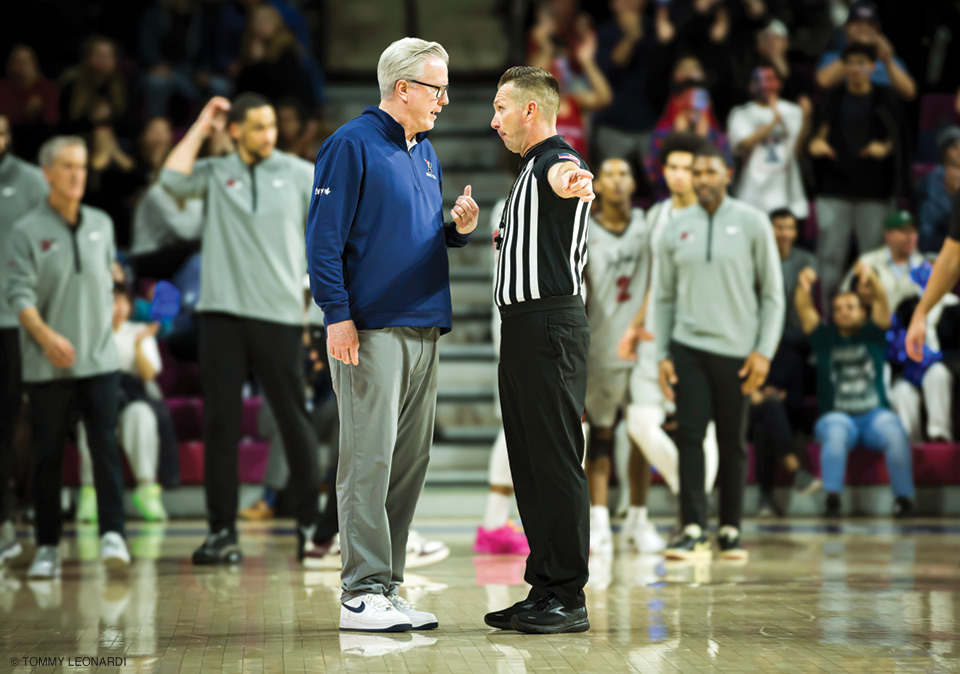
McCaffery has a reputation of being something of a hothead, but his assistants insist that’s mostly a misconception. Yes, he does scream at referees and sometimes picks up technical fouls. He is no stranger to ejection, including from his final game at Iowa. But that’s because he holds refs to a high standard, and “it’s ultimately about protecting his players,” says Moore. And in practice, “you can barely hear him,” Spurlock notes. “He has his pet peeves, like every coach, but other than that, he’s not screaming, calling guys out. He’s not disrespecting kids.”
“He’s fiery, but at the same time he’s clear about what he wants from you, and there’s an expectation,” says Penn sophomore AJ Levine, who through the first part of the season has drawn the start at point guard—but also, at times, the ire of McCaffery, who’s been quick to yank him out of games. “He’ll never let someone guess what they’re supposed to be doing out there.”
For anyone who only sees the hot-tempered coach on TV, “the biggest thing people are surprised about is how many jokes he cracks, and how easy he is to talk to,” Spurlock says. Moore notes that McCaffery will often “crack a joke that’ll catch the players off guard,” and that although “he’s serious, he also keeps things light so that it doesn’t feel like his door is closed—his door is always open for any player.”
McCaffery can laugh about his referee battles, too. When Little would text him after one, “he’d tell me ‘Paul, they don’t know I’m from Philly!’” The day after McCaffery stared down a referee for an uncomfortably long time during a February 2023 comeback win over Michigan State, Spurlock recalls the head coach seeing the replay on ESPN and asking his assistant if it was going viral on social media, which is one place you won’t find McCaffery. “And I said, ‘Coach, it’s everywhere,’” Spurlock says. “And he busts out laughing and just goes back to work.”
There are other ways his in-game persona differs from his off-court one. Spurlock has “always admired” the kind of father McCaffery is, especially how he balanced coaching and parenting with his sons Connor and Patrick, who played a combined 11 seasons for him at Iowa. He has two other children, son Jack and daughter Marit, with his wife Margaret, a former basketball player at Notre Dame. “It’s family before anything,” Moore says. “If we’re in a meeting and one of his kids calls or his wife calls, everything stops.”
The McCaffery clan is spread far and wide. Connor is an assistant coach at Butler, where Jack is a freshman forward. (Connor is also well known as the boyfriend of WNBA megastar Caitlin Clark, who he met at the University of Iowa.) Patrick currently plays professionally for a Romanian team—and during a recent interview his dad was glued to a TV in his Penn basketball office, questioning calls made by the FIBA Europe refs from 5,000 miles away. But everyone was at the Palestra for McCaffery’s introductory press conference last April—including his sportswriter brother Jack, with whom Fran is extremely close.
“It’s always family first,” Little says. “I’ve gotten a better appreciation for Fran as a husband and a dad. I love the fact that he has such a close-knit family.”
It didn’t take long for McCaffery to make his first big splash with the Quakers. Five days after the coach’s introductory press conference, TJ Power announced that he’d be transferring to Penn after spending the prior two seasons at the University of Virginia and Duke. Coming out of high school in 2023, Power was among the top 20 recruits in the nation but had struggled to earn consistent playing time in the ACC. McCaffery, who had recruited Power to Iowa “as hard as I’ve ever recruited anybody” and calls him a “special” player, offered a soft landing spot for the 6-foot-9 forward to rediscover his mojo.
After shaking off some rust in his first couple games of the 2025–26 season, Power began to show why he was a former five-star recruit, boasting a skillset you don’t often see in the Ivy League. In McCaffery’s second home game, the one that gave Penn fans and alumni that early jolt of energy, Power led the Quakers to an 83–74 win over Saint Joseph’s (now coached by Donahue) with 23 points, 15 rebounds, and several big plays down the stretch. Later in November, he carried the team on his back, scoring 29 points and burying some huge second-half three-pointers as Penn overcame a 15-point second-half deficit to beat another city rival in La Salle.
In that win, and in the previous day’s over Merrimack, McCaffery showed his coaching chops by making major second-half adjustments to galvanize his squad, which in both cases included subbing in another transfer he had brought to Penn, Lucas Lueth from Iowa’s Kirkwood Community College. Forward Dalton Scantlebury and guard Jay Jones, two key pieces of what McCaffery calls a “really good” freshman class that Donahue had recruited (all of whom honored their commitment after the coaching change), also made the most of their opportunities when called upon in those wins. (The Quakers ran out of gas playing their third game in as many days in the Cathedral Classic, their Thanksgiving weekend round-robin showcase at the Palestra, in a double-digit loss to Hofstra.) And through the first part of the season, Ethan Roberts—a 6-foot-5 forward who had transferred to Penn the prior year but whose offensive game has blossomed under McCaffery’s run-and-gun style—formed a dynamic 1–2 punch with Power. Roberts poured in 31 points against St. Joe’s and then 30 at Drexel four days later to lift Penn into the Big 5 championship game, though the senior suffered a concussion as Penn got routed by Villanova for the city crown.
While it will take time for McCaffery to build Penn’s roster in his mold, the arrival of Power combined with the development of Roberts gave fans an early glimpse of what the coach can do to turn around a struggling program—and offered hope that the Quakers, if healthy when the league slate opens in January, can return to the four-team Ivy tournament after a two-year absence and perhaps even contend for a title.
“Franny is a tremendous coach but he is a piranha recruiter,” Crowley says. “He’s always had kids, at all his stops, where you’d scratch your head and say, ‘What’s he doing at Iowa?’ or ‘What’s he doing at Siena?’ And the second thing is he can see things that others miss. He takes a kid that doesn’t play as a freshman but he develops. He gets better, and by the time he’s a senior you say, ‘Man, what a player that kid is. How did Franny get that guy?’”
From Daren Queenan, who at Lehigh in the 1980s became one of the NCAA’s most prolific scorers, to Luke Garza, the 2021 National Player of the Year at Iowa, McCaffery indeed touts a long track record of high-level recruiting. He and his coaching staff immediately aimed to keep that going at Penn, and over the summer secured commitments from their five primary targets for next season’s freshman class, including two of the top-rated high school seniors in New Jersey, Isaiah Carroll and Ethan Lin. “It doesn’t always happen that way, but Fran’s an easy sell,” Luber says. “He’s taken four different teams to the NCAA tournament. He’s back at his alma mater. If you love the game of basketball, you’re going to love playing for him.”
Yet to continue recruiting at a higher level in the Ivies, McCaffery and his assistants know they’ll need to convince players to pass up not only full-ride scholarships but all the Name, Image, and Likeness (NIL) money that’s now flooding college sports. “The money out there is fairly substantial these days, and that could be enough to get somebody to say yes to a particular place, but it’s not what the people that come here are overly concerned with,” McCaffery insists. The sell to teenagers and their families will continue to emphasize “the 40-year gameplan, not the four-year gameplan,” says Luber, who notes the importance of not only developing kids as basketball players but also ensuring “they are preparing for what’s after basketball.”
While McCaffery is sympathetic to college athletes earning money, the new rule that allows them to transfer an unlimited number of times without sitting out a season “was a mistake, and I think [the NCAA] would probably admit that now,” McCaffery says bluntly, contending that the constant churn of players undermines the “camaraderie” that makes college sports special. The head coach is equally blunt when asked how he might stem the tide of Penn’s top players taking advantage of that by bolting after standout seasons, which has happened in each of the last three years—as it has throughout the Ivy League and other smaller conferences. “You have to coach them up correctly and provide a great experience,” he says. “And if you have a culture that works, then kids will stay. If somebody throws a bag of money at them, and they want to go, then go. We’ll get somebody else.”
McCaffery isn’t a stranger to being an underdog in recruiting wars. After finding and developing mid-major gems at Lehigh, UNC Greensboro, and Siena, McCaffery at Iowa was up against Big 10 powerhouses with way more money in their NIL coffers. “We were playing against teams where one guy had a million dollars,” says Spurlock, who praises McCaffery’s ability to develop undervalued recruits into core contributors, as he did with the Big 10 Freshman of the Year two seasons ago. Now that McCaffery’s at Penn, “he can show you the importance of a Wharton degree and what it did for him and his life,” Spurlock adds. “I think when you do that, man, that’s big time and it helps a lot.”
Although the Ivy League is clinging to its amateur model, having opted out of an NCAA revenue sharing settlement that allows colleges to provide direct compensation to student-athletes, McCaffery exuded confidence on a recent Zoom event with Penn alumni that “we can make some noise in the NIL space.” As reported the next day by the Daily Pennsylvanian, McCaffery announced an alumni-driven collective that can raise money which “has to be dispersed for true NIL opportunities where someone is legitimately profiting from their name, image, and likeness.” An example might be a player being hired to represent a company through their social media presence, though the coach stressed it would be “fair market value” and with a far more modest price tag than at other schools—“$2,000 deals here and there” to help defray college expenses. More importantly, McCaffery says, are paid internships that alumni can offer, providing student-athletes with “the opportunity to be mentored by some of the most successful people in business, in medicine, in education, in communications. There are still families and individuals that prioritize that.”
Pointing out that some college basketball players around the country are now making several million dollars per year, trying to win in a league that doesn’t even offer athletic scholarships “is complicated but it’s doable,” McCaffery says. “You just have to work that much harder.”
“It’s easy to look at why you can’t,” he adds, before chumming it up with former Penn players who once helped the program achieve national success and want to see a revival of its storied past. “I can go on and on about the world of NIL and pay-for-play, and we can debate if the Ivy League should have opted into revenue sharing. It doesn’t do us any good to debate it. We’ll deal with the rules we have in place.
“But we still have something special to sell on a number of different levels, not the least of which is what this place will do for you for the next 50 years.”
Like what it’s done for him.


I graduated La Salle College High School two years after Fran, but didn’t really know him at all, and am sad that I saw “White Magic” play in only a couple of high school games. I watched a lot of Big Five basketball on TV as a kid, and played in one grade school game at the Palestra one Saturday morning, scoring just one basket at each end. After enrolling at La Salle High, I tried out three years for their basketball team, but was cut each time. I had attended three years of summer basketball camps under La Salle College’s Paul Westhead and Dave “Lefty” Ervin, and had developed a deadly accurate jump shot during my high school years, but my 5-11 height, foot speed, and ball handling were my weak points which kept me from the squad. I settled for playing some CYO ball, but that was basically the end of my basketball “career”, if you could call it that. But when it came time to choose a college in winter of ’79, I was accepted to six schools (Lehigh, Villanova, and Drexel among them), but I chose Penn mostly because of the superior financial aid package they offered me (mom was a low income widow), but maybe an almost equal factor was my excitement in watching their hoops team reach the Final Four and thinking I would perhaps be a first-hand witness to a Penn basketball dynasty during my undergraduate years. I remember feeling excitement when Fran transferred to Penn from Wake Forest. Even though my direct interactions with him were basically zero, I would have to list him as contributing factors to both my interest in basketball at that time, and my matriculation to Penn.