A pair of Jewish entertainment veterans—and former Penn classmates—
are paying tribute to the Borscht Belt.
“Think of it like a cabaret with elements of a TED Talk and just a whisper of Bar Mitzvah.”
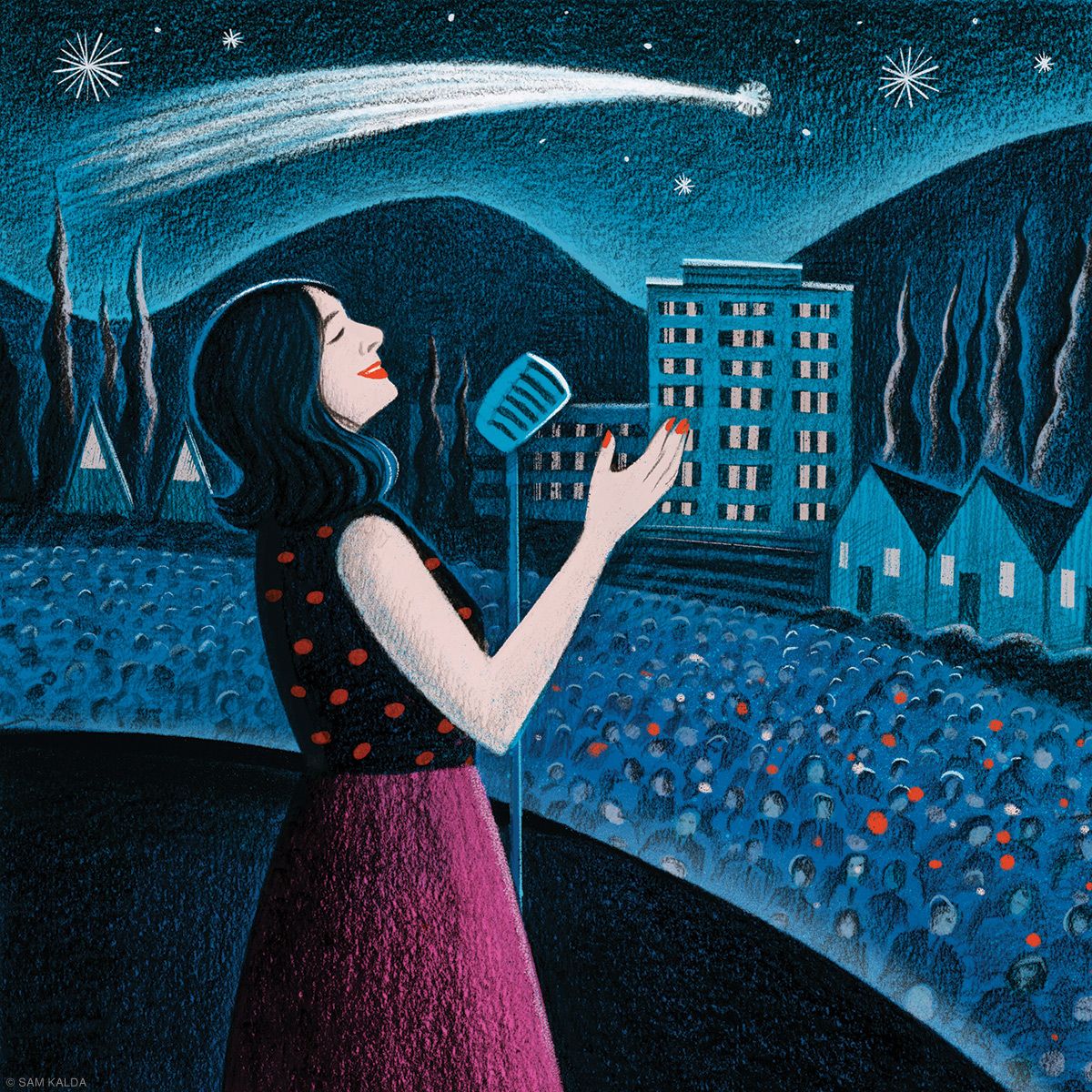
That’s how Jill Abramovitz C’93 describes to her audience Borscht Belt Serenade, the one-woman show she cocreated with former Penn classmate Gideon Evans C’93 that uses songs and slideshows to chronicle the rise and fall of what Evans calls a “phenomenon and juggernaut of American entertainment and history.”
The two veterans of the entertainment industry—Abramovitz is a Broadway and television actress, Evans a TV producer and podcast host—never had much of a personal connection to the popular summer resort region of New York’s Catskill Mountains known as the Borscht Belt, where Jewish families vacationed from the 1920s to 1960s. But, like many Jews, they loved the famous comedians and musicians that performed in the area’s iconic hotels and resorts—and understood their lasting cultural impact.
So when Evans saw a local news segment about the 2023 opening of the Borscht Belt Museum in Ellenville, New York, “I was just like, I have to be involved somehow with this museum.” His initial idea was to create a podcast similar to the one he had already done on legends in standup comedy. But after connecting with the president of the museum, “we brainstormed some ideas, and we hit on this idea of music.” He quickly reached out to Abramovitz—a friend since their time together in the Penn theater community in the early ’90s—to see if she’d join him in creating a musical show to be performed at the museum’s yearly festival in July 2024.
Despite her busy schedule, Abramovitz—who Evans regards as not just a great performer of Broadway musicals, but also a “prolific writer”—said yes right away.

“It’s almost like pleasing the ancestors, in a way,” Evans says, with Abramovitz laughing in agreement. “My dead mother is smiling somewhere.”
With the festival serving as a hard deadline, the two swiftly wrote the show, meeting at coffee shops in New York, where they both live, and over Zoom. They plotted Borscht Belt-era songs for Abramovitz to sing, enlisting a musical director to arrange the tunes. “Some of the songs you couldn’t find the sheet music anywhere,” Abramovitz notes. And in between the songs, they wrote a history lesson of the Borscht Belt, mixing in jokes and opportunities for audience interaction.
Their first performance of the show, at the aptly named Borscht Belt Fest 2024 in upstate New York, was a success, even though Abramovitz made it to the stage with mere minutes to spare after a flight cancellation forced her to drive all the way from St. Louis. (She had been in St. Louis for a Fiddler on the Roof production and is currently acting in a play called The Recipe, about Julia Child, at La Jolla Playhouse in southern California; Evans is the cohost of a podcast called Bad Elizabeth about notorious Elizabeths through history.) They’ve since put on Borscht Belt Serenade at other venues, including the Penn Club of New York this past November, and will return to the Borscht Belt Museum for a performance this May.
They now hope to take the show to other parts of the country, pointing out that Jewish Community Centers (JCCs), where they’ve already done a show, are perfect places to “celebrate Jewish culture” and partake in singalongs and musical trivia with knowledgeable audiences. But at the Penn Club, they were pleased to also see a lot of younger, non-Jewish alumni in the crowd, enjoying new material. “Even though the Borscht Belt is a Jewish story, it’s also an American story,” Evans says. “It was almost like Vegas or Branson—a center of entertainment in America. So I do think there is a draw even among non-Jews.”
“We don’t want to assume that [audience members] come in knowing anything and to make anyone feel alienated in any way,” adds Abramovitz, who sings renditions of popular songs from the 1920s like “My Yiddishe Mama” and “Makin’ Whoopee,” among others. “We want to bring them in and introduce them to this wonderful part of American history, while also acknowledging some of them already know a lot of it. So I think it’s a very welcoming show.”
This isn’t Abramovitz’s first foray into the Borscht Belt. The actress portrayed a worker at a Catskills resort in the Marvelous Mrs. Maisel, the television show which, along with the film Dirty Dancing, most famously depicted the “Yiddish Alps.” With hundreds of background people milling about on set in 1950s-era costumes, “I really felt like I was traveling into my own past,” says Abramovitz, whose grandparents were Holocaust survivors and whose mother’s first language growing up in New Jersey was Yiddish. Although her family “wasn’t fancy enough” to go to the Catskills and instead visited Jewish bungalow colonies in New Jersey, “what an experience it was to get to feel like you’ve time-traveled into something that influenced your own family,” she says. “It all feels so in my DNA, in my cells.”
Evans feels similarly, noting that “even though I don’t have a super close connection to that world, it feels like I do.” In addition to growing up steeped in Jewish culture—his grandfather, he says, was “probably one of the first people to start slicing lox” at a supermarket—he loved listening to prominent Jewish comedians like Mel Brooks and Carl Reiner, before getting into comedy himself as a producer for The Daily Show with Jon Stewart [“Profiles,” Jan|Feb 2012]. Evans admires Jewish entertainers like Sophie Tucker, Eddie Cantor, and the Barry Sisters, all of whom performed around the country and achieved mainstream success—but when “they went to the Catskills, it was almost like being home.” By retelling their stories now, at a moment in history when antisemitism is again on the rise, Evans hopes “having a show where you can be communal and sing songs and listen to songs that are just joyful, will make you think, I’m part of a community that’s pretty wonderful.”
Both Abramovitz and Evans feel nostalgic for those joyful Borscht Belt days, but “you can’t stop time moving forward,” says Evans. In the show, Abramovitz explains that the Borscht Belt’s decline came about partly due to shrinking restrictions on where Jews could vacation; the exclusion of Jews from many hotels and resorts from the late 19th century to the mid 20th century is what originally catalyzed the development of Jewish safe havens in the Catskills. (The rise of air conditioning also played a part by making sweltering cities like New York more bearable in the summer, as did the increasing accessibility of air travel.)
Intent on channeling both aspects of that bittersweet legacy, Abramovitz imparts a traditional Jewish expression of condolence for a loved one near the end of the show.
“May their memory be a blessing,” she says of the abandoned Catskills resorts, most of which didn’t make it past the ’70s. “And what better way to preserve a memory than through song.” —DZ