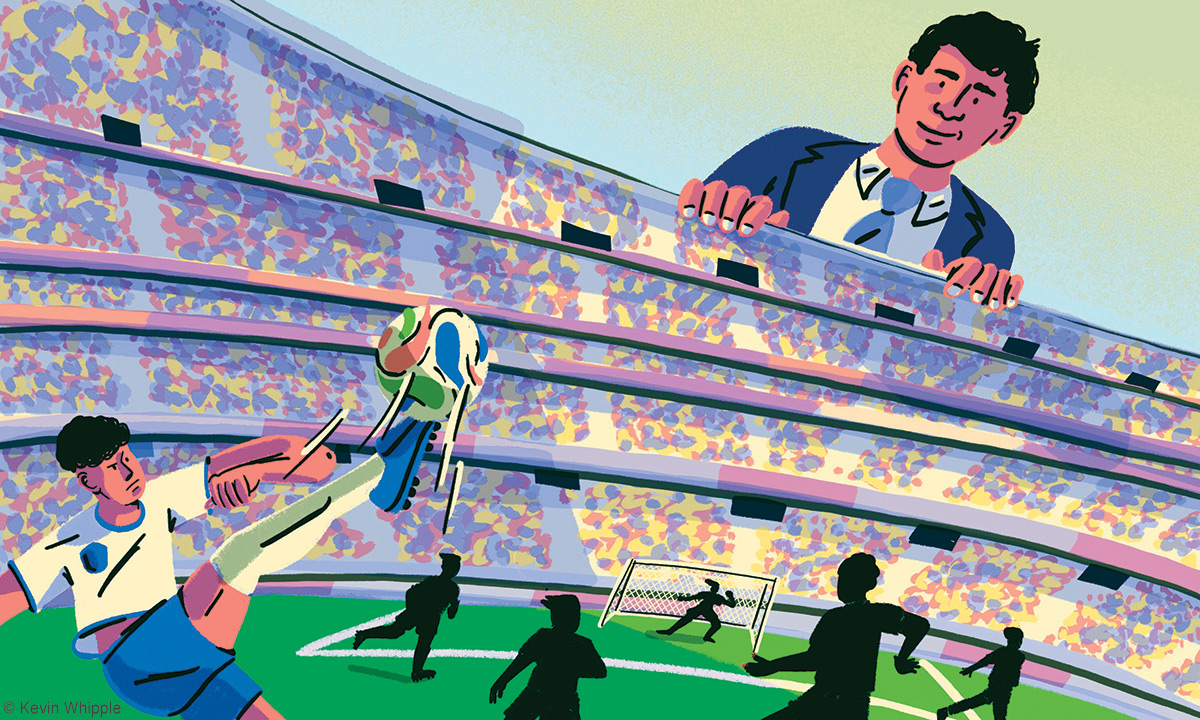
The CEO of the FIFA World Cup NYNJ Host Committee helped make this summer’s tournament a big success.
After 120 tense minutes of soccer, the referee blew the whistle at MetLife Stadium, declaring Spain the winner of the 2026 FIFA Men’s World Cup and officially drawing the tournament to a close.
Among those cheering in the crowd was Alex Lasry C’09, the CEO of the NYNJ Host Committee, the local organizing body responsible for logistics surrounding the eight matches played in East Rutherford, New Jersey.
During the 39 days of the expanded 48-team, 104-match tournament spanning cities across the United States, Mexico, and Canada, Lasry had a vitally important role at one of the marquee sites. In New York and New Jersey, he was in charge of safety and security, transportation to and from the stadium, and fan engagement for an event that brought billions of dollars of economic impact to the region. (Everything that happened inside the stadium, from the first-ever World Cup final halftime show to the controversial ticket sales currently under investigation by the attorneys general of New York and New Jersey, was run directly by FIFA and outside his purview.)
For the World Cup final on July 19, the culmination of the largest and highest-attended single-sport tournament in history, Lasry and his team worked with officials on a safety plan for President Donald Trump W’68 and other heads of state as they watched the game surrounded by 80,000 spectators.
Earlier in the World Cup, on June 13, he had to figure out what to do when nine buses transporting fans back from the Brazil–Morocco game at MetLife Stadium had to be abandoned in Manhattan during the New York Knicks championship celebrations, with some being set on fire and vandalized. “That was honestly probably the biggest thing we had to deal with,” he says. “It was scary but everyone was safe and fine, and we ended up giving the bus drivers a suite for the game as a thank you.”
Lasry’s committee also set up fan fests in some of New York City’s most iconic locations, including under the Brooklyn Bridge and at Rockefeller Center. For the final, he helped put together one of the world’s largest World Cup watch parties: 50,000 fans in Central Park.
“It’s probably the best job I’ve ever had,” says Lasry, which is a big statement considering he’s had some pretty good ones.
Lasry, who grew up in New York, knew he wanted to attend Penn from the moment he visited his older sister, Samantha Lasry C’07, during her freshman year. “I fell in love with the school and applied early,” he says.
He landed a single in the Quad, which gave him his own space but made it harder to make friends, so he tried a variety of sports. He thought he would join sprint football but only made it through one practice. “I went out one night for new student orientation and overslept for the next practice,” he recalls. “I was like, I don’t think this is for me.” He instead started showing up at the Pottruck Center for pickup basketball, where he ended up making most of his closest friends, and later played intramural basketball, winning a championship his senior year.
He joined Beta Theta Pi, which proved useful when he met his now-wife Lauren Markowitz Lasry C’09—who was friends with many of his fraternity brothers—at Smokey Joe’s. “I took a sip of a beer she had just ordered,” he says. “She thought it was funny, which was a good thing. I know it could have gone terribly.”
A political science major, Lasry interned at Senator Chuck Schumer’s office while still at Penn, finding “the energy and excitement of politics in DC to be super fun.” After graduation he returned to Washington, DC, for an internship in the Obama White House, working for senior advisor Valerie Jarrett from 2009 to 2011. He helped Joshua DuBois and Mike Strautmanis on the earliest stages of what became the My Brother’s Keeper initiative, which created communities for boys and young men of color. He also worked with actor Kal Penn, who was an associate director in the Office of Public Engagement and who taught at Penn in April 2009 (and who this summer joined Lasry at a World Cup game).
In 2012 Lasry went to NYU for business school and two years later joined the Milwaukee Bucks after his father, hedge fund manager Marc Lasry, purchased the NBA franchise. He spent the next 12 years there as a senior vice president, helping negotiate the public-private stadium partnership, developing the Deer District with a fully unionized, living-wage workforce, and leading Milwaukee’s successful bid for the 2020 Democratic National Convention. (It went primarily virtual because of the pandemic, but the effort helped the city land the Republican National Convention four years later.)
Lasry missed politics and in 2022 ran for a US Senate seat in Wisconsin (he ended up dropping out before the Democratic primary) before working in the Biden administration’s US Department of Commerce as deputy assistant secretary for travel and tourism. In that role, he helped expand the government’s visa interview capacity by more than one million appointments ahead of the World Cup and Olympics. That helped set the stage for his World Cup job—though when Tammy Murphy, the chair of the board of directors of the NYNJ Host Committee, called and asked him about it, he couldn’t believe it. “I thought at first they were asking me to buy tickets or a suite or something, to be like a sponsor,” he says. “Even when they said, ‘We’re looking for a CEO,’ I was like, ‘Oh great, I’m happy to get you some names.’”
One of the more challenging parts of his job was building a mobility plan after MetLife Stadium’s parking lots were repurposed for fan zones and security. Lasry and his team helped set up a shuttle system that moved 12,000 to 20,000 fans per game and worked with New Jersey Transit to expand capacity to 40,000 people per game. (There was an initial uproar over the train’s ticket prices, which were eventually reduced.)
With eight matches, he had the opportunity to improve plans as the tournament progressed. At an early game, he had each staff member talk to 20 fans to find out what was working and what wasn’t. “We kind of learned that our directional signs weren’t good enough, and people didn’t know where they were supposed to go,” he says. “We also figured out we didn’t have enough volunteers.”
There were certainly some job perks, particularly attending the games. “Morocco–Brazil, our first game, was a special one. My dad’s from Morocco, so having that was really, really special,” he says.
“Germany–Ecuador was super, super fun because Ecuador had to win to advance. And so seeing the elation and excitement from all the Ecuadorian fans and the team after the game was very meaningful.” In addition to the star-studded final featuring Argentina’s Lionel Messi, MetLife Stadium also twice hosted global superstars Kylian Mbappe of France and Erling Haaland of Norway, who captured the hearts of many fans during a stunning upset of Brazil.
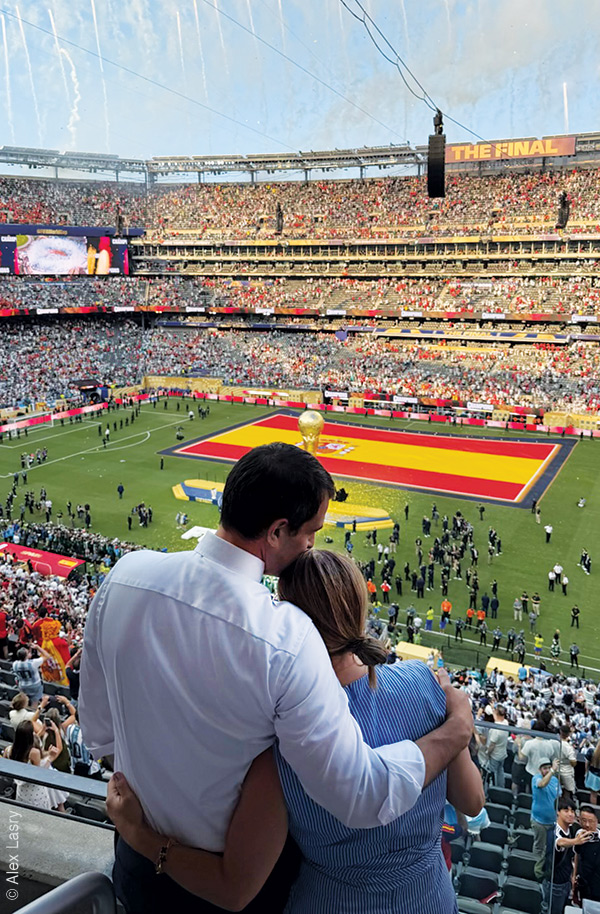
Soon Lasry will plot his next steps. But in the meantime, he is going to relax and reflect on the massive success of the world’s biggest sporting event. The day after the tournament ended, he posted a photo on Instagram of him and his wife at the World Cup final trophy celebration with a quote from Marvel’s Thanos: “I finally rest, and watch the sun rise on a grateful universe.”
—Alyson Krueger C’07