What one couple is building to empower people with Parkinson’s disease.
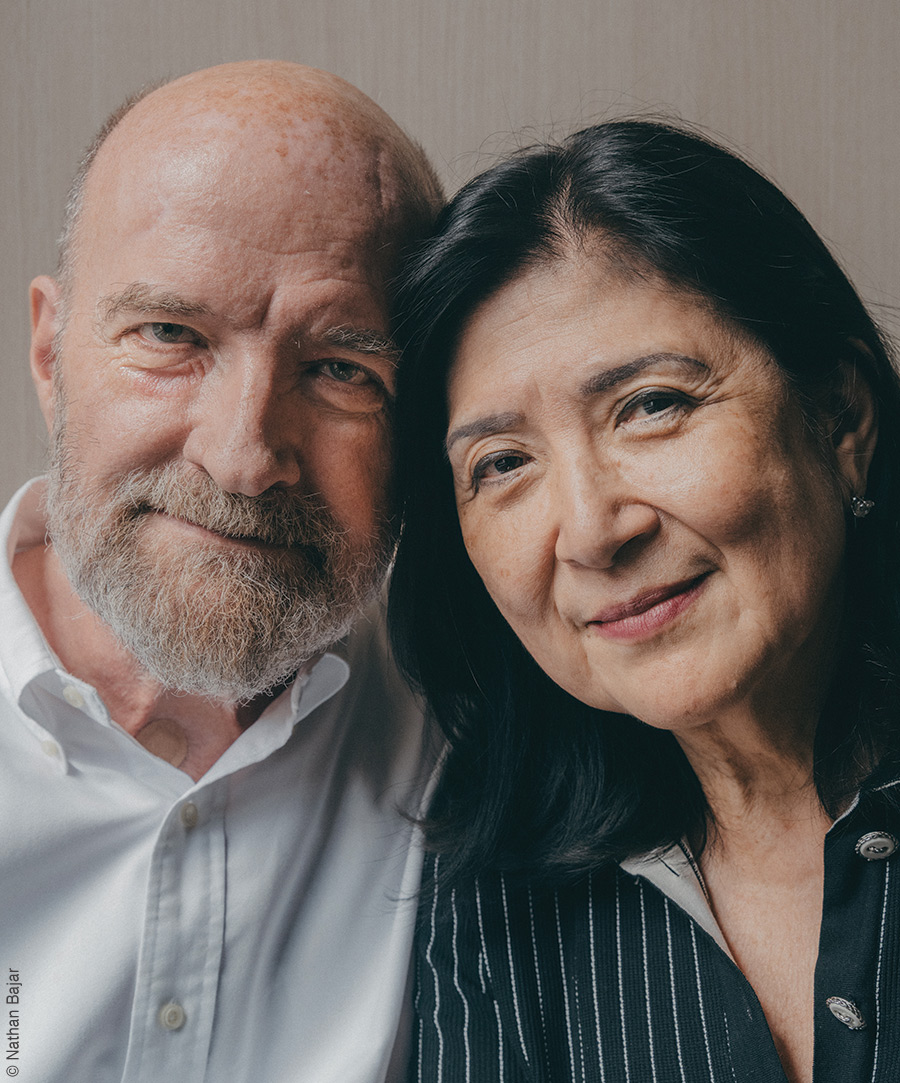
In 2018, Derek Bandeen and his wife Bonnie Miao Bandeen C’80 WG’85 were ready to start the next chapter of their lives.
Their four kids were out of the house and they had both recently retired after long, accomplished careers at Morgan Stanley. Derek had run the bank’s equity division globally and managed thousands of employees. Bonnie served as the global head of Asian equity and European emerging markets trading.
They were embarking on new adventures, such as enrolling as fellows at the Advanced Leadership Initiative at Harvard, where they lived in student housing and took classes to figure out how to contribute to the social good. “We had so much fun,” Bonnie says. “It felt like we were renaissance people who were just learning things.”
Then the diagnosis came: Parkinson’s disease.
After a tremor in Derek’s hand worsened, he sought out neurology specialists who delivered the news. “I didn’t even go with him, because we thought there were going to be more tests,” recalls Bonnie.
“It was such a hard thing to tell Bonnie,” says Derek, who was 55 at the time and feared that the disease promised “to fundamentally change the next 20 years of her life.”
Their lives changed in many ways one would expect. There were tests and doctor’s appointments and learning how to manage symptoms. But their lives also changed in an unexpected way: in February the couple opened the 6,800-square-foot Bandeen Center in midtown Manhattan. The first initiative of the Parkinson’s Wellness Foundation, a nonprofit they founded in 2024,the center is a place to help people with Parkinson’s at all stages of their journey to live full, active lives.
It offers workout classes including yoga, tai chai, and dance to improve physical skills like mobility and flexibility. There are support groups for mental health needs, nutritionists to help with diets, and voice therapy classes to strengthen vocal cords. There is an events space for putting on theatrical productions and a café for hanging out. “The idea is to have all the resources people with Parkinson’s need under one roof,” Bonnie says.
“I think the communal part has actually become the most important part,” says Derek. “I can’t tell you how much it helps just to talk to other people who have it.” He notes that most people with Parkinson’s don’t know anyone else with the disease, making it an extremely lonely condition. The center also offers lectures and support groups for spouses, caregivers, and children.
The process has been stimulating for both of them. “I want to build something where my husband can benefit, and Derek wants to build something that serves the greater good. So we are both fulfilling our interests,” Bonnie notes. “We want to build something that could help a lot of people with Parkinson’s.”
Bonnie was born in Taiwan into a half-Chinese, half-Korean family. Her father was a Shanghai refugee who fled the Communist takeover in 1949. Her mother was a survivor of the Korean War. She spent most of her childhood in Okinawa, a small island in Japan, where she taught herself English by watching The Sound of Music.
Seeking a challenge, she decided to enroll in an American school in Wallingford, Pennsylvania, for her senior year. “I wanted to show my parents I could get straight A’s in an American high school,” she says. Despite her guidance counselor’s declaration that she wasn’t Ivy League material—Bonnie scored in the high 700s on the math section of her SAT but only a 480 on the verbal part—she decided to apply to nearby Penn. She still isn’t quite sure how she got accepted. “Some really lucky streaks happened to me,” she says.
Her first year at Penn was rough. She tried to major in computer science, a subject she struggled with so much that she received a letter warning that she would be put on academic probation if her grades didn’t improve. “I told my kids about 10 years ago that I thought I should be a computer science major, and they nearly fell off their chairs laughing because they don’t see me as technologically competent,” she says. She pivoted to Asian studies and economics, subjects in which she excelled.
After graduation, she applied for jobs in international business. “Almost every job I applied to, I got an offer, I think because my background is so complicated,” she says. She ended up taking a position with Wells Fargo in San Francisco. She was there a few years before heading back to Wharton for her MBA.
After her second Penn graduation, she accepted a job at Morgan Stanley, where she met Derek (who had attended Duke for both his undergraduate degree and his MBA) on her first day of work. They were two of seven people in the same training class, and the cohort went out together several times a week. Despite being on opposite sides of the trading floor—she was on the international desk, he was in derivatives—they started dating and, within a year, decided to get married.
Derek was already in a senior position growing the derivatives business, and Bonnie was running Asian trading globally. She was the only woman on the floor and the only minority. “I can’t tell you how many times I wanted to cry in the bathroom,” she says. “It was very locker room. They shouted at you. I remember hearing guys making fun of me.” But she persevered and eventually earned their respect. “I clawed my way with hard work and diligence,” she says. “I even made a few friends who looked after me.”
In 1993, Morgan Stanley transferred them to London, where they ended up staying for two decades while raising four kids (all of whom attended Penn). Bonnie also stayed active with her alma mater, serving on Penn’s Board of Trustees from 2014 to 2024. She also served on Wharton’s Board of Advisors from 2016 to 2023 and remains on the Trustees’ Council of Penn Women.
After Derek’s Parkinson’s diagnosis, they tackled it as a team. Bonnie researched everything she could find on the disease, determining that exercise and diet were most important. In 2020, she joined the board of the Michael J. Fox Foundation, the world’s largest nonprofit funder of Parkinson’s disease research. That’s when she realized that most support for patients was focused on finding a cure rather than managing symptoms and improving quality of life.
They did find two wellness centers, one in Massachusetts and one in Ohio, but both were small operations and neither was geographically practical. “When we walked into the Cleveland one, Derek leaned over to me and said, ‘You know what, this is the first time I’ve been in a building where everyone has Parkinson’s,’” remembers Bonnie. That’s when they knew they had to open their own.
They returned to Harvard for a second fellowship in 2022, this time with a specific mission. They spent six months interviewing neurologists, speaking with patients, meeting with foundation CEOs, and assembling a 10-person volunteer committee. They raised $4.6 million from 71 friends to form the Parkinson’s Wellness Foundation to create a community for people affected by Parkinson’s, before signing a lease in midtown Manhattan for the Bandeen Center.
They decided to charge for membership and structure it like a gym: a day pass for $40, a monthly pass for $220, and a yearly pass for $2,000. The center also provides discounts to those who can’t afford the membership fees.
Though it has only been open for about six months, there are already expansion plans; the team has taken over an additional 2,200 square feet next door. Bonnie and Derek are keeping careful records of their research and decisions so that the model could be replicated elsewhere.
“If you look at Parkinson’s, it affects one percent of the population aged 50 and over,” Bonnie says. “It’s the fastest-growing neurodegenerative disease, so this is something that is going to need to grow.”
—Alyson Krueger C’07