
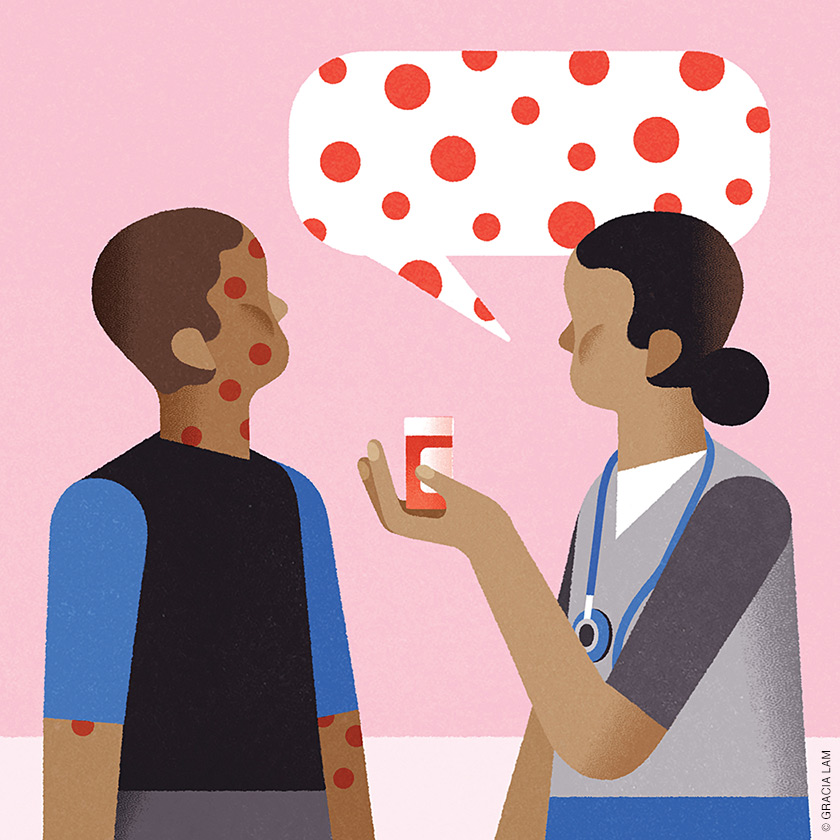
Pharmaceutical side effects often resist biological explanation. Sociology may hold the key to superior understanding—and better patient outcomes.
By Jason Schnittker
In an era when pharmaceutical drugs play an ever more central role in medical care, side effects remain a mystery. Virtually everyone will experience some side effects, even from over-the-counter medications, and any television viewer is aware of the many unintended consequences of prescription medications they might never take. Yet side effects are also routinely ignored—by doctors, patients, and regulators—partly because the mechanisms that cause them are so poorly understood. They cut across systems and symptoms—from headaches to gastrointestinal distress to pain—even though drugs usually have a specific therapeutic target far removed from those symptoms. And the link between drugs and adverse reactions can be tenuous. For some scientists, the side effects of medications are simply everyday symptoms that have been wrongly attributed to a drug, mostly by patients. After all, when most people experience numerous daily symptoms as a matter of course, it is easy to blame at least some of them on a pill you swallowed with breakfast.
So the medical profession tends to regard side effects by looking the other way. When the benefits of modern pharmaceuticals are so clear, why worry about the small risk of discomfort or, even better, a symptom that another drug can alleviate?
This is a mistake. Side effects might seem superficial—or even bizarre—but, after cost, they’re the leading reason why people stop taking medications. And side effects in and of themselves lead to physical and emotional suffering. Given evidence suggesting that vulnerability to side effects is on the rise within the US population, and that younger generations appear to be more susceptible than their predecessors, it is time to take side effects seriously.
Attempts to do so, however, encounter an immediate impediment: the standard tools for testing drugs. For the most part, scientists (quite understandably) seek to understand why drugs work as intended—not their many unintended consequences. The efficacy of a therapy is measured by how well it achieves a desired outcome, one that has been specified ahead of time; trials are not designed to determine whether a new drug systematically triggers a potentially unlimited list of symptoms, most of which could not be imagined in advance. (Researchers compile possible side effects by tracking adverse symptoms reported by patients, but these overlap significantly with symptoms that are already common in the general population, like back pain, fatigue, and headaches.) For that reason, it is often the case that the active ingredients of a pill can explain very little about the side effects people experience.
Yet this challenge need not defeat us, because there is strong evidence that when it comes to side effects, social factors matter at least as much, and arguably more, than any biological process. Duy Do Gr’20 and I have studied pharmaceutical side effects from a sociological perspective, using a variety of data sources, from data on pharmaceuticals and their active ingredients, to historical information on the drug approval process, to surveys of patients about their experiences.
The results are illuminating. People who are anxious and who have lost a sense of control over their lives report far more side effects. Our research shows that the side effects of the COVID-19 vaccine were much more common among people worried about the consequences of the pandemic, including that they might lose their job. The social process behind side effects means they sometimes emerge in surprising ways. Although older people take more medications and metabolize drugs more slowly, younger people often report more side effects, in part because younger cohorts report more anxiety. If we accept that young people are an especially anxious generation, we should also expect them to report more adverse drug events.
Patterns of this sort are premised on the nocebo effect, the flip side of the placebo. Nocebo effects occur when a consumer’s negative expectations or beliefs, rather than the active ingredient of a drug, produce negative outcomes. Like other studies, we find that the nocebo effect is powerful and not at all isolated. A 1963 review of over 60 published studies found that 23 percent of patients participating in the placebo arm of clinical trials reported side effects. More recently, a 2017 study published in Lancet found that muscle-related side effects—perhaps the most well-known side effects of cholesterol-lowering drugs—were apparent only when patients and their doctors knew they were taking statins. In other words, according to this study, muscle pain in statin treatment—no matter how severe and consequential—likely reflects a nocebo effect, the expectation of that precise side effect among people certain they are taking a drug that produces it.
This dynamic is found across many different drugs. A 2009 study in Cardiology reported that among men who are aware that betablockers can cause erectile dysfunction, the drug produces that side effect in 32 percent of cases, whereas among men unaware of this side effect, it occurs in only 13 percent. The list goes on, indicating that some of the most common side effects are likely nocebo effects and, indeed, precisely when a drug develops a reputation for side effects, those expectations can produce side effects in new patients.
But this is only the start. Recognizing the existence of the nocebo effect only opens the door to even more questions. Where do our expectations come from? Why do they spread? Who exactly experiences the nocebo effect? How can doctors predict who will react poorly to a treatment, and what should they do about it? One reason the nocebo effect is so common is that the many positive expectations that people hold regarding pharmaceuticals operate hand in hand with the intuition that a powerful drug must have side effects. Research has shown that the placebo effect has grown over time, likely because people have stronger expectations of, for instance, relief from pain or depression, producing a stronger placebo effect in trials of analgesics and antidepressants. These expectations are not off-base—pharmaceuticals have played a demonstrable role in improving life expectancy. But the nocebo effect has probably grown as well, precisely because people see a link between effective drugs and strong side effects. Yet a side effect is no less consequential when it is imagined than when it is real. The side effects reported by patients should be taken more seriously than they are. When side effects are ignored, they exert more influence, not less. Patients might prefer a different drug when they experience a side effect thought to be rare. When a physician fails to warn a patient about a side effect, that side effect is more concerning.
If we accept that side effects are common, consequential, and social in origin, we also need to grapple with the ethical dimensions of prescribing. Physicians are obligated to tell patients about any risks, but informing patients about specific side effects increases the risk of experiencing them. Patients who learn about myalgia are far more likely to report muscle pain. But ignorance is no solution, nor is withholding information. Evidence indicates that informing patients about the nocebo effect can help to reduce side effects (and patients generally understand how it might work). Knowing that psychological distress is correlated with side effects can also increase the value of treating mental illness. Ultimately the pharmaceutical armamentarium is better served when physicians play an active role in reducing side effects, when preparing their patients to both recognize the benefit and contextualize the risk.
Our healthcare system will soon need to grapple more seriously with the significance of side effects, whether we are prepared for it or not. The pharmaceutical industry continues to innovate, and new drugs rarely have fewer side effects than their predecessors. Regulatory agencies might be increasingly willing to accept risk, as when they endorse a “right to try.” Polypharmacy has grown, often involving combinations of drugs we know little about. We are certainly no less informed about side effects than we used to be. Pharmaceutical advertisements often contain far more information on side effects than the diseases they are intended to treat. People are aware of risk in a way they almost never were before. And, as with much else, Americans are increasingly getting their health information from social media and other non-expert sources.
Many side effects will defeat attempts to identify specific causes. But if we take the social ecology of side effects more seriously, we will be better able to use the drugs that we have. In this regard, the social production of side effects presents an opportunity. When side effects are produced by the social and psychological circumstances of patients, it is possible to reduce them by diminishing a patient’s anxiety or by changing the therapeutic approach. Taking side effects more seriously need not limit innovation. To the contrary, it might allow for a nimbler—even a more precise—clinical enterprise, one that puts efficacious drugs to good use.
Jason Schnittker is a Penn professor of sociology and the author, with Duy Do Gr’20, of Side Effects: The Social Ecology of Adverse Drug Reactions (Columbia University Press, 2026).