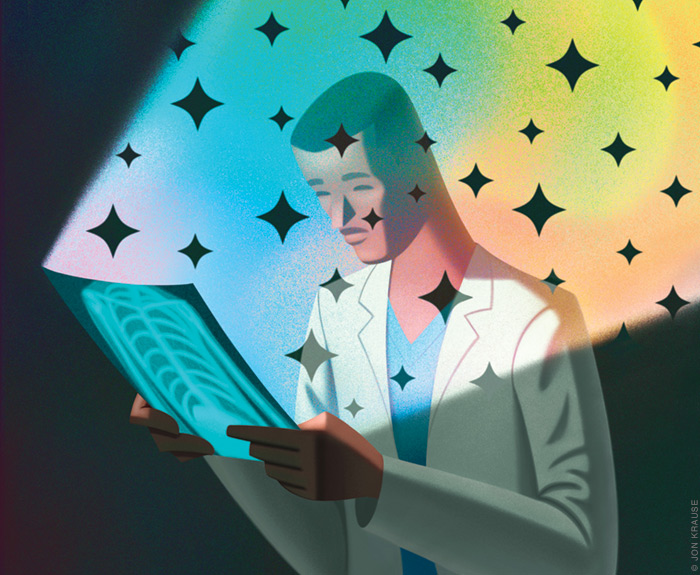
AI was supposed to make human radiologists obsolete. What’s taking so long?
By Robert Wachter
In 2016, Geoffrey Hinton, who would go on to win the 2024 Nobel Prize for his work on neural networks, was asked about the future of radiology. “If you work as a radiologist, you’re like the coyote that’s already over the edge of the cliff but hasn’t yet looked down, so he doesn’t realize there’s no ground underneath him,” Hinton said. “I think we should stop training radiologists now. It’s just completely obvious that within five years deep learning is going to do better than radiologists … we’ve got plenty of radiologists already.”
Hinton’s statement was the medical equivalent of Warren Buffett saying he was selling his radiology stock short. Whereas radiology residency programs had always been massively competitive, in 2020 only 41 percent of residency spots in America were filled by graduates of US medical schools, as students decided that a career in radiology was too risky a bet.
Then something funny happened. Radiology salaries remained sky-high, and students witnessed an explosion in radiology help wanted ads. By 2024, the number of US medical students choosing diagnostic radiology nearly doubled from 2020. If the field is in crisis today, it’s because of a nationwide shortage, not a surfeit, of radiologists.
As we speculate about the possibility of AI replacing humans in healthcare, the case of radiology is instructive. After all, there are few fields in medicine that seem as vulnerable to technological disruption as radiology, given that the field is largely about matching the appearance of a constellation of digital dots to a known database of diseases. Hinton’s miscalculation has much to teach us about the complexity of medicine, the forces that will likely shape (and slow) healthcare’s AI revolution, and why predictions that AI will replace physicians anytime soon should be served up with a generous dollop of skepticism.
I asked John Mongan, a University of California, San Francisco radiologist and AI expert, why he still had a job a decade after Hinton’s famous prediction. “The people who were making those predictions understood computer vision but didn’t really understand radiology,” he said. “They were writing algorithms that could tell you that an image was a dog or a sailboat. And they thought that radiology was just doing that for medical stuff. But radiology is a lot more than that.”
For one thing, the interpretation of an X-ray is often influenced by the patient’s history, which the radiologist might glean from reading the patient’s chart or talking to the clinician caring for the patient. I remember when the first cases of AIDS began cropping up in the early 1980s. At the time, the diagnosis was a death sentence, the most common fatal complication being a previously rare lung infection called Pneumocystis carinii pneumonia, or PCP. PCP could produce a chest X-ray that was floridly abnormal—but sometimes its radiologic appearance could be exceedingly subtle, more like a little smudge on a glass windowpane. In the latter cases, my chest radiologist would often say, “If you tell me this is a straight 50-year-old man, I’d say the X-ray is normal. If it’s a 26-year-old gay man, I’d say it’s PCP.” In other words, the exact same X-ray appearance could mean very different things, depending on the clinical context.
This constraint seems surmountable given AI’s rapid advancement in “reading” the medical record. But it turns out there are even more challenges to overcome on the road to useful and trustworthy AI in radiology.
Radiologists, for instance, frequently need to review old films. A complex case might require scanning dozens of prior images, often drawn from various imaging modalities (plain films, CT scans, MRIs, ultrasounds, etc.). To be truly constructive, a radiology AI tool would also need to review these past images, then compare those findings with the current image, assigning appropriate weights to differences in imaging type and varying time horizons. Consider a radiologist looking at a CT scan of a pancreatic mass, trying to determine if it’s cancer. She might need to compare the current scan to a finding on an ultrasound from four months ago, or an MRI from two years ago. Judging the progression over time, appropriately adjusting for the varying lag periods and the different study techniques, creates a series of daunting problems for AI-based solutions. (It’s tricky enough for experienced radiologists.)
An additional limitation is that today’s machine vision tools are mostly able to master only one diagnosis at a time. NYU bone radiologist Miriam Bredella recalled seeing a demo of an AI system designed to detect arm fractures. It correctly diagnosed a fracture of the radius, a bone in the forearm, but missed one an inch away in the thinner but longer ulna. “The system wasn’t trained on that,” the company representative confessed.
This specificity means that the radiology AI products currently on the market are generally one-trick ponies. What’s more, they’re typically sold separately, often by different companies, and each can run hospitals tens of thousands of dollars a year for subscriptions and operating costs. But human radiologists must look for all these things, as well as broken bones, signs of pneumonia, edema, cardiomegaly, pulmonary hypertension, enlarged lymph nodes—basically, all the diseases that can befall humans—simultaneously when they review a set of images, which markedly limits the value of these single-disease detectors.
Regulatory scrutiny is another large hurdle for digital radiology. While it remains a bit vague whether an AI-based readmission predictor or diagnosis-suggester needs regulatory approval, there’s no doubt that a radiology AI tool falls under the FDA’s jurisdiction, under the category of Software as a Medical Device (SaMD). The SaMD review introduces another bottleneck: Just as AI radiology tools typically address a single diagnosis, the current FDA approval process mirrors that specificity. This means that radiology AI companies are forced to seek one approval for pulmonary embolism detection, then another for pneumonia detection. Each approval takes many months to obtain and may cost more than $1 million per indication.
The real world of radiology—and medicine—is not that siloed; it’s messier and far more integrated. Take a patient with unexplained weight loss who gets a CT of the abdomen. There are literally hundreds of diagnoses that may be lurking, and we count on radiologists to see all of them. The need for each diagnosis to have its own bespoke algorithm and separate regulatory approval may be prudent at this stage of AI’s development but will significantly hinder the utility and adoption of artificial intelligence in radiology.
The AI tools currently having the biggest impact in radiology are screening programs, particularly for cancer, where the goal is straightforward: identify a single disease (e.g., spot a nodule suspicious for lung cancer on a chest CT or a density that might be a breast cancer on a mammogram). This kind of AI-enabled screening can be a huge help if it allows the radiologist to quickly endorse a negative result and move on to review positive or suspicious cases.
Even here, though, our enthusiasm needs to be tempered by AI’s long history of overpromising and underdelivering. In the 1990s, computer-assisted mammography tools were widely implemented after being endorsed by the FDA. Yet once the tools entered community practice, studies showed that their accuracy plummeted. What caused the problem? In the real world of clinical practice, the doctor—who lives in fear of overlooking a cancer—will likely recommend a biopsy after a positive reading by the AI, even if she would have judged the lesion to be benign in the absence of AI.
As more attention is paid to these human-AI interactions, things seem to be improving. In a 2023 Swedish study, roughly 80,000 women were randomized to receive either standard mammography—in which two human radiologists look at the scan to be sure they’re not missing anything—or an AI-assisted reading. In the latter group, the AI reviewed the scan first. If the mammogram looked benign to the AI, then a single radiologist signed off on the result. If there was anything suspicious, the scan entered the standard double-reading queue.
The results were impressive. The AI-assisted group identified 20 percent more cancers than the human radiologists operating without AI. The false positive rates were low in both groups. Notably, the overall workload of the radiologists went down by 44 percent in the AI-reading arm, a savings of nearly 37,000 radiologists’ readings, allowing patients to get their results faster and saving the health system a small fortune.
Given the never-ending volume of images in their work queues and the waning fear of Hintonian job replacement, you might think that radiologists would be clamoring for AI to help. But most radiologists don’t find that today’s tools—with the notable exception of the single-disease screeners—add to their efficiency. University of Pennsylvania radiologist Saurabh Jha GM’12 likens the current AI-assisted programs to a backseat driver who incessantly and annoyingly points out road hazards. “That’s not helpful,” said Jha. “If you want to help me drive, then you take over the driving so that I can sit back and relax.”
A 2024 study supported this view. Among 6,726 radiologists in China, those using AI experienced a burnout rate 20 percent higher than those who weren’t. The reasons were unclear—it’s possible that the AI created additional work by flagging more abnormalities to review, or that the AI, by taking the easy stuff off the radiologists’ plate, increased their cognitive load. Since it wasn’t a randomized trial, it’s also possible that the radiologists who were already burned out were the ones choosing to use AI. In any case, this is another thread in the tapestry of why replacing radiologists with AI is harder than it looks.
While the tools are clearly not good enough to replace radiologists today, the progress is unmistakable, and the potential is immense. I asked UCSF’s John Mongan what he’d tell his kids if they said they wanted to go into diagnostic radiology. “I think it’s a great field,” he said. “If you don’t like computers and you don’t want to learn anything about AI, you should really think twice about it. But if you are ready to embrace and be part of the revolution, there’s going to be plenty of work for human radiologists for the next several decades. … I don’t think the radiology department is going to turn into a data center with two people.”
In the end, I suspect that AI will have a central role in radiology, and that we’ll ultimately need fewer radiologists than we do now (or perhaps the same number to interpret far more imaging studies). Perhaps Geoff Hinton’s infamous 2016 warning about training new radiologists will prove prescient after all—though the job losses seem destined to arrive on a timeline measured in several decades rather than the handful of years that he predicted. Like many prophets of technological disruption—particularly in healthcare—Hinton may have correctly identified the destination while drastically underestimating the length and complexity of the journey.
Robert Wachter C’79 M’83 is a professor and chair of the Department of Medicine at the University of California, San Francisco. Excerpted from A Giant Leap: How AI Is Transforming Healthcare and What That Means for Our Future by Robert Wachter, MD, in agreement with Portfolio, an imprint of Penguin Publishing Group, a division of Penguin Random House LLC. Copyright © Robert Wachter, 2026.