
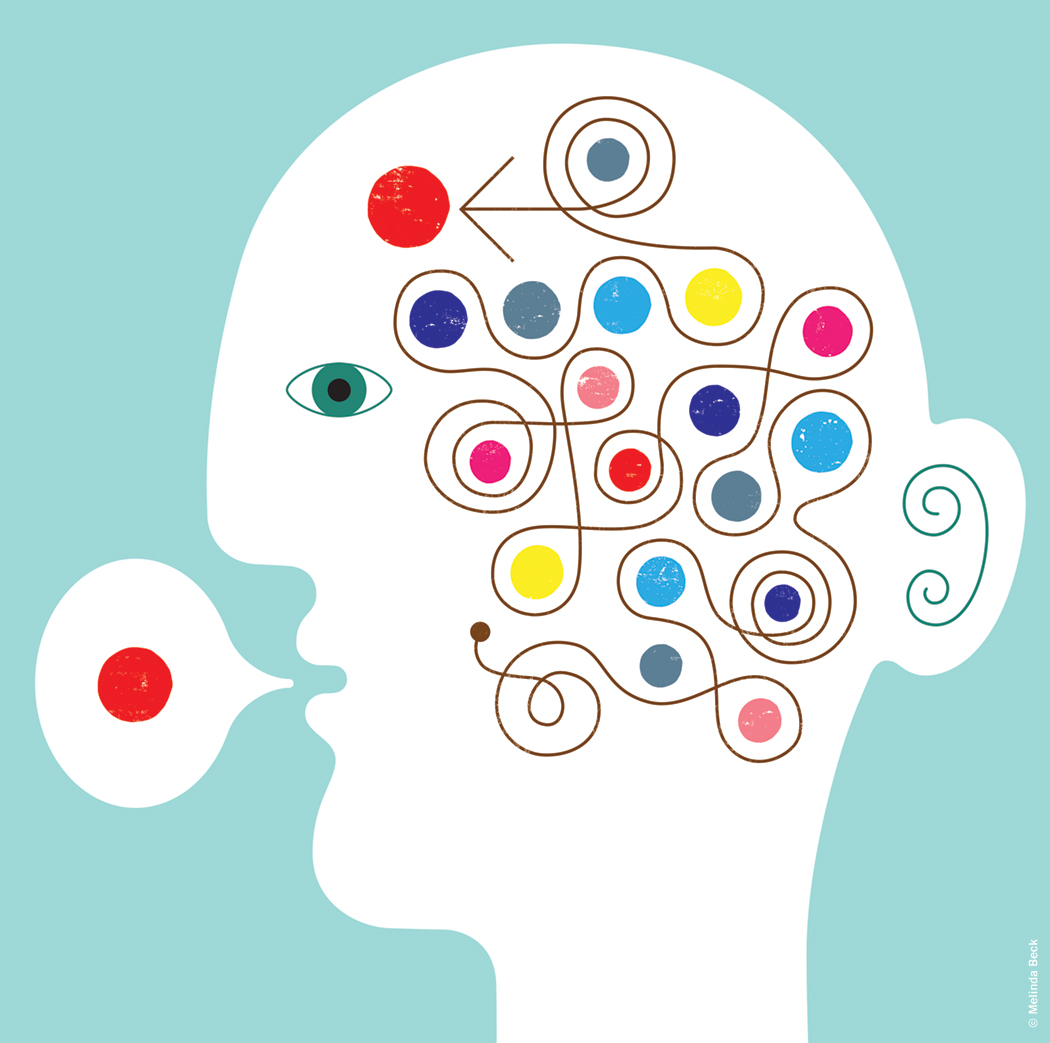
Annenberg professor Emily Falk’s new book probes the human brain’s value system.
For Emily Falk, who studies how we make choices, choosing to take a job at Penn was easy. For one thing, it meant coming home.
Falk grew up in the Delaware Valley, got interested in neuroscience as an undergraduate at Brown, and went on to earn a PhD at UCLA. As a professor at the University of Michigan, she visited Penn to give a talk that her parents attended. Soon after, she jumped at the chance to conduct her work in neuroscience at the Annenberg School for Communication.
Falk—a professor of communication, psychology, marketing and OID (Operations, Informatics, and Decisions), the vice dean of Annenberg, and the director of the Communication Neuroscience Lab—could probably explain just what her gray matter was doing when she made that decision. The workings of the brain in such circumstances are at the center of her new book, What We Value: The Neuroscience of Choice and Change, published in April by W. W. Norton.
Gazette contributor Daniel Akst C’78 spoke with Falk about her research, the brain’s “value system,” and the role of other people in the choices we make.
What can we learn from neuroscience about the choices we make and how we might make different ones?
When I started doing this research, I wanted to figure out how to help people make choices that would make them happier and healthier. I started out thinking about media campaigns—for example, how we might help motivate people to use more sunscreen and avoid skin cancer or to get more physical activity or quit smoking. When we measured activation in certain key brain systems, including the brain’s value system, the self-relevance system, and social-relevance system, it helped us predict who was going to change their behavior. What’s happening in these brain systems that might be useful for those of us who want to more deliberately make those kinds of changes? How do we coach people when we know that there are particular behaviors that would lengthen their life or make them happier?
Can you explain what you mean by the brain’s value system and how it influences the choices that we make?
When people think about values, some might think about moral values that we learn from our communities or our education or our religion. And some people might think about economics, like getting a deal online or at the store. Neuroscientists think about the output of the calculations that our brains are doing all day every day that produce our choices. First the value system identifies what we’re choosing between, and then calculates a subjective value based for each option on our past experiences, our current situation, our future goals. The value system is connected to other brain systems that help us enact the choice. After we make the choice, the value system keeps track of how it went. Did it go better or worse than I thought it would? That helps us learn and update for the future. We think: That cake was delicious. I should definitely get it again next time at this bakery. Or: Ugh, that was way too sweet. I’m never getting this again.
Do people really weigh things as you suggest?
A lot of the time we do make choices on automatic pilot. But we can also choose to focus on different aspects of a situation to change how we feel about it. If you’re looking for an apartment, maybe the realtor showed you something really awful to anchor you on that, and then they show you this apartment and it looks amazing. If they had taken you first to a beautiful penthouse that was out of your price range but had everything you’ve ever dreamed of, and then brought you to this place, it looks less appealing, right? But you can play that game too. You can decide the order in which you look at places and also who you take along with you. If you want to feel good about the cheaper apartment, go with an upbeat person who’ll appreciate the bay window and the beautiful light and who’ll chat with the neighbors to help you make friends. With that person, the place might look pretty good to you. But if you go with your friend who’s really skeptical and grumpy, that friend may say, Ugh, look at the ceiling. I can see some water damage. And, Oh, this place is right next to a busy road. It’s going to be super loud. You’d make a completely different valuation even though you’re standing in the same apartment. One thing I explore in the book is, how can we be more aware of these factors?
You mentioned the self-relevance system and the social-relevance system. What are those?
The self-relevance system makes calculations about who we are: Is this me or not me? One thing about the self-relevance system, though, is that it’s producing sort of a caricature of who we are in any given moment. And that sense that this is me or not me can play into what we prefer and the choices that we make in ways that shape who we are—but can also limit who we are. For example, we know that there are strong societal norms about what kind of people do certain jobs—when you think about an investment banker or a nurse, different images probably come to mind. As a result, our identities can shape what we anticipate the rewards of particular actions to be. Would I do well as an investment banker? Do people like me tend to be successful in that role? Also, when our brain thinks of something as “me,” it tends to think of it as good. “Not me” is more likely to be bad. Knowing this can be useful in thinking about decisions or goals that we have, both in playing to our strengths yet recognizing how we sometimes cling tightly to behaviors we’ve done in the past because they’re part of who we are. That can make it hard to let go of those behaviors in favor of things that might serve us better in the future. In the book, I describe strategies—like values affirmation—to help us feel more open to change.
Isn’t neuroscience a double-edged sword? It might help us make our preferred choices. But it might also help profit-seekers and politicians influence us in ways we might not prefer.
There are lots of tools that marketers and advertisers use to design and select messaging. Neuroscience can help people understand: What are the factors that shape decision making? What goes into the value calculation? Why do self-relevance social rewards feel so powerful and how does that play into our value calculations? Maybe neuroscience can help people think more purposefully about how they want to set up their environments or their communities or how they want to spend their time. I think it’s important for the knowledge to be in the public domain, so that people can be aware of what is possible. Just like any tool, these insights can be used for purposes that align with our values—or are counter to them. For example, I’m really concerned about the rise of AI, and the ability to make AI companions or customized platforms that will exert influence over people’s decisions. People typically are not aware of how strongly others influence them, and agents created by these tech companies, who have strong profit motives and don’t have our best interests at heart, will change our preferences and behaviors.
Your book focuses not just on how neuroscience helps us understand and guide our choices, but also how it helps us come together.
There’s a bunch of interesting neuroscience showing the ways that our media environments drive our brain responses. So for example, if you and I watch the same engaging movie clip, our brain responses are going to be synchronized in certain key regions. And that synchronized response is particularly true for people who see the world in similar ways. When friends watch movie clips, their brain responses are even more similar to each other than when strangers watch movie clips. Further, when different groups of people hear one backstory versus another one, the people who share the same backstory coming into the scan show synchronized brain responses with each other, but different brain responses from the people who are given an alternate backstory. That’s true listening to J. D. Salinger stories, which are not explicitly political, and when we scan the brains of Democrats and Republicans watching the exact same news clips. Democrats show synchronized responses with one another but not with Republicans and vice versa. I think this has to do with the assumptions we bring to the table going in.
What are the implications of that?
We need to be more curious about the backstories, about the assumptions that people are bringing in beforehand. Ask yourself where you are getting your ideas, who are the authors of books that you’ve read recently or podcasts that you’ve listened to. And if all those people are really similar to you, you will have a more limited toolkit when you’re trying to come up with new ways of approaching problems. We need to think about this so that we have some way of regaining a shared reality and identifying solutions to our biggest challenges.