Before departing for Stanford, Penn’s long-serving senior executive vice president looks back at 25 years of transformative progress—and ahead to a new era of uncertainty for higher education.
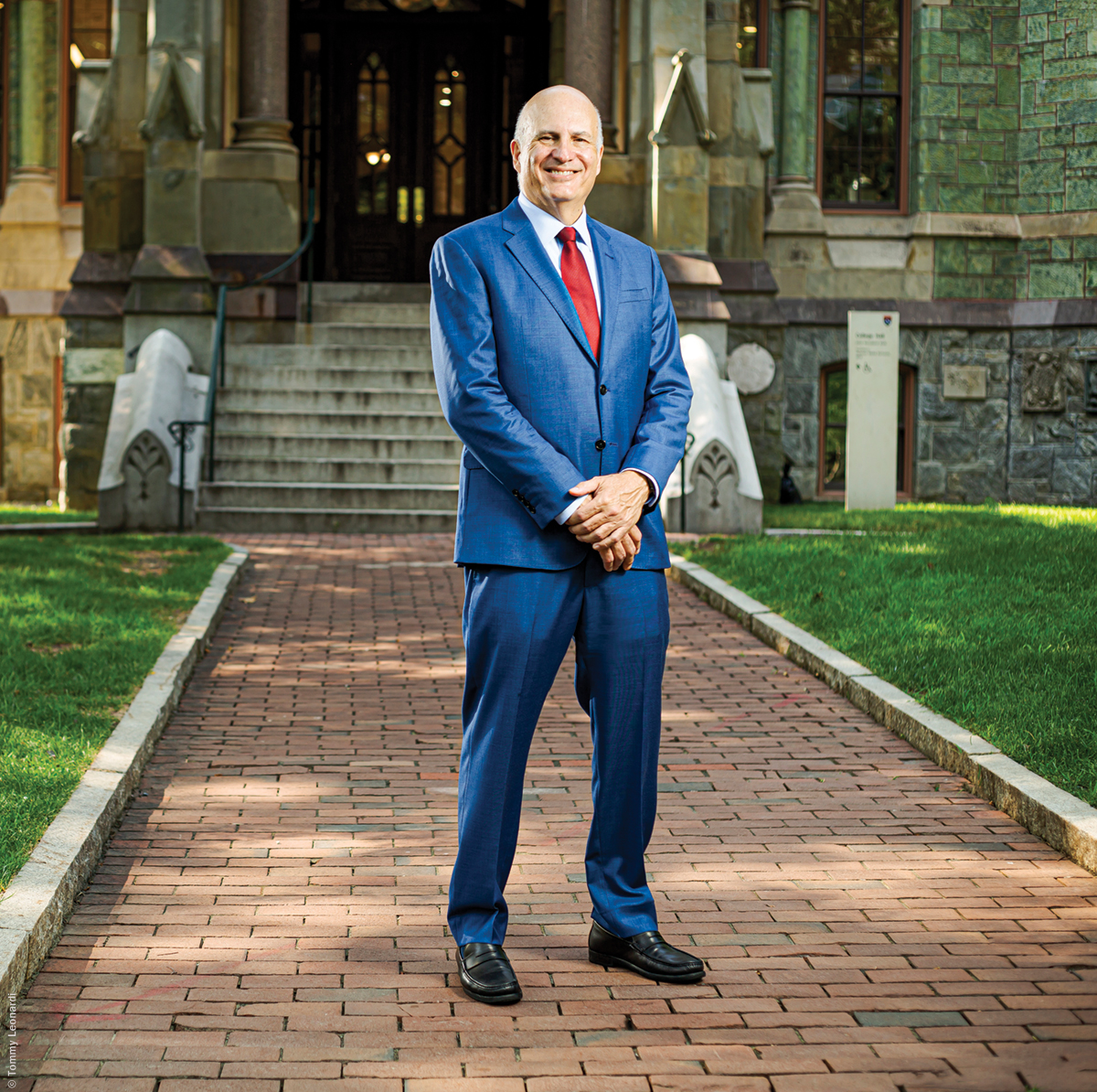
Craig Carnaroli W’85 remembers visiting Penn on a college road trip in the summer of 1980 with a friend whose mother pulled up at 34th and Chestnut Streets: “I saw the law school building, and that, to me, is what a university looked like,” he says. Had she picked a different spot nearby, he might instead have found himself facing a surface parking lot or a scruffy open field, legacies of the 1960s era of “urban renewal.” If the budding Wharton student had gotten a peek at the University’s books, he would have seen an institution emerging from years of shaky finances and deficit spending in the 1970s.
Conditions had improved considerably by the time Carnaroli returned to campus as the University’s vice president for finance and treasurer in 2000, after earning an MBA at Stanford in 1990 and working in finance for a decade at CS First Boston and Merrill Lynch.
Amid the controversies of his 12-year tenure in the 1980s and early 1990s (see this issue’s cover story), Penn President Sheldon Hackney Hon’93 had led a $1.47 billion fundraising campaign (then the largest in higher education) and restored the University’s financial health. Then Judith Rodin CW’66 Hon’04’s Agenda for Excellence had further accelerated Penn’s fundraising prowess, enhanced financial aid programs, and improved relationships with Penn’s neighbors in West Philadelphia during her decade in College Hall.
While at Merrill Lynch and after he came to Penn, Carnaroli worked with Rodin and then-Executive Vice President John Fry in unwinding the financial difficulties faced by the University of Pennsylvania Health System in the 1990s. Named executive vice president—which Carnaroli likens to the role of chief operating officer—by President Amy Gutmann Hon’22 in 2004, he has been a key figure in the physical transformation of Penn’s campus, the explosive growth of the endowment, and the ambitious expansion of financial aid over Gutmann’s tenure and beyond, as well as in navigating the turbulent current era in higher education.
In a June statement announcing that Carnaroli was leaving Penn to become Stanford University’s senior vice president for finance and administration, President J. Larry Jameson praised Carnaroli’s “financial stewardship”—pointing to the increase in Penn’s “net assets from $4.7 billion to $31.0 billion”—as well as his role in contending with disruptions like the financial crisis in 2008, the COVID-19 pandemic, and the University’s ongoing response to real and threatened federal funding cuts.
Carnaroli says he’d been thinking for a while about what his next chapter would be. “With some of the turmoil we’ve experienced over the last few years, I felt I could be kind of a source of stability through some of these leadership transitions,” he says. “I just felt like it was the right time for Penn and the right time for me to pursue something different.”
Though he got his MBA at Stanford and worked in California for a year or so, “I’ve definitely been more of an East Coast guy,” Carnaroli says. He grew up in East Lyme, Connecticut, before coming to Penn to study. One of his “many reasons to be thankful” for that decision—in addition to the “lifelong friendships that you have from being here”—was a work-study job with Wharton’s Robert Inman, now the Richard King Mellon Professor Emeritus of Finance, he says. “That, plus my evolving interest in economics and finance, really ignited my passion around how the public and private sectors work together” and helped lead to a “whole career dedicated to nonprofit management and finances.” He cites historians Walter Licht and Rick Beeman as other influences while a student and later an administrator.
A self-described “sports junkie,” Carnaroli also enjoyed reconnecting with the Palestra and Franklin Field as a staff member.
Taking on the role of EVP allowed him to broaden his perspective from finance and financial operations to the University’s overall management, Carnaroli says. That has included opportunities to engage with the broader community, such as by chairing the University City District board and supporting partnerships with groups focusing on workforce training, affordable housing, and other issues, as well as through Penn’s longstanding strategy for expanding local engagement through “where we hire, where we buy, who we use to construct. And I think that’s been very effective,” he says.
One memory “that sits with me most,” he says, was President Gutmann’s inaugural speech in Irvine Auditorium when she introduced the Penn Compact. “I just feel like that vision that she laid out really galvanized the community, and people wanted to identify with it. I always say it was quite prescient, what she wanted to emphasize” through the Compact’s goals of increasing access, integrating knowledge, and engaging locally and globally. “If you think about the issues we’ve dealt with over the last 20 years, those have been important ones.”
Another point of pride was helping get the long-gestating project to develop the former “postal lands” east of campus “to the finish line,” he says. That process had been started by Hackney and then-trustee chair Al Shoemaker W’60 Hon’95 in the 1980s and “greatly advanced” by Rodin, Fry, and then-senior vice president for facilities and real estate Omar Blaik, but it took until 2007 for Penn to acquire the land. That led to the creation of Penn Park and a planning process to develop Penn Connects—the University’s master plan for growth and an example of Gutmann’s “great vision,” Carnaroli says [“New Campus Dawning,” Sep|Oct 2006]. Led by him and Interim Provost Peter Conn initially and then Provost Ron Daniels, working with the design firm Sasaki as consultant, it involved “the deans, students, thought leaders, faculty, trustees, I mean, everyone. It was a great sign of people coming together.”
In addition to Penn Park, “we’ve seen an incredible transformation of the campus over the last 25 years, physically,” Carnaroli says. Through judicious use of land within Penn’s footprint, the University has “been able “to expand in academic areas like data science and energy science, and to offer housing for students on campus, as opposed to in the neighborhood,” he says, and “I think the quality of the architecture has been quite good.”
The elimination of loans from Penn’s financial aid packages in 2007 “was a big move on our part, a big resource commitment. But again, Amy said, ‘This is a priority,’ and she made it a priority in terms of fundraising,” he says—and the board of trustees and alumni community responded. “The statistic I love is that undergraduates who graduate with debt is down to 19 percent from 80 percent.”
From a financial perspective, “what you’re trying to do—which we were successful at—is to grow revenues other than tuition faster than inflation,” Carnaroli explains. “Philanthropy really took off under Judy and Amy. They raised the bar for what we needed to be raising annually.” And technology transfer “was completely transformed” under Gutmann’s leadership since the creation of the Penn Center for Innovation (PCI) [“Making Things Happen,” Jul|Aug 2024], with annual revenues now seven times what they were when PCI was launched. Similarly, the endowment contribution “used to be about eight percent of the academic budget. Now it’s close to 20 percent,” he says.
Traditionally, tuition has provided a third of revenue, sponsored research a third, and “everything else about a third,” Carnaroli adds. “That investment income and number—we’ve really strengthened the balance sheet over time.” But the growth of endowments at Penn and elsewhere has also contributed to mounting hostility toward higher education. “In the public sphere, [people say], ‘You have these big endowments, you don’t use enough of them,’” he says. “So, well, it was maybe a good financial strategy. We have to look at it maybe through a different prism of, is there a size at which, ‘Enough is enough?’”
Carnaroli is matter of fact about the University’s handling of the external crises of the 2008 financial meltdown and the COVID-19 pandemic. In the case of the former, Penn benefited from the fact that “our endowment at that time was not as illiquid as the other university endowments,” allowing the University to avoid cutting budgets and laying off staff as aggressively as some peer institutions. “But ultimately, the recovery of the mortgage crisis was much faster than people anticipated. So I think, again, we were prudent that we didn’t overreact. We kind of trimmed where we needed to trim.”
COVID presented a mixed picture in financial terms, involving both reduced operational expenses during lockdowns and lost revenues for things like housing and business services. “That being said, it was very disruptive to our educational and research missions as well as to how people work,” he says, with effects that continue to linger. “There’s a long tail to this, unfortunately.”
He’s more concerned about what the future may bring. Last March, he and Provost John L. Jackson Jr. announced a series of cost-containment efforts sparked by the incoming Trump administration’s actions against higher education [“Gazetteer,” May|Jun 2025].
“Whether we realize it or not, we’ve lived through a golden age of higher education,” Carnaroli says. “Think about it: low interest rates, booming endowments, high levels of philanthropy, incredible demand, growing programs, online degrees. It’s been quite a boom period, with very relatively low inflation,” which benefits the financial model for universities.
The version of the endowment tax that survived in the One Big Beautiful Bill Act passed in July “came in lower than we’ve been forecasting—but still an increase over what we pay today,” Carnaroli says. If recent decades have resembled a golden age, “I think we’re now in a very uncertain age.”
The federal government seems to be pivoting away from “the model that we’ve had back to Vannevar Bush,” whereby the government provides research funding and universities “help create the innovations that fuel the economy,” he adds. “I think this administration wants to be more selective about what they fund and what areas they want to fund, and that will have a hit.” A range of impacts—from limits on indirect-cost recovery to reduced research grants, falling international enrollments, student loan changes, and endowment taxes—is “just going to change the operating model of the university.”
He expects universities to emphasize becoming “leaner administratively,” while “dealing with an environment, unfortunately, where there’s a lot of mistrust of higher education.” That’s “a shame,” he says, “because there are so many great people in our community that are doing wonderful things. But people have very strong feelings. This is where social media [comes in]. Things get blown up more than they deserve.”
Carnaroli suggests that Penn “should be planning for the future to be different. Therefore, I think it’s an opportunity to rethink how we’re organized and how we operate.” Acknowledging that “I’m out of my lane here academically,” he suggests potential adjustments in “how we cluster people with common research interests” across different schools and departments to promote more collaboration and stretch fewer research dollars further.
“I think the pressures will not abate,” he adds. “Before any of this happened, people worried about the cost of tuition.” While in practice financial aid often reduces the net price—what students and families actually pay—well below the full tuition rate, “you’ve got that kind of angst in the environment. So rethinking the models of how we deliver education is prudent for university leadership.”
Looking ahead to his new role at Stanford, Carnaroli recognizes that “universities are all a little bit different” and that he’ll “need to learn that environment and how they operate.” But there’s one general principle he’ll bring with him. “I subscribe to the Aretha Franklin School of Management,” he says. “Everything is about R-E-S-P-E-C-T. I just believe that if you respect everyone and you show them respect, you’ll get that back.”
He’ll certainly take away “incredibly fond memories” from his time at Penn. The outreach from staff colleagues, faculty, and students since his announcement “has been overwhelming,” he says. “I’ve gotten more from Penn than I put in. It’s bittersweet. I mean, I love the place.” —JP