
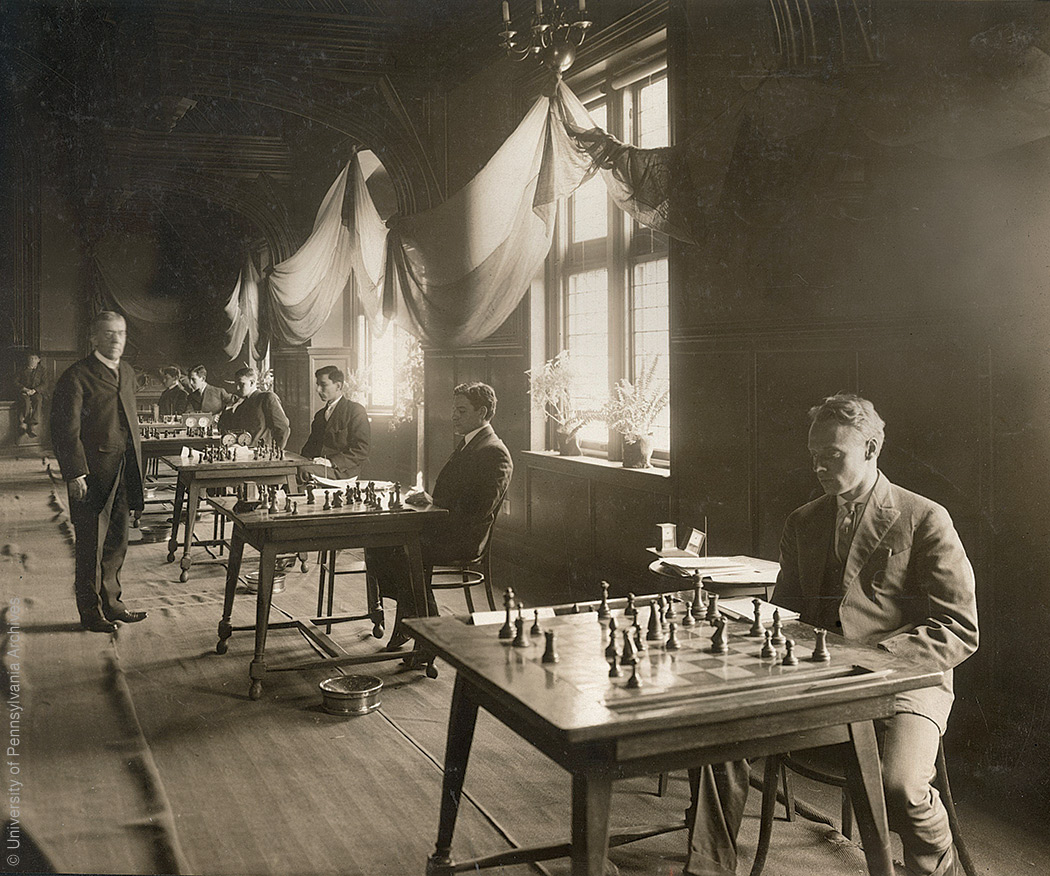
On February 8, 1908, the editors of Old Penn (this publication’s predecessor) lamented that “the condition of chess at the University is not at all what it should be.” Not only were the chess tables in Houston Hall taken up by checkers players, but many of the chess pieces left on the tables were “broken or carried off as souvenirs.”
But on March 21 of that year, the chess club became the center of attention as the eighth intercollegiate international cable chess tournament commenced in Houston Hall and Windsor Court Hotel in London, respectively. And the Americans—including Penn’s own William H. Hughes C1909 and Isaac Ash L1908—emerged victorious.
“Never has any chess match attracted quite the amount of national attention,” boasted The Daily Pennsylvanian (Oct. 1, 1908). An estimated 5,000 attendees watched at some point during the day at Houston Hall, while reports from London claimed an even larger audience there.
Players sat alone at tables, waiting for their international opponents to make their moves, which were conveyed over a transatlantic telegraph wire. A referee kept a close eye on each side, and the audience followed along in Houston Hall with large replicas of chess boards hung on the wall.
On one side of the Atlantic, students from Penn, Columbia, Princeton, and Harvard represented the United States; on the other, students from Cambridge and Oxford represented England.
Dimming the luster of victory somewhat for Penn’s contingent, Hughes lost to his opponent from Oxford and Ash’s match against a Cambridge student ended in a draw, while Columbia’s and Princeton’s players won their games. Still, the prize—a dark oak trophy bearing a bronze shield with the flags of both the US and Great Britain—was displayed in Houston Hall for a time before it went on to other schools. —NP