“The women simply gather, as if pulled by tide.”
By Mariam ElNaggar
Cairo moves long before anyone in the apartment does. The road between the Giza Zoo and Cairo University begins its day in motion—buses braking hard, students pouring through the gates, taxi drivers inventing lanes where none exist. The sound rises through six floors of concrete and humidity until it becomes a single, unbroken current: a kind of weather.
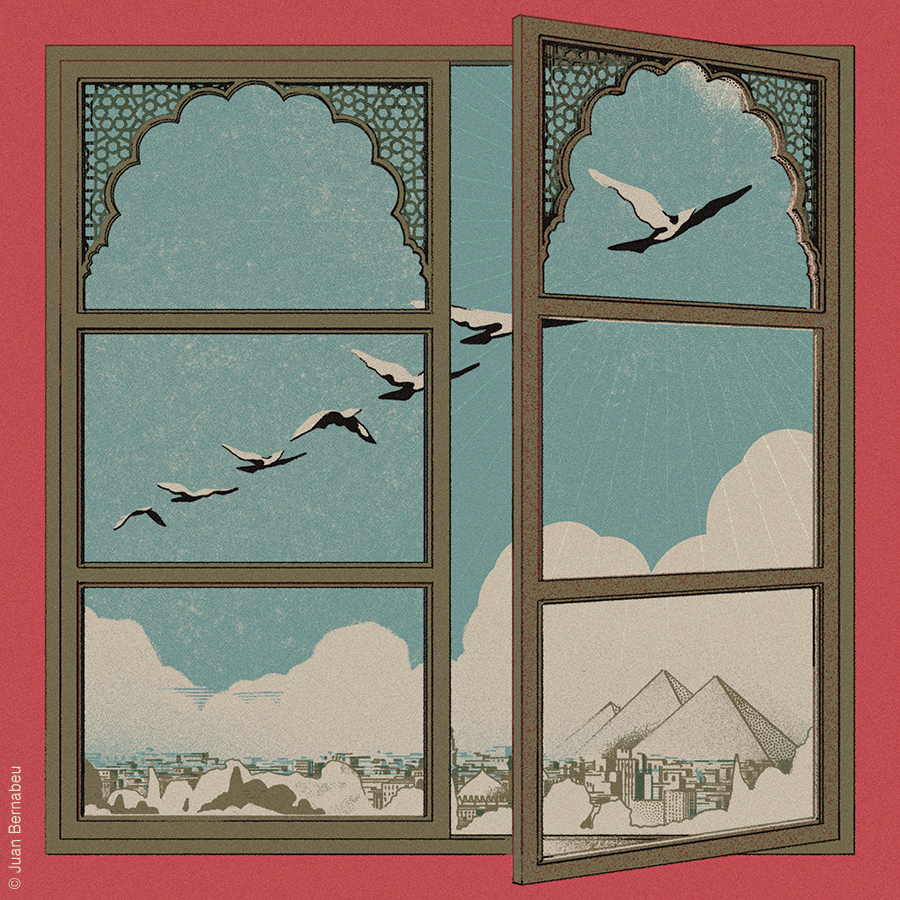
From my great-grandmother Seto’s window, where I am still small enough to stand on the sill, the zoo looks green enough to be another country. The gazelles move through it like a quiet rumor, their bodies taking the color of whatever light touches them—sand, haze, early morning dust. They lower their necks in unison, ears flicking. They never startle.
Inside the apartment, movement scales down. It becomes texture instead of volume: Seto’s slippers whispering across the tiles, the scrape of a metal chair, the click of a gas stove catching flame. Butter melting in a pan. Onions surrendering to heat.
There had always been a certain choreography to her days: rinse, fold, stir, pour, correct, rinse again. She never rushed. She never repeated herself.
The rhythm carried.
Across a hallway that never quite went dark, the two apartments met. My grandmother, Noussa, would sprinkle jasmine water on the tiles in the morning, and the scent would drift toward Seto’s door. The buttered onions would drift the other way.
By the time I was in middle school, Seto had begun to slow, and the entire family adjusted its movement to hers. The daughters, Noussa and Toota; the granddaughters, Iman, Ingy, Aya, and my mother Dina. They orbited around the apartment. They sat at her feet. They listened for the way she rose from a chair, for the way she cleared her throat, for the small shifts in breath that signaled something changing. These women moved with the loyalty of muscle memory, taught by decades of watching the oldest woman in the family hold everyone together.
Ever since her husband died young, Seto had been the one who knew how to run a house, how to comfort a child, how to negotiate a sibling dispute without taking a side. She raised her children and half her grandchildren. Ingy, who lived in America, cried every time she left Cairo, because leaving meant stepping out of Seto’s orbit.
Movement fills the apartment on the day she begins to die. It isn’t panic. Just the dense, deliberate motion of people who know what to do but wish they didn’t have to do it. The great-grandchildren stand where they can. Some lean against walls. Some count breaths. At 15, my hands don’t know where to go. My grandfather, the doctor, moves once to bend down, lift her eyelid, look for the last thing he knows how to look for. When he straightens, no one asks him what he’s seen. The answer is already moving through the room. Someone cries. Someone sits. Someone else leans into the doorway the way you lean into bad weather.
The body is carried into the bedroom. No one asks who will do the washing. The women simply gather, as if pulled by tide. They were taught by women who were taught by women who were taught by women, a knowledge passed hand to hand the way water passes through fingers.
I follow without thinking.
The room is warm, Cairo’s heat stored in the walls like a secret. I lean back against them. The water is cold enough to change the air. My mother pours the first pitcher. The water runs over Seto’s shoulder and makes its own decisions from there. Down the arm. Along the ribs. Into the curve of the stomach. The women adjust their rhythm to the water’s. One supports the head. One washes the feet. One folds a towel. When the pitcher empties, another hand refills it. No one speaks.
They are a machine made of women and water.
The water does not pause for breath. Her body does not shiver or respond. This is the kind of cold that does not belong to weather. The women’s hands continue anyway. Circles on her arms, slow and certain. Circles on her back. Circles around her ankles. This is not cleaning. It is returning.
When they braid her hair, her head is lifted with such care that the air in the room seems to hold its own breath. The braid is tight, a final act of order beyond ceremony and time. The kafan is unfolded. Cloth passes beneath her, around her, over her, the way you would wrap something valuable for a long journey. The women do not collide. Their hands find each other without searching.
Outside the window, the zoo continues as if houses do not lose their centers, as if whole families do not change shape in a single afternoon. A bus shrieks through the intersection. Students laugh loudly enough to be heard six floors up. The gazelles lower their necks to grass.
After her death, the apartment moves differently. Footsteps echo more sharply. Conversations run shorter. Noussa’s laugh shrinks, becoming something off-balance. When a Sudanese family moves into Seto’s apartment, new rhythms enter the hallway: incense instead of butter, different feet on the floor, a different way of closing the kitchen cabinets. The hallway absorbs it the way walls absorb humidity. But movement is stubborn. It remembers.
Sometimes, when I visit, I stand at Noussa’s window and look toward the zoo. I press my forehead to the glass. It’s cool, the way Seto’s tea glasses never were. I watch everything that hasn’t stopped yet: the cars, the air, the faint sway of trees under heat. Somewhere below, a giraffe lifts its head above the treeline; the gazelles continue grazing.
And something in me keeps moving toward the moment in that warm bedroom—the sound of pouring, the women’s hands working in circles, the body gleaming with water. The last movement she could not make for herself, made for her by the women she raised.
Mariam ElNaggar C’26 graduated in May. This essay won the grand prize in the Gazette’s 2026 annual undergraduate essay contest.