The Wolf Humanities Center interrogates the complexities of truth.
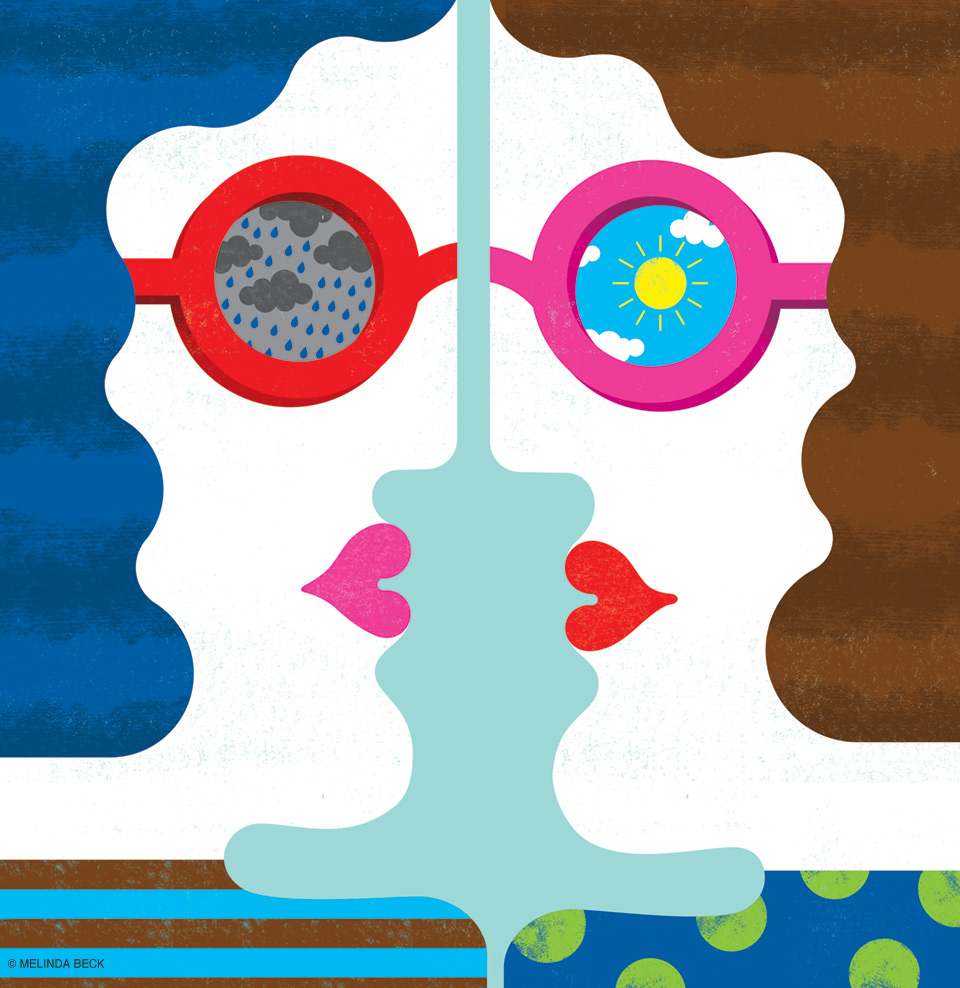
Julia Verkholantsev, topic director of the 2025–26 Wolf Humanities Center Forum on Truth, has an improbable confession: “Truth,” she says in an interview, “is a little bit boring. I’m actually very interested in everything that is opposed to truth.”
In a manifesto describing the forum, Verkholantsev, associate professor of Russian and East European Studies at Penn, calls the notion of truth “elusive and intricately complex,” as well as “inextricably intertwined with its numerous conceptual opposites: falsehood, dishonesty, error, delusion, misinformation, illusion, and self-deception.” That perspective inspired the forum’s September conference, “The Edges of Truth: Secrecy, Artifice, and the Limits of Knowledge,” which delved into practices such as astrology, cryptography, and forgery.
Each year the Wolf Humanities Center Forum explores a broad, seemingly amorphous subject through talks, films, and other events, as well as research fellowships for faculty, postdocs, and students. Recent topics have included Revolution, Heritage, Migration and, in 2024–25, the more elliptical Keywords. All events are free and open to the public; many are livestreamed and recorded.
Along with the September conference and a fall film discussion series, the Forum on Truth sponsored an October lecture on “Truth and the Novel,” by the Pulitzer Prize-winning historical novelist Geraldine Brooks, and “Ukraine and Russia: Writing History in the Time of War,” a November panel featuring historians of the two nations. Slated for the spring semester are “The Truth about Sign Language Acquisition” (February 11, in collaboration with Penn’s ASL Program), and “Make It Look Real” (a March 18 film screening and discussion in collaboration with the Penn Museum).
Verkholantsev says she first proposed Truth as a forum subject in 2016, after that year’s presidential election. One inspiration was her research into etymology, which she describes as a branch of ancient philosophical thought “based on the belief that language preserves the true meanings of words.” She had a political motivation as well. “I was on the cutting edge,” she says. “Back then, no one was talking about misinformation, disinformation, fake news.”
The idea didn’t get traction at the time. But Verkholantsev went on to serve as Undergraduate Humanities Forum Director, helping undergraduates pursue research projects. And by the time the topic of Truth resurfaced in conversations at the center, she had an entirely different take. “None of what really motivated me back then motivates me anymore,” she says. “I think there’s enough conversation about misinformation and disinformation. We are caught up in this presentism, and we don’t have a moment of reflection. I wanted to step back into history.”
In fields such as law, politics, and religion, Verkholantsev argues, truth is “functional”; it has applications. By contrast, “the strength and the power of the humanities is in approaching [the topic] as something that is not easily defined. This is what the humanities are good for: They teach people tolerance of ambiguity. I wanted to put truth through this test.”
In developing the program, she “was obsessed with finding someone who can talk about historical fiction.” Part of Geraldine Brooks’s allure was that she had first been a journalist, including a stint as Mideast correspondent for the Wall Street Journal. “I was interested in how she can talk about the tension between fact and fiction,” Verkholantsev says.
More than 100 people filled the Penn Museum’s Widener Lecture Hall to hear Brooks deliver the Dr. S.T. Lee Distinguished Lecture in the Humanities, touching on both her journalistic career and methods as a historical novelist.
In searching for a book idea, Brooks said she looks “for the thing that actually happened in the past that, if you made it up, nobody would believe it.” Examples include an English village’s choice to quarantine itself during the bubonic plague, which inspired Year of Wonders (2001), and the tale of the first Native American boy to attend Harvard, recounted in Caleb’s Crossing (2011). “I’m intrigued by these stories that are true but improbable,” Brooks said.
Knowing too much about the history can actually be an impediment, she argued: “If Caleb had left us a diary of his experience, there’d be no room in that story for a novelist’s imagination.” Brooks nevertheless struggles to imbue her novels with accurate historical detail. However, she said that empathy and a knowledge of human nature are more important. “We put ourselves in somebody else’s shoes,” she said. “We empathize. We imagine.”
In her Civil War novel, March (2005), about the father in Louisa May Alcott’s Little Women, Brooks applied what she had learned about war’s devastation as a foreign correspondent. She had seen attacks in which “teenage Iranians rolled themselves into the guns of teenage Iraqis and ended up mashed into the sand. So, modern weapons, Civil War weapons. The effect on the body is the same, the fear is the same. Human emotions are what shape consciousness.
“And that is where I look for the truth,” Brooks said. “You can move the furniture as much as you like. But the strong emotions are the things that shape us. And they, I believe, don’t change.”
On November 19, Benjamin Nathans, the University’s Alan Charles Kors Endowed Term Professor, served as an interlocutor to Harvard professor Serhii Plokhy, in a wide-ranging discussion of the challenges of writing the contemporary history of Russia and Ukraine.
While not exactly Monday morning quarterbacks, usually historians “already know how the game has ended,” “who are the winners,” “who are the losers,” Plokhy said. Not so in the case of the current war between Russia and Ukraine. Other challenges, he said, have been the prevalence of misinformation and the unavailability of archival materials. One compensation has been the ability to draw on contemporaneous social media postings.
Plokhy—who has written multiple books on the war and cochairs the Ukrainian History Global Initiative—said he first learned about the Russian invasion from a sister in Ukraine, and he makes no claim to being a detached observer. “You can’t stay outside of what is happening,” he said. “I am very clearly taking a particular side. I want not just to write history—I want to influence it.”
His models, he said, are historians of World War II, many of whom took “a very clear moral position.” He added: “My position on this war that I have been writing on is very clear, it’s very personal. It’s very clear who is the aggressor. It’s very clear who is the victim. Once I really identified my position, then the task was to turn all those emotions into the best and the most convincing work that I can write.”
Future historians may critique his version of the truth by “trying to show how limited my source base was, how biased I was, how I didn’t cover this and didn’t cover that,” Plokhy said. “Because apart from real problems,” that is “how historiography works: You have to find a niche for yourself and then say something that others didn’t say. It’s almost guaranteed.”
—Julia M. Klein