Why a high school English teacher became a dance studio entrepreneur.
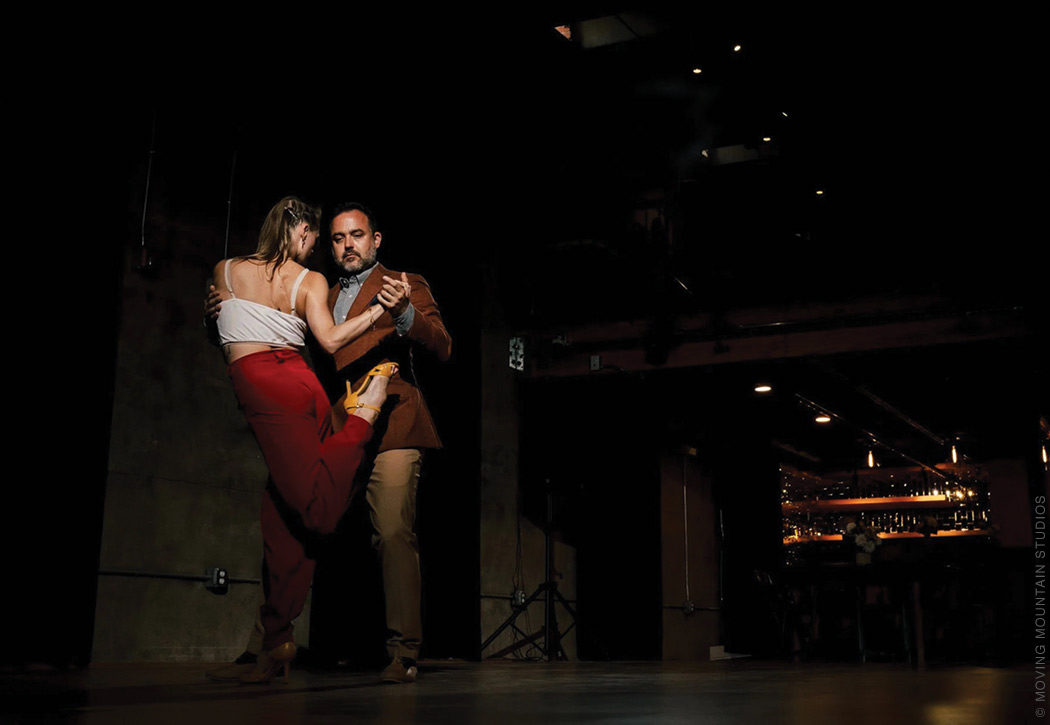
On the first Sunday of every month, people in Charlotte, North Carolina—some of whom recently immigrated to the city from all over the world—gather at The Long Room, an events venue and tango club in the heart of the city.
They drink coffee, eat bacon and hash browns, and spend the day dancing with an instructor and with each other. The event, which attracts up to 70 people, has become so well known that participants have traveled from as far as Washington, DC, and Atlanta to be a part of it.
With the program now in its second year, not only is the crowd becoming proficient at tango, but they are also forming genuine friendships and building community.
“You know, some people go to church on Sundays,” says Matthew Seneca C’99, the club’s owner. “And then some people come to tango.”
Seneca believes the dance parties are an antidote to loneliness—something he’s experienced firsthand since discovering a passion for dance at Penn.
When Seneca first arrived at the University, he thought he wanted to be an actor. He grew up in Madison, New Jersey, where he had starred in high school productions of South Pacific and The Diary of Anne Frank. He considered attending an acting conservatory but ultimately chose a more well-rounded academic path. “I was really attracted to the vibrancy and life of Penn,” he says. “It started when I visited as a high school senior. I just fell in love with Locust Walk and all the different student groups advertising their shows, their projects, their plays.”
Seneca became involved in theater at Penn but discovered his passion for dancing the summer before his senior year. A swing band was playing on campus across from the Button, and a young woman asked him to be her partner. He loved it so much that he signed up for a swing dance class that summer. During his senior year he joined a new swing dance club called the West Philly Swingers that met in the basement of Hill House. “Swing dancing became my entire social life,” he says. “It was wonderful. I met my first serious girlfriend through swing dancing.”
For Seneca, dancing was his hobby for the next 10 years. Professionally, after college, he worked as an administrative assistant to the executive director of the Resident Chorus of the Philadelphia Orchestra, where he did everything from bookkeeping to grant writing to box office work. “I learned about the structure of nonprofit organizations,” he says. “It was also so fun to be embedded in the classical music scene of Philadelphia at the time.”
In 2007, he decided to transition into education. “It was a good intersection of skills I knew I would be good at, including creative writing and theater.” After attending the graduate school of education at Temple University, he moved to Charlotte, a rapidly growing city that was in desperate need of teachers. “Over the phone I was able to get a very good job at a big public high school teaching English,” he says.
Charlotte had only one drawback: very little swing dancing. So he decided to try a new style that was popular in the city: the Argentine tango. He began training under an instructor from Argentina and was soon traveling to tango festivals around the world and to Buenos Aires to study more deeply. “I was dancing in the great dance halls of Argentina and taking classes and workshops from high-level dancers,” he says. “I just spent a long time learning the dance.” By the time the pandemic hit, he was teaching tango classes himself.
During the pandemic, he burned out on high school teaching. “I reached a point where I felt like I was no longer progressing in my career,” he says. “I was teaching AP English. I had the schedule I wanted. It was just rinse and repeat, and I was really having a self-crisis.” He resigned and focused on teaching dance full time, first virtually, and then from a small studio once in-person events resumed.
In 2023, he purchased a 2,800-square-foot space that had previously been the offices of a real estate company. He had a vision: Why not turn it into a dance school and community hub? He approached Sarah Harkins, a former principal ballerina with Charlotte Ballet who was also teaching dance, about partnering.
The duo renovated the space, which already had a viewing balcony and outside courtyard, and installed a stage area, theater lighting, and a catering kitchen.
Now, the venue earns much of its revenue by renting to different groups, both artistic and corporate, looking to host events. “We have this lovely little area that can be a dressing room or a VIP space,” he says. “A small catering business is about to do a five-course dinner here. We had a big EDM DJ dance party the other day.”
The venue was booked every day in December, and Seneca is now pursuing his MBA at the University of North Carolina at Charlotte so he can focus more on the business side.
But at its core, the space is a home for tango. It houses Seneca’s tango school, Tango CLT, which hosts the monthly Sunday brunch party. It also offers tango classes taught by locals and visiting instructors, and a weekly Wednesday night dance party for people who want to unwind after work.
Seneca loves how the space attracts people from all nationalities and backgrounds. “Tango is the dance of immigrants,” he says. “It started in Buenos Aires, which was a port city. Over many generations you had the Spanish, enslaved people brought there, and then big influxes of German and Italian immigrants.”
“Everyone can dance tango,” he adds. “And I know it makes people happy.”
—Alyson Krueger C’07