“I was likely the only woman large animal vet in Utah, and I still had a lot to prove.”
By Linda Rhodes
It was late on a Thursday afternoon in 1979 when my office phone rang.
“Hey Dr. Rhodes, it’s Jeb here.” I couldn’t place the name.
“Jeb? Are you at the dairy?”
“No ma’am. I’m down at the bull barn. Can’t find Doc Nelson.”
Oh, right. That Jeb. “What’s up?”
“You gotta find him, and he needs to come RIGHT NOW! We got a bull down here that is bleeding mighty bad.” I could hear the panic in his voice.
“Jeb, listen, Doc Nelson is out of town. What’s happening down there?”
I heard him groan, “Okay, then, you come. Can’t talk. Gotta get out there. Honk when you pull up, and I’ll let you in.” He hung up.
Jeb and I had met briefly a few months into my large animal internship at Utah State University in Logan, Utah. He was in charge of the dairy bull stud business. As a brand-new graduate of Penn’s School of Veterinary Medicine, class of 1978, I was on call for emergencies when my boss, Dr. Lamar Nelson, wasn’t around. But the staff was still not used to a woman veterinarian. In fact, I was likely the only woman large animal vet in the whole state and I still had a lot to prove.
Bleeding really bad. Let’s see. Sutures, largest gauge I have. Bandages. Cotton. Ropes. What else? Fluids. The drive was a blur, and I realized I hadn’t checked for tranquilizer in the truck, but it must be there. I always kept a bottle. I screeched up to the office building honking the horn. Jeb came running from the back.
“Okay, come on.”
“What happened?” I asked, jumping out of the truck and opening the back to grab my equipment.
“Bull got cut up really bad, bleeding like a stuck pig. Tried to attack a front loader!” He grabbed my gear, and we dashed around back.
I didn’t hear the full story until later. A new employee had locked the bull into his stall and opened the back gate into the concrete pen outside. He drove the small yellow front loader into the pen to scrape the manure, just how he had been taught. The pens each have a door where the bottom and the top can be closed independently. Often, while the bull is restrained in the stall, the top half of the door is left open for fresh air.
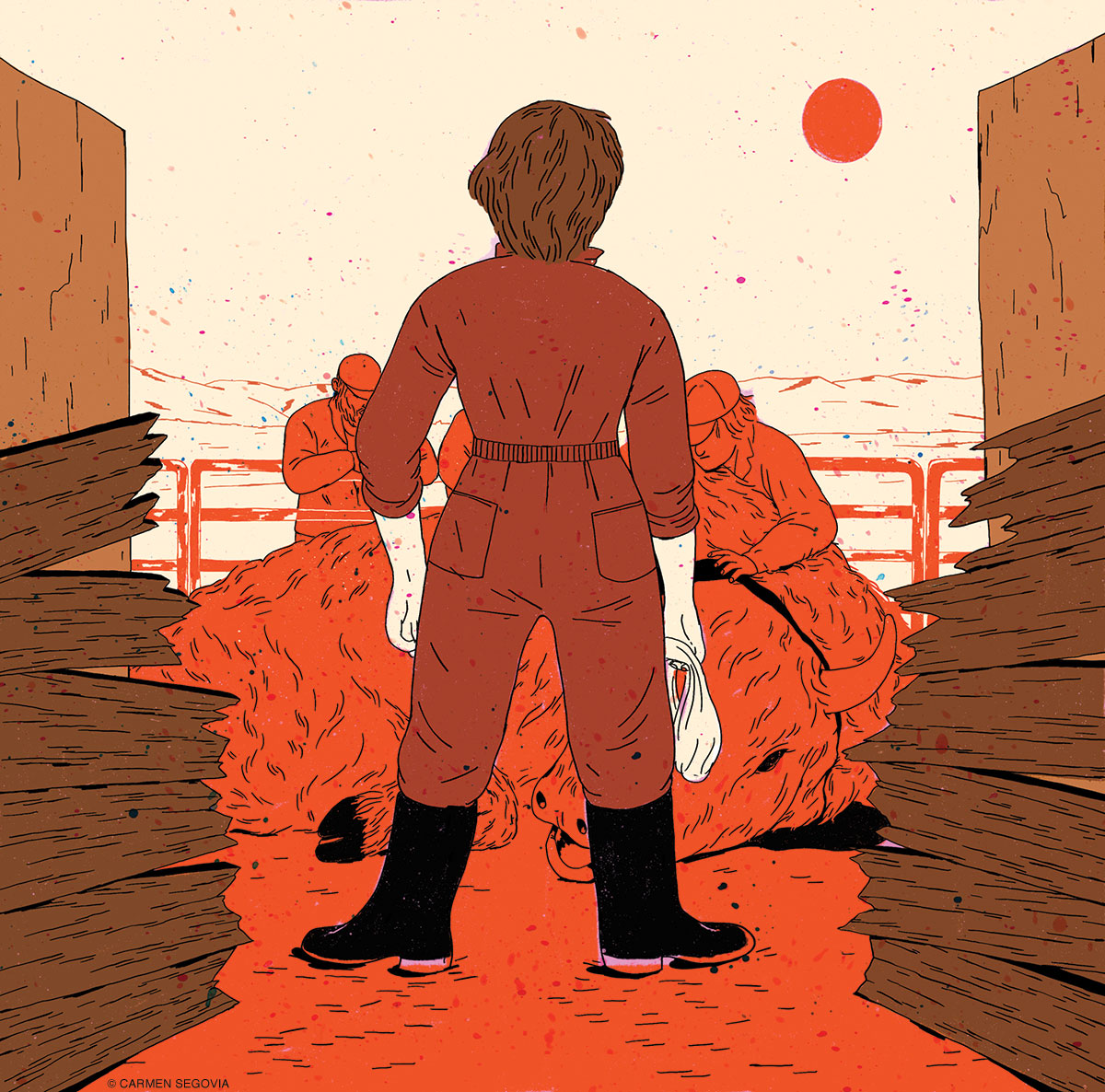
This bull could see the little front loader coming into his territory—and he didn’t like it. The problem was the new guy neglected to put the steel reinforcing bar across the lower door to the pen. Without the bar, the door shattered after only a couple of large head butts, and the bull was in the pen, challenging the little yellow front loader for dominance. He wasn’t going to cede one inch of his territory to some little party toy of a machine. When the bull charged, the terrified worker jumped off and barely missed being crushed. He scrambled over the fence. The bull put his head under the blade of the front loader and shook his mammoth neck back and forth in a magnificent display of dominance. The front loader blade was sharp steel and at each shake, the blade bit into the skin and then the neck muscles of the crazed bull who ignored what must have been significant pain. Finally, the overwrought beast lost enough blood that he collapsed.
By the time I ran up, blood had spurted and pooled into a shallow lake on the concrete.
“Doc, over here!” a cowboy yelled.
The bull’s tremendous bulk heaved as he sucked in air. He lay on his side, eyes closed, his enormous chest moving up and down. One look and I realized no tranquilizers were needed—the bull was almost dead from blood loss. If I gave him fluids to get his blood pressure up, he would bleed more but maybe revive—and kill me. If I didn’t, he might die soon. Fear and possibilities—too many possibilities—raged in my head. The whole crew quieted down, watching to see what would happen next.
Bleeding was the most critical thing to consider. I knew I had to stop it before anything else. Packing the huge wound would give me time to think. I climbed into the pen and walked around the great bull’s head, wading through a puddle of clotting blood to look down into the gaping hole that had been carved by the front loader blade. The cut was about a yard long, curving over his massive neck, and at least 10 inches deep, through layers of large muscles.
Multiple blood vessels spurted little red fountains. The entire wound was awash in blood. No possibility of neatly tying off the bleeders. At least it looked clean—a clean cut from a steel blade, no manure or embedded dirt. I didn’t have enough cotton or a big enough needle. The supplies I needed were in the truck.
“Jeb, I’ll be right back. You get some hot water.”
I sprinted to the truck and pulled out rolls of cotton, needle holders, a package of heavy-duty catgut and the biggest curved suture needle I could find and dashed back.
“What do you want me to do?” Jeb asked.
“Does he need blood?” one of the technicians yelled.
Of course, he needs blood, I thought, but there is no goddamned cattle blood bank to call.
“You gonna give him a shot?”
“You need iodine?”
Everyone had a suggestion or opinion. I ignored them, knowing I had to handle this and make sure no one got hurt in the process. I ripped open several rolls of cotton and stuffed them into the wound. They disappeared. Two more, then two more. Finally, the blood stopped gushing.
“Jeb, lean on this cotton with your arms.”
He nodded, climbed on the bull’s back and sat there like a bull rider, leaning both his big forearms on the cotton rolls, starting to soak red. Maybe I could get some stitches in and then start IV fluids. The bull was not dead yet—I could see he was still taking shallow breaths. I threaded the large surgical needle with the catgut and cut off about a yard. I tried to act calm, but my hands shook. My mental picture of this bull waking up from the pain of me plunging the big needle into his neck muscle was terrifying, but there was no time for a local anesthetic. Jeb had been leaning on the cotton rolls for about five minutes, and the worst of the bleeding had slowed. I gingerly reached into one side of the wound and removed enough blood-soaked cotton to get a stitch deep into the interior muscle. I tried to remember the suture pattern that would take the most tension. The thick muscle pulled together as I tightened a big suture and tied a sturdy surgical knot, and then another and another—individual sutures for strength.
At least the first madness of the emergency was under control. My suture job wasn’t pretty, but it stopped the bleeding. After 15 minutes I finished suturing the deep muscle layer. At each bite of the needle, I pulled some of the blood-soaked cotton out of the wound. The technicians watched, standing outside the pen, peering through the steel fencing. The bull’s breath was shallow and ragged, but he was still breathing.
The skin next, sutures not pulled too tight, but tight enough to close the wound. The leathery skin was much harder to sew, and I discarded a couple of needles because they blunted from poking through that tough hide. The big rough catgut was the biggest suture material I had ever used—it felt like twine. I was about two inches away from finishing the skin suture across the wound when I heard the bull snort and stir. After so much blood loss, how could he wake up without fluids? He would be one sick bull unless I could get some into him before he completely woke up.
“Who can run to my truck and grab some fluids?” Jeb was still mounted on the bull, dabbing the remaining blood that was leaking from the wound.
“What do you need?” one of the guys asked, and I told him where to find the bags—I needed as many as he could carry. I threaded the needle with more catgut to finish the last few inches of stitches when the bull opened his eyes.
Jeb yelled, “He’s waking up!” and deftly jumped off the bull’s back and over the fence. I grabbed my needle holder and took a step back as the bull heaved himself to his feet. My initial a sense of relief—He’s alive!—was rapidly followed by Oh shit.
The groggy bull could barely stand. He looked around the familiar pen, turned his head and saw me. Even in his weak and wobbly state, his testosterone-crazed brain said, Charge! He swiveled toward me and lowered his head into attack posture. Each of my carefully laid sutures popped with a loud crack as he flexed his neck down, and I watched the incision gape open again.
“Doc, run!” Jeb yelled, but I was already flat out.
I vaulted over the fence just as he crashed into the steel poles. The ground shook, and the bull went down in a heap. He had knocked himself out. I grabbed the fluid bags the tech had brought from the truck and jumped back into the pen. His wound oozed blood. At least my sutures had slowed the bleeding. I didn’t know how much time I had before he woke up again, but I was determined to get some fluids into him. Jeb was right there with me, holding off the giant jugular vein while I plunged the needle in, hooked up an IV, and climbed up on the fence above the bull. Jeb and I sat up there, taking turns holding the fluids and changing the bags as they emptied. If the bull woke up suddenly, we’d both be on the right side of the fence.
The wound gaped open but the blood, thank God, was just a slow drip at the bottom corner. The suture job in the neck muscles was holding enough for the blood to clot, but my God, that wound was ugly. When the last fluid bag was empty, Jeb and I climbed down from the fence. With the big beast still unconscious, I took one more chance and went back in the pen to administer a mighty injection of penicillin—a full two bottles worth—and puff some yellow sulfa powder into the wound. Jeb and I looked at each other.
“You have a little blood on your face,” he said, grinning. We both were soaked in blood, my glasses speckled red, hair clotting, coveralls smeared. I smiled.
“Let’s see how long before this brute wakes up again,” I said, expecting that he would wake up but knowing there was still a chance he wouldn’t after so much trauma.
A long 20 minutes passed, and finally the bull heaved himself onto his chest, still too wobbly to stand, slowly moving his head, eyes blurry, from side to side. Maybe he’d knocked a bit of sense into himself and decided he’d had enough. He laid quietly, his breath ragged. By now, the late afternoon sun was low, the drama over. The poor new guy who had been on the front loader had gone to the emergency room for a tetanus shot. He’d been more than a little scraped up in the scramble.
I was a mess, sweaty and shaken from the ordeal. Bull blood dried under my fingernails, and it would take a good soak in the tub to get rid of it. I didn’t know where Jeb was, probably cleaning up in the men’s room. I hadn’t had a chance to thank him. I stripped off my coveralls, threw them on the floor of the truck cab, and climbed in to drive home.
Heading north up the valley, I didn’t know if I had succeeded or failed. I went over the things I could have done differently and the things that could go wrong—infection, chronic draining wound, muscle damage, kidney failure. Sighing, I decided to call it a success for now. When I’d left, the patient was alive.
The story spread throughout Logan quickly. A bull attacking a front loader and then almost bleeding to death, combined with the lady cow vet handling the emergency, was big news. Doc Nelson returned the following week and heard most of the story at church.
“Heard you had quite a situation over at the bull stud place,” was all he said.
“You chose the right time to be away.”
Laughing, he patted my shoulder and said, “At least the patient lived, and no one got killed.”
A couple of months later, I drove south to see how my monster patient had fared. On tiptoe, peering into the bull’s stall, I looked at the back of his neck. Amazingly, it had healed. A thick line of scar tissue ran behind his ears and a deep V-shaped depression on his massive neck indicated where the cut from the front loader blade had been, but he moved easily around his stall, pawing and snorting.
I heard the door slam, and Jeb came down the hall.
“That’s him, alright! Don’t he look fine? Just as mean and feisty as ever!” Jeb reached out his thick hand and we shook. “You don’t have to wait until Doc Nelson is out of town to visit again,” Jeb said, winking.
“Please, no more emergencies.”
“You got it, Doc.”
I had earned that “Doc,” and I was proud of it.
Linda Rhodes V’78 is the author of Breaking the Barnyard Barrier: A Woman Veterinarian Paves the Way, © 2026, from which this essay is adapted by permission of the University of Nevada Press.