
Seeking solace in small acts of construction.
By Alexei Dmitriev
America has had a credibility problem in the Muslim world since the “war on terror” began 25 years ago. Lately, that problem has turned into a crisis. In 2022, when Russia invaded Ukraine, I couldn’t just watch from home, so I went to help Ukrainians fleeing the war. That work was about solving immediate problems faced by refugees: food, shelter, papers, and onward travel [“Way Station,” Nov|Dec 2022]. After the US attacked Iran, I also felt a need to do something constructive. But this time around I did not volunteer to feed or shelter the needy, nor did I want to deal with politics. My aspirations were modest: I would use my schoolteacher’s vacation to help kids in Pakistan improve their English. I speak some Urdu, I have been to Pakistan before and feel comfortable there, and I am an English for Speakers of Other Languages teacher in Maryland. I felt I was a good fit for the undertaking.
Once in Pakistan, I confronted an overwhelmingly pervasive narrative: America comes to the Muslim world to destroy. As bombs fell on Iran, convincing my new Pakistani friends that Americans meant well was an uphill battle. So I gave up on putting a positive spin on America and started using my English classroom to teach the kids something I have come to value since emigrating to the US from the Soviet Union in 1985: the freedom and capability to form and voice independent thoughts. I wanted to get them talking about topics they understood—like friendship, character, and relationships—and coax them into expressing their opinions. My plan was to make open discussion the dominant method of learning.
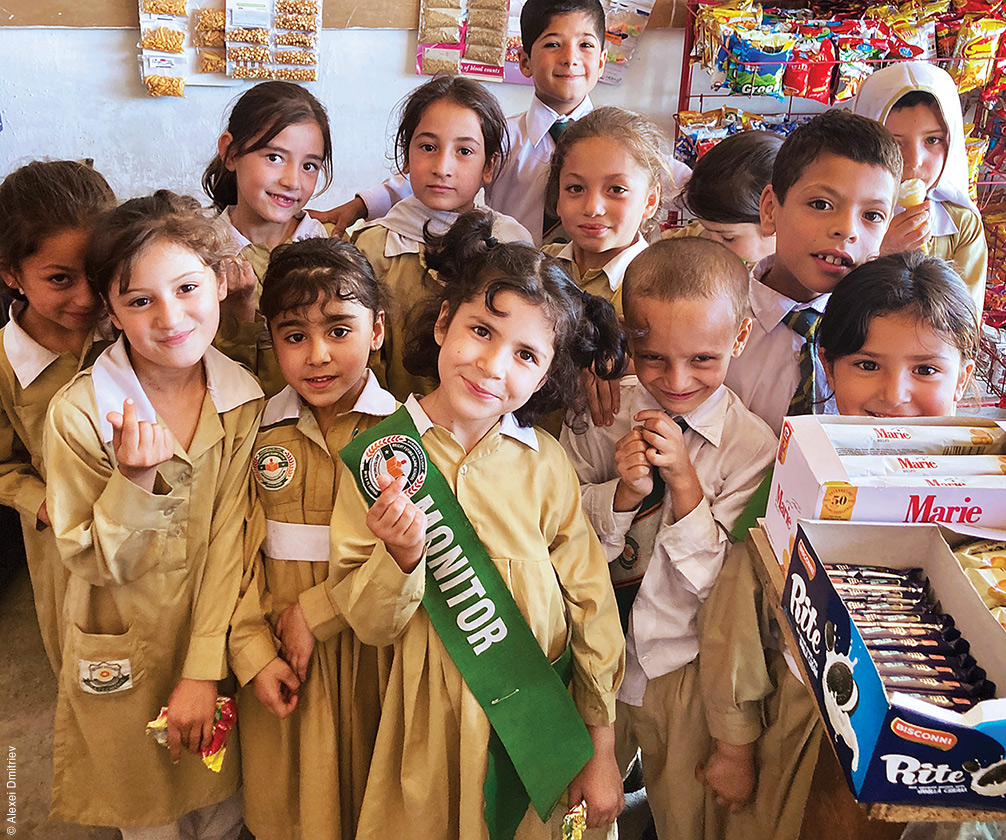
For a month, I taught in three Aghosh orphan-support homes run by the Alkhidmat Foundation: one in Murree with high school boys, one in Gilgit with elementary and middle school boys, and one in Chitral with a co-ed elementary and single-sex middle and high school. These were not the elite boarding schools of Islamabad, Lahore, or Karachi. They were dorms for fatherless boys coming from remote villages—the demographic most receptive to the idea that America is waging a crusade against Islam. I also taught at Alkhidmat Foundation–run schools for girls in Chitral, who are usually the first to drop out when war, inflation, or displacement strains a family.
Pakistan’s constitution promises free and compulsory schooling to all children aged five to 16. Yet most government-run schools in Pakistan do not have enough teachers or resources, and students are funneled toward rote memorization: repeat after me, memorize the passage, regurgitate it on the exam. This method produces students who can recite dutifully but flinch when asked a question that demands a real answer. Some 77 percent of Pakistani children face what the World Bank calls “learning poverty,” the inability to read and understand an age-appropriate text by age 10. I rose against that model and invited my students to express themselves.
It did not go well at first. The repeat-after-the-teacher mode was so ingrained that to my question “What color is your shirt?” the answers came back, “What color is your shirt green.” To further complicate matters, most of the kids spoke a local language at home, so my Urdu was sometimes better than theirs—which made it even harder to get a point across when we ran up against the limits of their English. Nobody volunteered to speak. The boys especially were mum. Some had been publicly embarrassed by teachers for giving wrong answers, so silence felt safer. English grammar was a manageable obstacle; the lack of confidence loomed much larger.
I met each group where they were. I asked the youngest kids in Gilgit to build their own questions—Do you like cricket or football?—before teaching them how to answer. With the middle group, every why needed a because, and every because needed an explanation they could support, often with an example from their own lives. The older boys and girls read Angela Morgan’s “In Spite of War” and Wordsworth’s “The Daffodils,” and I asked them things like: What do you think wealth actually is? What does your inward eye see? Does the idea that lilies are powerful enough to make us forget about wars mean anything here, in Chitral, today? Why—or why not?
I explained that memorized answers are powerless against life’s hardest questions. And that the habits imported from diligently doing Islamic studies, where they had to memorize Arabic passages they didn’t understand, were not applicable to math, science, Urdu, and English—the subjects where they actually had ability to reason.
So I taught them to ask questions, weigh evidence, and sustain their opinions. One moment that stayed with me came during a conversation about friendship. Saad, whose red hair and green eyes evoked the theory that descendants of Alexander the Great’s soldiers still inhabit these parts, asked, “What do I do if I see my friend fighting?” It would have been easy to give him the expected answer—tell a teacher, stay away, don’t fight—but instead I asked him what he thought. He wrestled with it. If it was his friend, he said, shouldn’t he help him? But then we talked about whether helping a friend meant helping him fight or helping him stop. What if his friend had started the fight? What if someone else was being hurt?
Eventually, Saad landed on a conclusion. “I think you should stop your friend, because being his friend doesn’t mean you should help him do something wrong.” It was a small moment, but it was exactly what I had hoped for. He wasn’t looking for the answer I wanted him to repeat. He was trying to construct an answer of his own—and defend it.
I hope that long after a girl named Syeeda stood in front of the class to proudly read her own rendering of “In Spite of War,” she will remember the American schoolteacher who told her she was smart, and insisted she form her own opinion when everything around her told her to recite. If 13-year-old Zaid remembers someone who taught him that his own stuttering “because” mattered more than someone else’s flawless recited line, perhaps he will retain a lifelong tool capable of withstanding radicalization. Even if his note of appreciation to me read: “Sir, you teach at me and I am learned.”
One month. Nearly 300 children. Hundreds of questions posed and answered. Still, towards the end of my stay I wondered if I was making their lives harder.
What would happen after I left? They’d return to classrooms where memorizing is still safer than questioning, where the “right” answer still outranks an original one, and where a kid who would want to ask why might be ridiculed. And let’s say I did give them a glimpse of a school where students’ opinions counted. What good was that in a world where bombs continued to fall?
At the beginning of all this, I’d nursed certain idealistic hopes. Maybe a boy who learned to be comfortable questioning his teacher would one day question a Taliban recruiter. Perhaps a girl who learned that her own “inward eye” has intrinsic value might be less willing to roll over before a patriarchy bent on keeping her at home—safe from the West’s purported threat to her modesty and faith. This seemed like the only way I could possibly try to mitigate the effects of a war I didn’t choose and couldn’t stop.
But the truth was that we shared the same predicament. My students and I lived in a world over which we had very little control, albeit in different countries. We all confronted forces vastly larger than ourselves, and none of us could know whether our efforts would ultimately make any difference. So that couldn’t be the point. There was no use in pretending that a classroom could undo an injustice like war—or that interrupting the next cycle of radicalization and conflict was a responsibility to be borne by Pakistani orphans. The point had to be simpler: to learn how to build something when you know that the world around you is collapsing.
A question, an argument, a friendship, and a child saying, “I think—because” are absurdly small things when compared with airstrikes. But they are acts of construction, and construction matters when so much else is being destroyed. For a few weeks, we tried to practice another way of being with one another: questioning rather than obeying, reasoning rather than repeating, building rather than breaking.
I went to Pakistan hoping that I could give these children something that would make their lives better. But I left far less certain, because that assumption proved harder to sustain. There was one fundamental benefit, however: we were together when we endeavored to make something decent out of a world none of us had chosen. We won’t know whether the world takes note. But it is a way of establishing a measure of meaning and dignity when hopes for global peace are fading.
I now meet with my Chitral students once a week via Zoom. We cannot change the world, but we can keep building something in the part of it that we now share.
Alexei Dmitriev G’88 has contributed to the Gazette’s Views section for more than 20 years.