
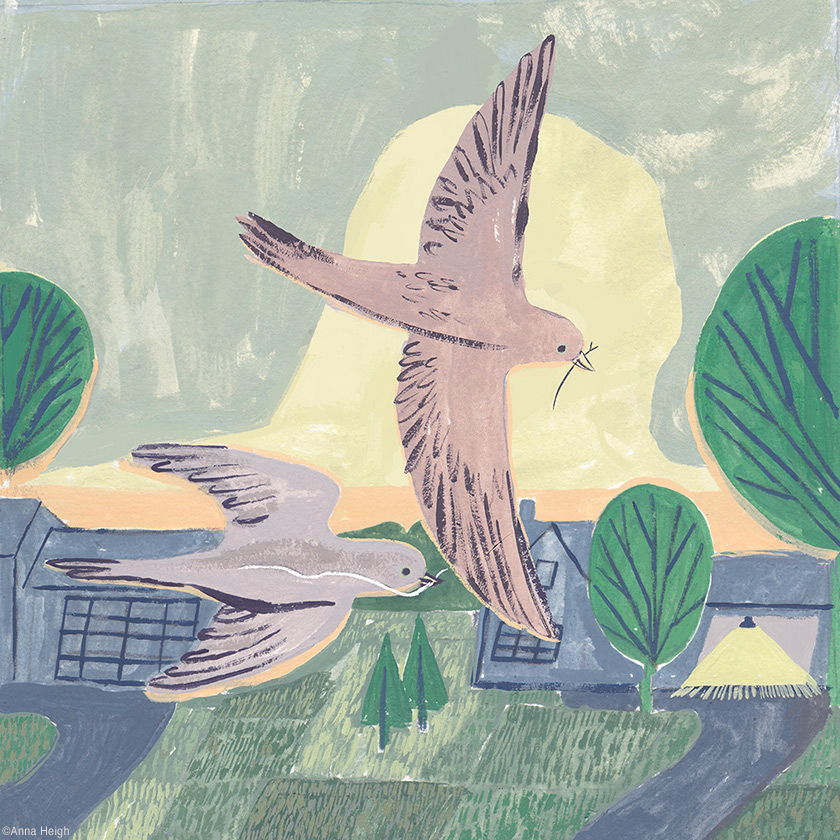
The summer of the mourning doves.
By Kathryn Levy Feldman
It started innocently enough in late March. When I opened the garage doors one morning, I saw a long twig dangling from the electric motor. I pulled on it, thinking it might scrape someone, and discovered it was firmly anchored. I figured it was caught on something, so I just clipped the end and forgot about it.
About a week later, I heard a noise coming from the garage: a high-pitched cooing sound that I thought might be the generator alarm. I went to investigate and found a plump bird sitting in a nest on top of the garage door motor. Another bird was pacing in the driveway, but scampered away when it saw me. The cooing, meanwhile, continued. My summer renters had moved in.
At first, I thought they were pigeons. They were smooth and gray and bobbed in that pigeon jerk when they walked. But a quick Google search told me they were mourning doves. They mate for life, build their nests in eaves or out-of-the-way places, can have as many as six broods per season (more than any other native North American bird), and usually lay two eggs in each brood. The parents alternate twelve-hour shifts sitting on the eggs. And yes, they coo.
This has been the summer of the mourning doves. Each successive brood gets a little more comfortable with us. The mother and I are on respectful terms. She keeps a fierce watch on my every movement as I come and go throughout the day, and I have come to recognize her when I spot her walking around my back patio or on the driveway. When she sits on the nest, she faces west, toward my car. Her mate faces east, toward my husband’s car. He puts his head under his wing. She stares straight ahead. We have not named them, although I have I taken to saying, “Good Morning Mama,” and sometimes, “Hello.” She just keeps staring straight ahead, not even scanning the horizon.
Each brood takes about two weeks to hatch and two weeks to fly the nest. It is truly remarkable. During the egg-sitting vigil, the father will pace in the driveway waiting for his shift to begin. The first go round, he appeared around seven o’clock at night—although I never actually saw them change places. When she laid the second clutch, he perched on the door of my husband’s car as if to cheer her on. There was a lot of cooing and occasionally a shudder, which I can only presume was the actual release of the egg. Satisfied all was well, he flew away. I assume the mother eats (mostly seeds, according to Google) when she isn’t sitting and vice versa. Once the babies hatch, I have seen her feeding them from her mouth. She leaves the nest for a few minutes at a time to forage.
During one of those forays, I climbed up on a ladder to see the babies. They hatch without feathers, looking scrawny, and are about two and a half inches long. One faced north, the other faced south, and they fit together like a perfect puzzle. After about a week, you could see little heads poking up. After two weeks, they were at least six inches long and covered with feathers. My grandchildren were fascinated with the first brood. They climbed up to see the babies and then returned the next weekend only to find they had flown away. We could hear so much cooing in the backyard that we knew they hadn’t gone far. My grandson grabbed a pair of binoculars to try and spot them, but no luck. Within a week, the mother was back laying more eggs.
One morning about two weeks after the second brood had hatched, I opened the kitchen door to the garage, to find two birds on the step staring up at me. “Not a good idea,” I told them, shooing them back. “You need to go the other way.” They scurried under my car and eventually emerged to waddle out of the garage. The next morning, I found one wandering around my front steps and the other in the driveway. I later spotted the parents on my back patio, presumably discussing the antics of their wayward offspring. And then one night, my husband forgot and put the garage door down. When I realized it the next morning and opened it, I was quickly greeted by a deafening symphony of cooing from the garage, as if the mother bird was scolding me. “I didn’t do it,” I found myself telling her. “He forgot.”
Soon enough, there were more eggs in the nest.
There are many meanings associated with mourning doves that take up residence in your house. Some say deceased relatives are coming to pay a visit; others that they are symbols of peace and new beginnings. Since they begin to lay their eggs near Easter, many have interpreted them as symbols of hope. I marvel at how clever they are. Their nest is shielded from the weather, which was fierce this past spring, and away from predators like crows that have been known to steal these eggs. They are the most respectful tenants; for some unknown reason, there is very little sign of their presence on our cars. And except for the occasional cooing, which stops when babies are hatching or growing, they are silent.
For now, I am grateful to watch nature unfold in all its unhurried, yet structured, glory. The birds know what to do and when to do it, and in between they wait. Maybe that is the lesson: slow down; keep looking ahead; and when it’s time, you will go.
Kathryn Levy Feldman LPS’09 writes frequently for the Gazette.
