
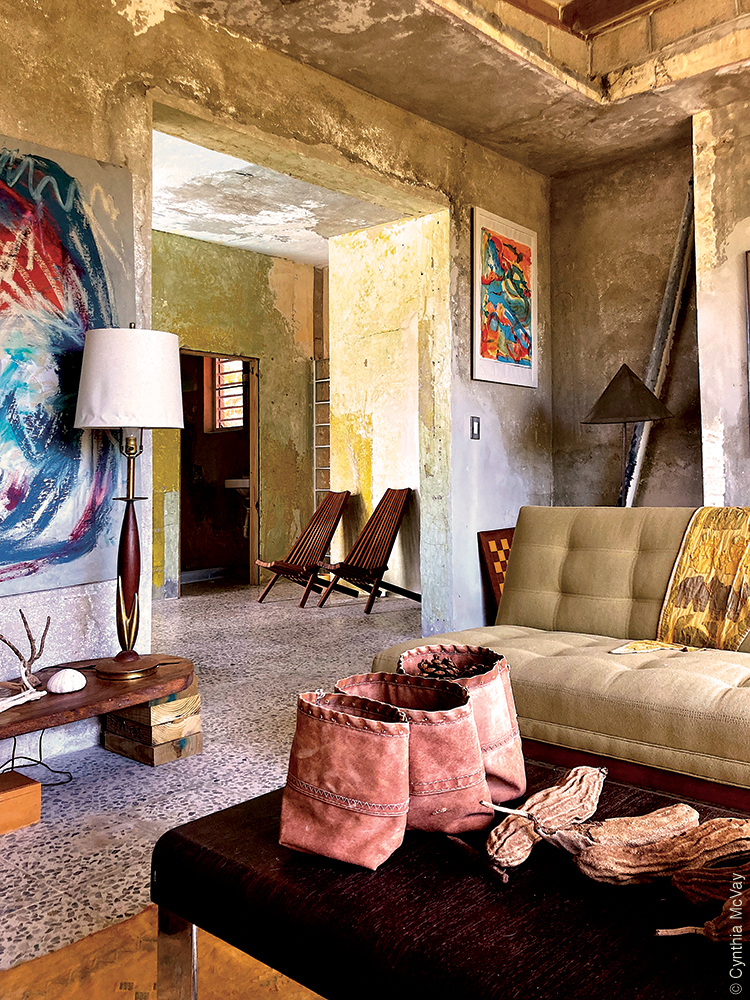
Turning rubble into a dwelling on St. Croix.
By Cynthia McVay
I am drawn—no, I am addicted—to saving wrecks and ruins. I tried to quit, but I can’t help myself. They beckon. I get my fix from fixing them, putting them back together. I wish I could fall for a turnkey, finished home like normal people, but they hold little attraction. There’s no challenge or mystery or story. I love older structures for their understated elegance, placement in the land, mature vegetation, unabashed mark of activity and time, and their (often) simple functionality. Their layouts, priorities, and proportions make sense to me. I don’t need a walk-in closet, or a kitchen the size of a gymnasium, or a media room. I minimally renovate, just enough for basic creature comforts while respecting the original intentions of the makers. Urgency accompanies older buildings, too. I worry that they will crumble beyond recognition, or—worse—someone else will “gut” them, removing the character that sets them apart.
In 2018, I purchased one such property on the island of St. Croix in the US Virgin Islands. While I was visiting the island for the first time, the listing popped up on Zillow. With dramatic stone walls and enormous window openings, it perched on a hill in a seductive, vulnerable state at a bargain price. I couldn’t resist.
I have renovated a half-dozen homes over the years, but not one like this. This ramshackle skeleton required everything—roof, windows, doors, walls, plumbing, electrical—done immediately, if I wanted to get out ahead of hurricane season. Arriving a year after Hurricanes Irma and Maria, I competed for scarce and expensive tradesmen and materials, as FEMA pumped millions into the island’s repair. Lots of people needed new roofs, not just me, and arguably with greater urgency. Operating as general contractor and architect, I quickly boned up on what it means to build a hurricane-proof, water-catching roof and clean, impermeable cisterns fed by ducts and conduits during the rainy season.
To get a jumpstart, I brought two carpenters from the Hudson Valley for the month of January. Because there was no electricity, we got by with loud, annoying, gas-fueled generators to operate the tools. One broke down. Then another. I borrowed my neighbor’s generator, and it croaked too. Nonetheless, we banged out the roof and covered critical openings in short order. We had our laughs and our challenges, with me as their chauffeur and Home Depot runner. I must have loaded 500 bags of concrete—and then buckets and buckets of debris to take to the dump—into the back of an arthritic pickup. It was a memorable, productive month.
Over time, I assembled a team of mostly locals—local to the Caribbean, that is. They came from Antigua, Dominica, Trinidad, Jamaica, Puerto Rico, Dominican Republic, Nevis, and St. Croix. I valued them highly and they became dear to me as I ferried them back and forth in the pickup. A couple had stands with avocadoes or mangos at the local farmers’ market. One took a half day on Friday to collect fruit and vegetables from “the bush.” They shared local foods and plant knowledge with me, along with trade expertise. I often worked alongside them.
Reconstruction was guided by discovery, and a bias toward reuse. I watched how the sun worked its way around the structure and determined how to harness the hilltop breeze to minimize Caribbean heat and spring mold. We squared and fenced the three round arches in the driveway to create a main entry. I personally jackhammered five inches of concrete and standard-issue glazed white tile out of that patio to reveal hidden terrazzo. That patio now connects the main house to the guest wing and hosts an outdoor bar and multiple living spaces. A large, sculptural flamboyant tree shades a brick patio a few steps below. The deep pool on the west side of the house, a breeding ground for mosquitoes and curing station for tadpoles when I arrived, required significant investment to bring up to code, worth every penny. With a big sky, it offers another outdoor “room” to sip morning coffee, catch sunsets, and view the hemisphere of a rainbow after a shower. A fence, thoughtfully scaled and joining the existing walls, steps around the entire house, giving the property dimension and security, and keeps my dog Dexter nearby.
Some internal walls don’t reach the ceiling, a feature I saw designed into old plantation houses for air circulation. We made hurricane doors out of repurposed corrugated metal roofing found on the side of the road. I located elusive glass block—a mainstay of the island’s architectural lexicon—and used it to create a tub and shower stall and to fill several superfluous openings, allowing natural light to reach interior rooms, maintaining the open feel. I filled driveway potholes with concrete rubble and drove the rest to the dump.
After three weeks, there was a roof, some doors and windows, but no electricity or proper plumbing. My furniture had arrived via container (too early!) and was piled high under dusty tarps. I decided to save some money by moving from a nearby Airbnb to camp in the living room. On this inaugural night I would sleep atop four mattresses stacked high, like Princess and the Pea.
I dug out sheets and pillows and made my bed. I bathed in a (clean) garbage can that had collected water from the roof not yet connected to the cistern. I brushed my teeth with bottled water and spat into the driveway. I changed into nightwear. I slipped into the clean sheets. Mmm. I felt the breeze and heard the rich night sounds that had been absent at the Airbnb.
I was happy to be surrounded by this nocturnal concert, and, at first, it seemed, as I’d hoped, mosquitoes were not an issue, even with no screens in the gaping openings. I certainly wasn’t thinking about rats or boas or Cuban white frogs or the footlong Amazonian giant centipedes yet.
I was exhausted, but I couldn’t sleep. I lay awake following individual croaks and bellows, trying to ascertain whether they were frogs or birds.
The first hour was just about excitement.
The second hour was about pain. I used to miss the feeling of muscle fatigue I remember from my childhood. Sore muscles were reminders of hours playing kick-the-can and tag. But that night, my whole body screamed from the jackhammering I’d been doing nonstop, trying to get the most out of my $22-per-day tool rental. Had I caused permanent damage to my nerves? Or were my hands just a bundle of fractures? My legs, too, were heavy and pulsing. Instead of sleeping, I throbbed. I had no idea where my Advil was, and there was no use rummaging in the dust and dark in search of it.
I tried counting to six: three long breaths in, three long breaths out, meditation-style. I put a pillow beneath my knees when I lay on my back to ease lower back pain, and between my knees when I lay on my side to pad the knocking bones.
The third hour, just as I discovered sleep, the mosquitoes discovered me. I waited until one was near my ear and smacked it. The whine was gone, replaced by ringing. I sprayed myself with poison and hoped for the best. I pulled the sheet over my face and head until it got so hot, I kicked it all off. This cycle repeated dozens of times. I eventually dozed off.
I heard a loud knock at the door. I jumped out of bed petrified, alert, wondering who had found me on the hill, in the dark. Another knock. I opened the door and peeked out—and then down. An enormous hermit crab outside had been throwing himself against the door.
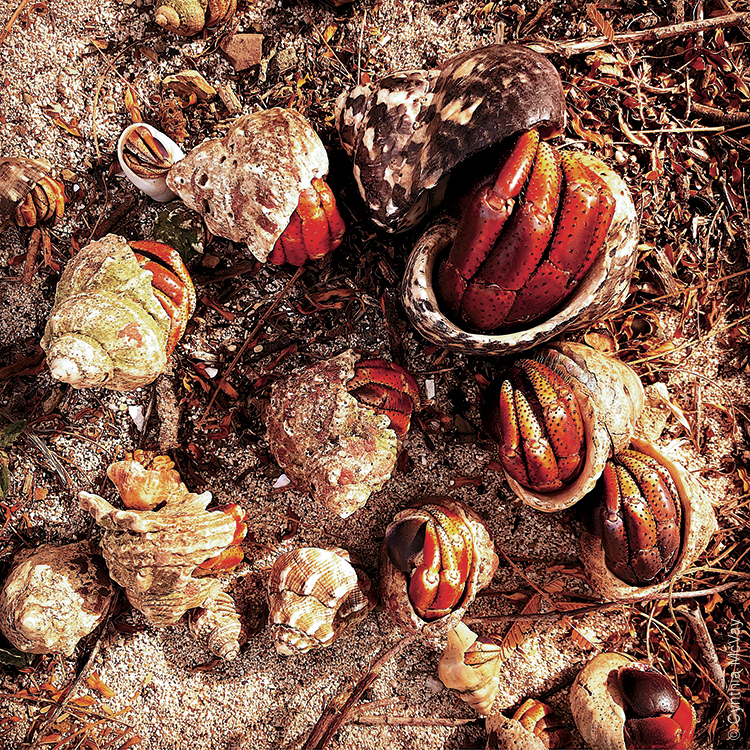
Hermit crabs had been living below the house between the cistern and pool when I first arrived. I found them a tad disconcerting as I explored the nooks and crannies of the underworld. But what was one doing here, on the threshold of my new abode? When I told my mason, Henry, about the encounter in the morning, he said, “Oh, yeah. They like to snuggle at night.”
Since I’ve moved in, they’ve moved on. I hope they’ve found somewhere cozy.
Cynthia McVay G’88 WG’88 is the author of Under the Crucian Sun: A Memoir of Place (2026) and A Field of My Own: A Memoir of Place (2025).