A stint as a “trainee mortician” set Penn English Professor Peter Stallybrass on the path to scholarship. These days, he prowls old bookstores and library stacks in search of the objects that make the past come to life.
By Beth Kephart
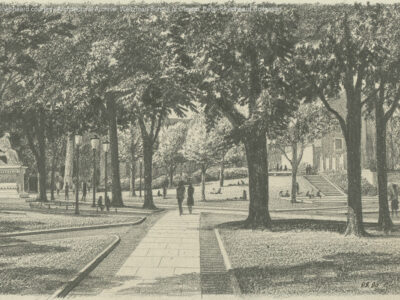
Monday, five o’clock p.m., mid-December. Outside, the weather is crisp and the sun has faded from the sky and the lamps have started to flicker on above the walkways of the Penn campus. There is the electric buzz of early darkness, the potent ambiance of dusk. There is something akin to anticipation.
Inside, on the sixth floor of Van Pelt Library, among antique books and oil paintings, Zola memorabilia and a well-worn Oriental carpet that decorate the Charles Lea seminar room, that expectant mood is magnified as musicologists, classicists, book binders, art historians, political scientists, language scholars, professors of religion, and an assortment of others gather for the semester’s final History of Material Texts seminar. At a narrow table before the swollen horseshoe of chairs, Assistant Professor of Music Emma Dillon, the evening’s featured lecturer, readies a talk that is titled, “The Sound of Sense: Devotional Designs in the Montpellier Complex.” About her, the din grows louder as graduate students catch up, and professors exchange notes, and more chairs are pulled out onto the floor.
By the time it is all over, some two hours hence, there will have been live musical demonstrations, courtesy of three talented undergraduates; collegial debates over Dante, Petrach, and Augustine; myriad reflections on the role of polyphonic music in medieval society; and an invitation to a post-seminar reception and party. “This is just one wonderful creative stew,” enthuses a graduate student whose own work centers on the performance implications of a particular Spanish music manuscript. “No matter what the topic of conversation happens to be,” agrees a professor of Romance languages, “it has implications for the work the rest of us are doing.”
Extraordinarily wide-ranging, often surprising, the History of Material Texts seminar has long been known for sparking the sorts of conversations one isn’t likely to encounter elsewhere. During the fall semester, Nigel Smith, professor of English at Princeton, came to speak on the way early modern religious nonconformists and political radicals used the printed book. Jennifer Thompson, a curatorial fellow in the European Painting Department of the Philadelphia Museum of Art, led a conversation about Peter of Poitiers’ Genealogy of Christ and its use in classrooms in the 13th through 15th centuries. The University of Cambridge’s Stefan Reif spoke on the Cairo Genizah and the two Victorian women who helped “discover” it. Penn Assistant Professor of Romance Languages Maurice Samuels reflected on illustrated historiography in 19th-century France, and Katherine Rowe, associate professor of English at Bryn Mawr College, spoke on the manual aspects of text production. The list goes on.
Now in its seventh year, the History of Material Texts seminar is the brainchild of Professor Peter Stallybrass, a Renaissance man (not to mention Renaissance scholar) whose passion for cross-disciplinary talk and collegial conversation is acutely transparent, persuasive. He is the perfect host—warm and inclusive, impeccably gracious, enormously interested in what others have to say. Blessed with the capacity to make the seemingly arcane not just accessible but fascinating, he is also blessed with the sort of rare sincerity and decent-mindedness that breeds affection and sympathy among those with opposing points of view. It doesn’t matter who you are or what you know, it seems. Stallybrass will find a way to make you feel at home, at ease in his Monday seminars.
Born in England in 1949, Stallybrass appears younger than his birth date would suggest. He has a youthful face and an effusive spirit and the graceful physique of a mountain climber, which, as it turns out, he is. Behind roundish glasses, his eyes spark as he speaks; his mouth breaks into easy smiles; he pushes his hand through a full head of misbehaving hair. When he sits, he sits anticipatively on the edge of his seat, his heels off the floor, the toes of his black boots pushed down. One senses, straightaway, that he is a man on a quest, a man who defines himself less by what he knows than by what he does not know quite yet.
Stallybrass arrived at Penn by way of Dartmouth in 1988, already deeply entrenched in notions of collaborative learning, already convinced of the inherent richness of libraries and old things. The son of a multi-lingual academic father, the nephew of one uncle who taught classics and another who split his time between editing, translating, and library work, the younger of two academically inclined brothers, Stallybrass grew up in a home where the parents had met as children through cultural events and where books were everywhere and, most importantly, were read out loud. Even now, at 90, the senior Stallybrass reads in several languages daily; he daily read to Peter’s mother until she passed away, two years ago.
It was a complicated family, but, also, says Stallybrass, an intensely tight-knit one, and by the time he’d reached 16, he’d decided that it was time to strike out on his own. He fled England for the south of France, where he lived briefly, and arrived back home at 17, to face the consequences of an interrupted education. To prove that he was ready to settle down into the academic life his parents had hoped he’d enter, Stallybrass took a job as a mortician.
A mortician?
“It was a hospital job,” Stallybrass says, the hint of a smile in his English accent as he acknowledges the, well, oddness of his early employment. “I was a trainee mortician, more like a porter. Mainly I literally took the bodies of those who had died down to the hospital mortuary, put the bodies in refrigerators, took them out of refrigerators, put them on tables, that sort of thing. But it was a small hospital and a very good one as well, so very few people died. So I just had lots of time to read, and that’s what I did: I read.” He was a teen obsessed with the things most teens get obsessed with—thoughts of isolation, alienation, death. Russian novels were his favorites, Dostoevsky in particular. Having been just a hobby in his early years, reading now intensified into something far more serious, nearly consuming. He remembers himself as “inwardly turned.” He recalls his early attempts at writing poetry, his passionate desire to fall in love.
He also suggests that, given his “checkered” academic career, he might not have gotten into any university at all had the University of Sussex not placed such a great emphasis on the interview portion of the application process. “I still remember that Sussex interview,” he says. “It was a wonderful experience.” Having gained entry to Sussex, Stallybrass stayed on for the next several years—taking undergraduate courses in literature, history, and anthropology, then entering a graduate program. At 24, sans doctorate, he accepted a lectureship at his alma mater, and, at that young age, began to teach the things that interested him. His favorite course had, he says, a terrible title: “Modern European Mind.” Through it he induced his students to think about forging bridges between European literature and European philosophy.
In 1978, Stallybrass set his sights on America, where he had never been. “I’d traveled a lot in Europe, but never to the United States,” he recalls. “My marriage had split up. I’d been at Sussex as an undergraduate, a graduate, and as a teacher, and I felt I should get away for a while. I wanted to go to Colorado because of the landscape—my father had been a climber; I’d grown up loving mountains. But very suddenly I was rung up by Smith College and offered the chance to teach English Renaissance poetry and Shakespeare for a year.”
So it was the east coast instead, and a job on a campus of smart undergraduate women, and a very different sort of teaching than he’d been doing at Sussex—all of which Stallybrass, with his adventurous heart, embraced. And there was something else he embraced as well—Ann Rosalind Jones, a colleague whom he met within his first week at Smith and whom he would eventually marry. By the time Stallybrass had to return to Sussex he was committed to making a life with Jones, even if that meant commuting across the ocean, from Sussex to Smith, over the next eight years.
Finally Stallybrass took the job at Dartmouth, which, he laughs gently, considerably shortened the commute. But there were more advantages to the job than the abbreviated commute, of course. There was the atmosphere, which was dynamic. There was the community of scholars, which, says Stallybrass, was extraordinary—a community that included Nancy Vickers (now president of Bryn Mawr College) with whom Stallybrass shares “a fascination with the overlaps between Renaissance lyric love poetry and contemporary popular music;” David Kastan (now professor of English at Columbia) with whom Stallybrass explores a passion for “second-hand bookshops and badminton;” and Matthew Rowlinson (who still teaches Victorian poetry at Dartmouth), with whom Stallybrass ran faculty discussion groups on Marxism and on Psychoanalysis and Literary Theory, and with whom he mountain-climbs and sails today.
As exceptional as the experience at Dartmouth was, after a while Stallybrass began to miss the challenge of teaching graduate students; he also tired of the long New Hampshire winters. When he was offered the job at Penn he took it, buying a house downtown, racking up frequent flier miles to Massachusetts, and indulging his students in every variety of theory—cultural theory, Marxist theory, literary theory—all taught with a historical bias. He was not yet obsessed with the history of the book, the field of study that, at Penn, has partly (but only partly) come to define him.
It was a book he read in manuscript form—“Shakespeare Verbatim” by Margreta de Grazia, a professor of English at Penn—that threw Stallybrass headlong into this new discipline. “If Margreta’s work is right,” Stallybrass explains, “it means that most of our work on Shakespeare is quite simply wrong. Wrong because we have transferred a wide range of our assumptions to a period which resists those very assumptions—about the individual and his/her detachment from ‘mere’ objects; about authorship and print culture; about originality and intellectual property; about the relations between identity, sexuality, and economic property.” Freeing oneself from inappropriate historical assumptions, seeing the past for what the past genuinely was, looking for clues in the absolute materiality of old books and paintings and musical scores were all challenges that evolved into yet another vital passion.
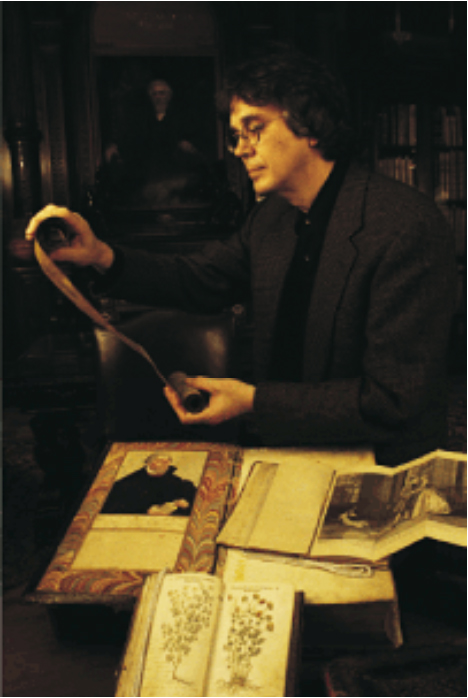
A passion, one might add, at the risk of being obvious, that is full to bursting with offshoots and tributaries, dizzying diversions. For there’s absolutely nothing, it seems, that doesn’t have the power to lure and fascinate this endlessly energetic professor, nothing that doesn’t lead to something else. Stallybrass’s enthusiasms are associative, his conversations packed with tangents, anecdotes, citations that are at once obscure and dead-on. Ask him what has intrigued him over the last few years, and he’ll mention a particular interest in film technology and its relationship to scrolls. A few beats later, he’ll disclose his work on the “elaborate bookmarking systems” that are repeatedly depicted in 15th- and 16th-century paintings and which he lovingly describes as “each made of two small pieces of vellum, glued onto both sides of the edge of a leaf, knotted where they meet, then covered with silk thread worked around the wire … it is amazing how small the heads of these bookmarks are, and how complicated they must have been to make.” Blink, and you realize that he’s now turned to yet another topic—his ongoing research on the history of reading, a field of study that apparently incorporates everything from the marginalia readers have left behind to a fascination with how children learn to read.
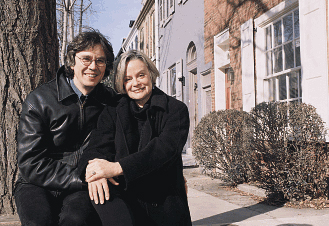
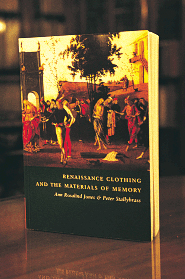
But it doesn’t stop there. In fact, the vast majority of Stallybrass’s “free time” over the past seven years has been spent in the research and writing of a wholly original book entitled, Renaissance Clothing and The Materials of Memory. Like almost all the papers and books Stallybrass has written over the course of his career, Renaissance Clothing was a collaborative effort, this one undertaken with his wife, who is the Esther Cloudman Dunn Professor of Comparative Literature at Smith College and an expert on gender ideology and women’s writing in early modern Italy, France, and England. Their goal was to explore the ways in which clothes are “involved with memory,” particularly during the Renaissance era, when clothes were passed on from master to servant, friend to friend, and were central to the making of that culture.
It is a thesis that took Stallybrass and his wife almost everywhere in pursuit of ideas, material evidence, fact, and innuendo—to the Center for the Humanities at Cornell and the Folger Shakespeare Library in Washington, where they earned research fellowships; to libraries across the United States and throughout Europe; to guest lectureships at UCLA, the University of Michigan, and elsewhere; and into the homes of colleagues and friends, where the two would sit and eat and explore the myriad issues raised by the work.
The project also sent Stallybrass back toward his own memories as a child growing up in a post-war Europe still plagued by rationing. All of Stallybrass’s own clothes were second- and third-hand pieces, which he sometimes resented. But he also has positive memories of clothes, particularly the days he would get dressed in his uncle’s Navy jerseys. “I still remember when my brother and I, at the ages of nine and seven, would put those jerseys on,” he says. “They were just enormous, those jerseys—they hung well below our knees. But they just felt wonderful, for I loved my uncle, he was the person I adored, and there was a lot of pleasure to be had in playing at being him. I dressed up a lot as a child, loved playing at being people. I know a lot of kids like to dress up, but I think I quite obsessively did.”
The impact of clothing—the way a hat or a cloak might retain and suggest the person who once wore it—was a point that was driven home even harder for Stallybrass when his good friend and sometime collaborator, Allon White, gave Stallybrass some of his clothes before he passed away. “I became obsessed by the way in which the shape of his body and his smell haunted the clothes that I now wore,” Stallybrass says.
If most of what has been written about clothing relates to fashion—the constant introduction of new styles and materials—Stallybrass and Jones were concerned with just the opposite, with the way that memories “haunt the materials we touch, handle, and wear,” he says.
“The more I thought about clothing, the more I realized that it had had a far more prominent social function in the Renaissance, both as a materialization of status and gender and as an economic currency. Men and women were paid in livery (in the form of cloth, food, and lodging) as much as in money. Moreover, clothing was the main pledge at pawnbrokers, and pawnbrokers were the central form of banking for the vast majority of people in the Renaissance. In other words, if I started out with a desire to give a transhistorical account of clothing and memory, I increasingly wanted to look at the changing history of the economic value and symbolic significance of clothing.”
With Jones bringing her own set of issues and concerns to the project, the two spent countless hours hashing the whole thing out. Sometimes one of them would do the research and the other turn it into an argument, Stallybrass says. Sometimes they’d split the research and writing. Sometimes they wrote separate chapters that the other would revise. And sometimes they’d sit side by side at the computer to write.
If it sounds excruciating, it often was, Stallybrass says. What began as a very personal book inspired by intimate experiences and dedicated to the memory of both authors’ mothers became chock-full of footnotes and references and sophisticated exegeses. Seeing each other only on weekends, Stallybrass and Jones felt the strain of a book that took seven years to write. By the time they were finished, they were simply glad to be done.
But on October 15, 2001, the book was back in the forefront again when it was announced that it had been awarded the prestigious James Russell Lowell Prize, awarded annually by the Modern Language Association for an outstanding scholarly book written by a member of the association. Some 90 books had been submitted to the competition; Stallybrass was elated when he learned Renaissance Clothing had earned the honor. “It meant an immense amount,” he says. “The prize was peculiarly wonderful because we’d never thought of the book from outside. We were just glad to have done it. It was a surprise and also a wonderful feeling to know that we’d achieved something together.”
But Stallybrass is not a man to rest on his laurels, to be content with what he already knows, and if you’re looking for him these days, you might first check into a library or a rare-book shop, where he loves, he warmly confesses, to go. You might find him at the Center for Advanced Judaic Studies, where he is currently a Fellow, or you might find him trolling up and down the stacks at places like the Newberry Library in Chicago, where he recently found nearly 20 of those elusive 15th- and 16th-century bookmarks. Maybe you’ll find him huddled over a stack of old bibles studying the marginalia of children, or deep inside the Special Collections at Penn, whose librarians—Michael Ryan, Dan Traister, Lynn Farrington, and John Pollack—have, says Stallybrass, made many of the courses he teaches possible by finding annotated bibles or children’s ABCs or early manuscript books in support of Stallybrass’s paleography class. And certainly you’ll find him before classes of undergraduates and graduates—sometimes in a classroom, but increasingly right in the stacks at the Free Library, the Library Company of Philadelphia, and the Center for Advanced Judaic Studies. “To be able to work in these places, to have access to the material, is such a privilege, something nearly all the libraries want to happen. I love being guided to discover things I’d never normally think about, and I want the same for my students.”
For if half of Stallybrass’s research is motivated by specific historical and theoretical problems, the other half, he says, is inspired by the sweet serendipity of what he is able, with the help of librarians, to uncover in the institutions that he visits. Already he feels his heart and mind tugged toward projects relating to colonial America; already he can’t wait to dig in to the source materials he’s recently learned they have at Penn, the Library Company, and the Free Library. But first, he says, he’s off to Venice for the summer, where there’ll be good food, good drinks, and some substantial research work on paintings and sculptures that depict reading and writing.
Full of life and an effervescent shock of light, Stallybrass works and speaks with the fervor one would hope to find in all professors. What he learns he shares. What he discovers he exults in. What he thinks is just a starting point for a broader conversation. What he knows is never enough. What he’d like to do, and keep on doing, is to close the gap between libraries and academic departments. “You have these incredible resources in a library,” he says, “clearly an amazing history in the actual material objects themselves, the actual books. The way a text is edited and shaped totally changes the way one perceives what one is reading and why one is reading it.”
By touching the past, he suggests, by entering the physicality of memory, one changes the questions one asks, and thereby opens the door to brand new answers. “I want to bring students together with the actual resources of the past,” he says. It’s as simple as that, and as exhilaratingly complicated.
Beth Kephart C’82 is the author of 1998 National Book Award Finalist A Slant of Sun and the 2000 National Endowment for the Arts grant recipient, Into the Tangle of Friendship. Her third memoir, Still Love in Strange Places, is due out this spring from W.W. Norton.