
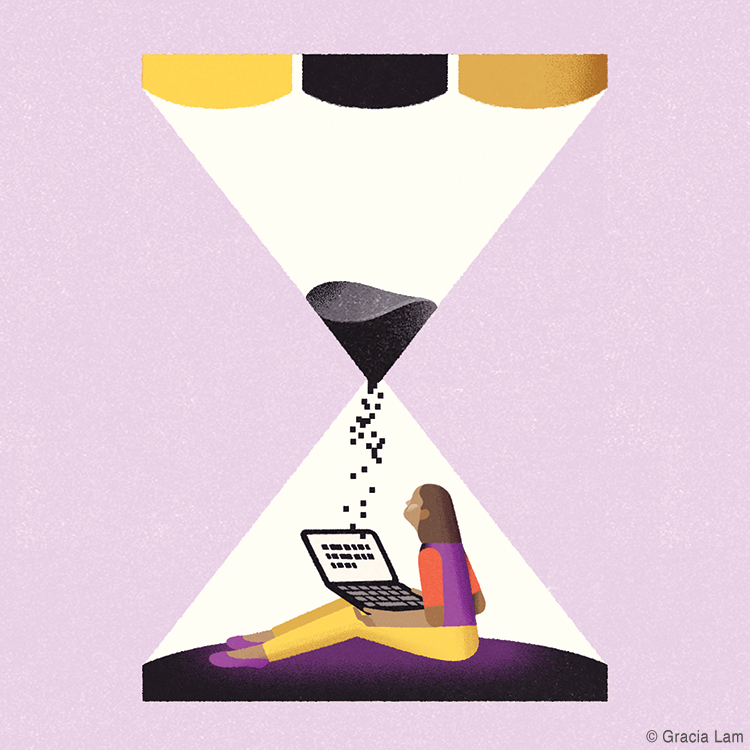
“The days held, and I learned to fill them.”
By Hilal Isler
By nine in the morning, I’ve already done plenty. Breakfast. A short stretch, less for ambition these days than maintenance. I’ve answered student emails: questions about deadlines, extensions, how to begin when you don’t quite know what you think.
Soon, I’ll have written two pages of a manuscript I’m working on. Lunch is at my desk, eaten quickly while I skim the news, always terrible; fresh horrors every day.
In the afternoon, I prepare my lectures. At night, I grade.
It’s a busy day, but it’s an ordinary one. It’s taken me years to learn how to live like this. Not efficiently, exactly, but deliberately. To understand what my time is really for.
In my early 20s, time felt endless. I couldn’t imagine ever running out. After college, I moved through a series of temp jobs: tending bar, waiting tables, tutoring kids, waking up at a different hour every day. My life had no real center back then, no real discipline. I was sloppy, unmoored. I stayed up too late, slept when I could, watched bad television, read worse books. Sometimes, late at night, I wrote.
Not that I was a writer or anything. Writers were a different breed of person, I thought at the time. I imagined them solitary and strange, living in remote-wilderness cabins, drinking themselves into genius. I didn’t think of writing as something you returned to every day. I didn’t think of it as work.
In my mid-20s, I moved to Philadelphia to begin a doctoral program at Penn. I’d been living in suburban Maryland for years and by contrast Philly felt dense and serious. Row houses pressed together. Summer heat lifting off sidewalks. Uneven SEPTA platforms that roared and echoed. Maybe I didn’t belong here, I thought. Maybe I was getting in over my head.
But soon enough I met someone on campus, a fellow graduate student, and my life began to rearrange itself in ways I didn’t yet understand.
Late one morning, after brunch, we sat outside together, reading. It was bright and brisk. I was thumbing through a copy of the Daily Pennsylvanian. The table was sticky with syrup and coffee rings, I remember that clearly.
“Look at this,” I said. “Says here they need columnists.”
“You should do it,” he replied.
I think I just stared at him at first. We’d only been dating a couple of weeks at that point and I hadn’t yet told him I liked writing things. I hadn’t told him that writing—writing with the intent of being published—was a door I’d never had the courage to open.
That night, in my room, the newspaper spread out before me, I wrote the two sample essays the application required. The following week, I got the call.
At first, I wrote very badly. But it didn’t seem to matter that much because it still felt like movement. It felt like I was moving toward something big, even if I couldn’t yet name it. Like I was stepping into a life I’d been rehearsing for all along.
Time accelerated after that. The days held, and I learned to fill them. I learned to work inside the shape of each hour. I sat cross-legged on my dorm-room bed, hands on the keyboard, telling myself I only had to stay there for 30 minutes, for 45. I was surprised by how much I could do when the day had edges. Penn helped me learn that structure has a way of magically stretching time.
What I had been missing before was urgency. Not the frantic kind, but the kind that actually steadies you. Deadlines—which I once believed suffocating—turned out to be clarifying instead. At last I learned to get out ahead of my days.
Now, in my 40s, time feels different again. My body wakes earlier. I stretch to keep going. My ambition is still sharp, but it’s tempered by an awareness of cost. I understand that energy spent in one place can’t be spent in another.
I still want many things: to teach well, to be present for my family and friends, to travel. But maybe above it all, I want to write. I no longer wait for pristine conditions. I write through noise, through fatigue, through doubt. I know time is limited and I have a lot to say.
I think sometimes of the younger version of myself—pulling pints, wandering. I want to tell her she’s not failing. She’s just circling a room she’s not quite ready to enter.
It’s late as I write this. The television murmurs in the background. The dishwasher hums. Ungraded papers blink on my computer screen, demanding attention. My body is tired in a way I recognize now not as defeat, but as evidence. I know I don’t have forever.
Hilal Isler GrEd’05 is an associate professor of instruction at the University of Texas, Austin. Her short story collection, Har Mar, was published by Northwestern University Press in July.

I loved this articule…. Thank you for sharing your experiences with me. You have gifted me tid bits that are so honest and beautiful that I feel nourished and understood. I have felt a Sense of sincere connection…. Very nourishing…. Thank you