
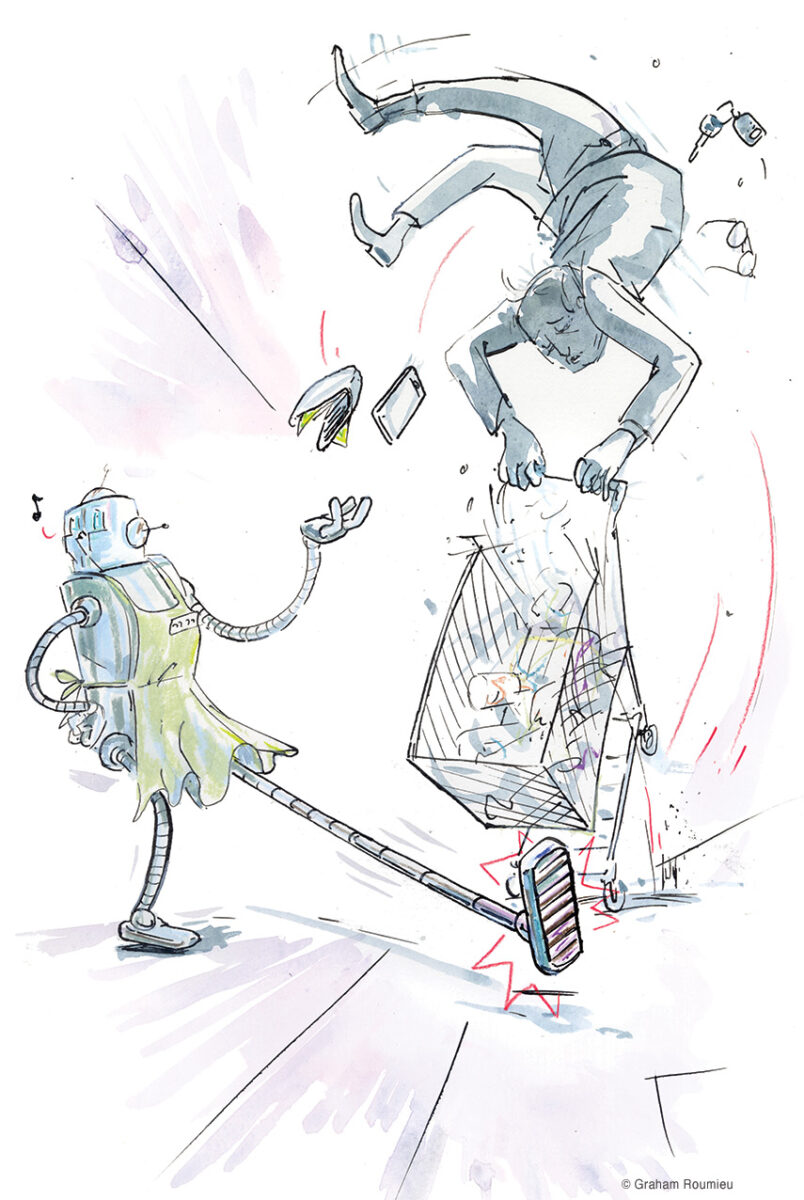
Consumer advocate Lindsay Owens C’06 is leading the charge to protect Americans from the depredations of “surveillance pricing.” Wharton marketing professor Z. John Zhang thinks a ban would hurt the very people it means to help. Fresh off testifying at a Senate Judiciary subcommittee hearing on the issue, the alumna and professor go toe-to-toe debating what Congress should do next.
By Trey Popp
It was September 2025, Americans were “rip-roaring mad about grocery prices,” and Lindsay Owens C’06 suspected that the fix was in. So the nonprofit advocacy group she leads, Groundwork Collaborative, launched an experiment. Teaming up with Consumer Reports, it recruited 437 volunteers to shop for groceries on Instacart, an online platform where people can order items from stores like Safeway, Kroger, and Target. Starting at the exact same time, each volunteer filled a virtual basket with the same 20 items for pickup at the same location. The test was run on five selected stores in four cities: Seattle; Saint Paul, Minnesota; North Canton, Ohio; and Washington, DC. Working in synchrony, the volunteers filled their individual carts and took a screenshot of the prices they would be charged for each item.
“Then we crunched the numbers—and that’s when things got weird,” Owens recounts. “Nearly 75 percent of the items in those Instacart baskets varied in price from one shopper to the next. A dozen Lucerne eggs at the same Safeway in Washington, DC, cost $3.99 for some shoppers and $4.79 for others—a 20 percent increase. Across the board, the average price difference for the same items was around 13 percent, but some shoppers were charged as much as 23 percent more. For certain products, there were as many as five distinct prices.”
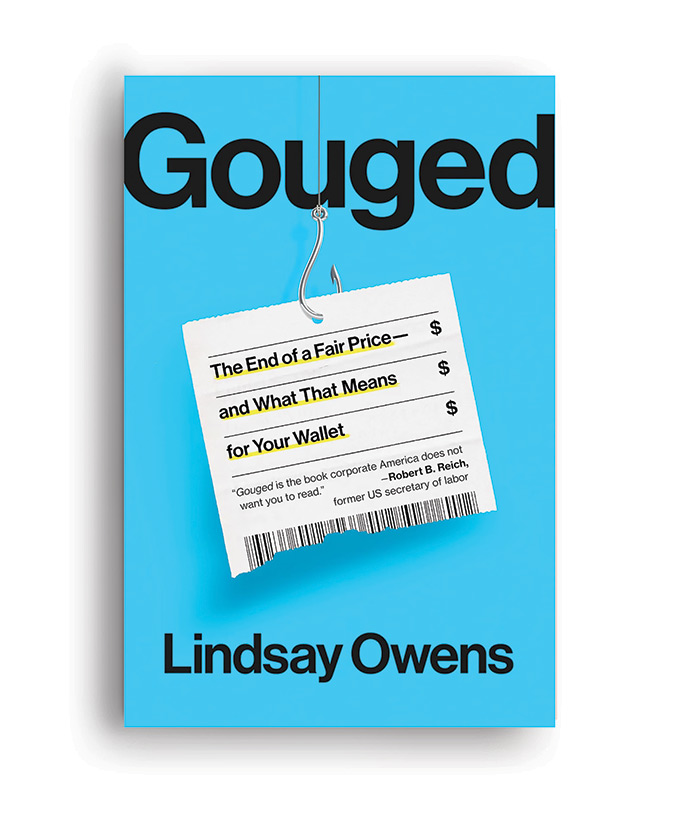
When it made the front pages of The New York Times and the New York Post that December, this revelation struck a chord. “Tens of thousands of consumers signed a petition urging lawmakers to put a stop to these pricing practices,” as Owens writes in her new book Gouged: The End of a Fair Price—and What That Means for Your Wallet (Viking, 2026). Then “the Federal Trade Commission, under President Trump, launched a formal investigation” into what the company had initially characterized as “limited, short-term, and randomized tests to help retail partners learn what matters most to consumers and how to keep essential items affordable.”
Instacart, which had also publicly maintained that it was “always transparent about pricing”—despite having told shareholders in 2023 about using a “machine learning-driven tool” called “smart rounding” that exploited instances of “low price sensitivity” to drive “millions of dollars in annual incremental sales”—swiftly recognized that it was embroiled in a PR nightmare. After all, most workaday grocery shoppers probably felt like Alex Tolley, a 71-year-old retired teacher who’d been one of Owens’s volunteers. “We just assumed that the listed price was the price for everyone,” he told Consumer Reports. “All prices should be the same for everybody, whether you’re rich or poor.” On December 22, Instacart backtracked with an announcement pledging to end “item price tests” and ensure that henceforth customers shopping “for the same items, at the same time, from the same store location on Instacart” would “see the same prices—period.”
“It was a remarkable reversal,” Owens writes in Gouged, celebrating the “citizen-led investigation and the groundswell of consumer backlash it unleashed.” But she intends the book as a warning, not a victory lap. Many of the threats Owens perceives to consumer welfare—from competition-eroding corporate consolidation, to potentially collusive algorithmic price-fixing, to the use of technological and legal restraints to block people from repairing products they own—do not yet have happy endings. And the specter of what some critics call “surveillance pricing” is sparking consternation across the political spectrum.
Are we headed for a future where brick-and-mortar retailers will marry electronic shelf labels with AI algorithms to raise prices on over-the-counter allergy medications in tandem with local pollen levels? Are online merchants already using your personal data—about your location, or your smartphone model, or your hunger level or upcoming funeral travel or pregnancy status as inferred from your browsing history—to charge you extra for a DoorDash order or bereavement flight or baby car seat? Owens hopes not but has amassed enough examples to fear that we’ve already crossed into troubling territory.
She has company. On August 4, shortly before her book was published, US Senator Josh Hawley (R-Missouri) chaired a Senate Judiciary subcommittee hearing on “AI surveillance pricing,” which he called “the unholy trinity of everything Americans hate: spying on people, ripping them off, and taking away jobs.” Owens, who was an economic policy advisor for US Senator Elizabeth Warren (D-Massachusetts) before serving as chief of staff and legislative director for Congressional Progressive Caucus Chair Pramila Jayapal (D-Washington), was his leadoff witness.
“With surveillance pricing, big tech has reinvented the ripoff,” Owens said in the hearing. Personalized pricing isn’t new, she allowed. Before the widespread adoption of price tags in the 19th century, “sellers used to haggle with customers, sizing them up to decide how much to charge them.” But 21st-century technologies have turned the tables on consumers who’ve long assumed that the price of eggs may vary by time and place, but not according to the identity of the buyer. “Companies can now purchase, track, and analyze your personal data at a previously unimaginable scale and clip. They catalog your location, your purchase history, and even your cursor movements to better predict exactly how much they can charge you.”
Owens laid out a litany of documented examples, along with an unsettling hypothetical. “Imagine you’re the parent of a sick child. It’s midnight. You ask Walmart’s AI shopping assistant, Sparky, to suggest a thermometer and some Tylenol. Sparky knows that your purchase is urgent, potentially leveraging that vulnerability to overcharge you,” she said. “As agentic commerce reshapes how we shop online, with AI agents starting to gain access to our habits, our purchases, and our personal conversations, the risk of being ripped off is only poised to grow.”
Owens called for banning personalized pricing, citing Groundwork Collaborative public-opinion surveys suggesting that more than three-fourths of Americans agree. “Clear and transparent prices are essential for a functioning capitalist economy,” she said. “It’s not too late to preserve fair pricing in America. We can start by pricing products again rather than people.”
But not everyone sees it that way. Wharton marketing professor Z. John Zhang also testified at the hearing, where he was the lone voice in favor of much of what Owens opposes. “Personalized pricing is not intrinsically sinister when viewed through the lens of economics,” he said. “Research shows that it can intensify competition [and] reduce profits,” ultimately benefiting consumers.
As Zhang later argued in an opinion piece for The Hill, “surveillance pricing” sounds ominous, but the menacing phrase “can obscure the central paradox: Different prices can look unfair, but one price for everyone can be even less fair.”
“A uniform price feels neutral because everyone sees the same number,” Zhang explained. “In practice, it can exclude people who would buy at a lower price while preserving access mainly for wealthier or less price-sensitive consumers. The visible unfairness of price variation must be weighed against the invisible unfairness of exclusion.”
Citing common practices like “student discounts, off-peak fares, targeted coupons for a price-sensitive shopper, [and] lower subscription tiers,” Zhang observed that “personalized pricing can make mutually beneficial transactions possible. The consumer who would not buy at the uniform price gets a lower offer, the firm gains a sale and consumer access expands.”
The key, he argued, is maintaining competitive marketplaces and consumer agency. “A hidden surcharge imposed because an algorithm concludes that a loyal or vulnerable customer will not leave is different. The economics may be related, but the legitimacy is not.” Likewise, “pricing built on deception, illegal discrimination, privacy abuse, exploitation of sensitive data or monopoly power deserves scrutiny and, where appropriate, prohibition.”
But he urged lawmakers not to heed Owens’s call for an outright ban. “Personalized pricing is a powerful competitive tool that can improve affordability,” he contended at the Senate hearing. “We should guard against abuses such as abusive surveillance and market power, but not reject a pricing tool that can benefit consumers and society.”
As it happens, the Senate hearing was something of a warmup match for Owens and Zhang, who had accepted the Gazette’s invitation to a friendly debate several weeks before they testified. On August 26 they joined senior editor Trey Popp on Zoom for a moderated conversation.
Over the course of nearly two hours of sparring, it emerged that Owens and Zhang had arrived at Penn at the same time. Zhang, who grew up in China and is now the Tsai Wan-Tsai Professor as well as the founding director of the Penn Wharton China Center, began teaching at Wharton during the first semester of Owens’s freshman year. But that was about the only thing they had in common—apart from the good-natured civility they both brought to the conversation. “I really appreciate the fact that Lindsay is very passionate about advocating on the behalf of consumers,” Zhang professed. “And I really enjoyed reading the book,” he added, complimenting Owens’ knack for enlivening her arguments with light humor, “even though I actually disagree with just about all the premises.”
Here are some highlights of their wide-ranging and sometimes elliptical conversation, which has been edited (and occasionally reordered) in the interest of clarity and concision.
Gazette: Everybody likes the idea of a fair price, but it’s not the easiest thing to define. What is a fair price?

Owens: Three economists asked a version of this question in a paper back in the 1980s. They gave consumers several hypothetical scenarios about pricing and asked whether they thought it was fair or unfair. Eighty-two percent of people said that it was unfair for a hardware store to raise the price of a snow shovel the morning after a blizzard. Ninety-one percent of people said it was unfair for a landlord to hike a tenant’s rent after he learned that the tenant got a job very close to the rental house. So consumers actually share a very common understanding. It’s not that Republicans and Democrats have different views of how fair pricing works. By and large, people feel like prices should reflect the underlying cost of making an item, and of course a little bit of profit for the company. But when pricing starts reflecting dynamics that are unrelated to the underlying cost of a good—like supply constraints, or the fact that a company has you over a barrel because it’s snowing outside and you really need the shovel urgently—that is a bridge too far for people.

Zhang: If you go back to medieval times, churches were involved in regulating pricing, and there was something called a ‘just price.’ And that was cost plus 5 percent, which was essentially your profit. So you can make a living, but you cannot make a killing.
But a lot of problems arise when you set prices only based on production cost. So the next idea of fair pricing is voluntary exchange: I charge a price, and if you like it you pay it; if you don’t like it, you walk away and go somewhere else. If it’s a voluntary exchange at a given price, that essentially is the fair price.
I agree with some of what Lindsay said. In fact, the shovel case, that’s what we teach, too. If you raise your price after a big snow, that just takes advantage of something consumers have no control over—if they have absolutely no option for anything else. But if they do have other options, and you raise your price, that probably is a fair game. So there are nuances.
Gazette: What are dynamic pricing and personalized pricing, and how are they related?
Zhang: Typically, prices are variable. One of the ways they can vary is over time. That’s called dynamic pricing. You can also vary the price across different customers. That’s called segmented or personalized pricing. Consider airline travel: business travelers tend to buy tickets closer to departure, but leisure travelers tend to buy way ahead of time. The whole reason you want to do personalized pricing is because you know that price sensitivity is different across different customers. But an individual customer’s price sensitivity can change over time, too.
Owens: Look, I don’t think fair pricing means frozen pricing. We want competitive, dynamic markets, and changing prices is a big piece of that. But prices need to be predictable. That helps people budget. Prices need to be transparent. That helps people comparison shop. And prices need to be the same for different people at the same place at the same time. You and I shouldn’t pay different amounts for the same loaf of bread at the same Kroger, for example.
Gazette: What are the conditions under which dynamic pricing works best?
Owens: I think dynamic pricing works really well when it is used to allocate genuinely scarce goods. An empty seat on a plane is worth nothing after departure. So filling it at a lower price point beats leaving it empty. I also think dynamic pricing can be a nice way to eliminate food waste. Electronic shelf labels have been used in Europe, alongside dynamic pricing, to mark down perishable foods—using a lower price point to get them off the shelf instead of throwing them in the trash.
My concern around dynamic pricing is that increasingly, we’re seeing it used in scenarios where resources aren’t scarce: we don’t have an allocation issue at play, a company just thinks it can charge you more.
Zhang: I agree that you find a lot of dynamic pricing in the context of some sort of a capacity constraint and scarce resources. Hotels and airlines all have some kind of capacity constraint. Utilities also use a lot of dynamic pricing. But dynamic pricing is not just to allocate scarce resources to the people who want them the most. Ultimately, you want to make sure that resources will go to people who value them the most.
Owens: But we’re in the midst of this affordability crisis, and for some consumers, even if they value something greatly, they can’t purchase it at that price. And when it comes to what I think of as high-frequency dynamic pricing—when prices are changing really rapidly, and when that intersects with household staples—that becomes a real challenge for families.
Zhang: We both agree that affordability is a big issue, and something that politicians should address. Inflation is a big factor to blame for the affordability crisis. And in the US, income disparity has become a real problem. But the problem with relating affordability to either dynamic pricing or personalized pricing is this assumption that somehow when you use dynamic pricing, prices always go higher. In reality, dynamic pricing helps to make more low-priced goods available. So it can be a way to address the affordability issue, not the other way around.
Look at the airline industry, and the reactions people had after deregulation in 1978. Everybody hated this variable pricing. They thought firms were gouging customers and jacking up the price whenever they wanted. But over the years, competition has intensified. There are more and more airlines, and they all use very sophisticated pricing tools, and ultimately consumers benefited, society benefited. In fact, the cumulative profit of aviation firms is very minimal—like, in nominal terms, 20-some billion dollars altogether since the beginning of civil aviation until now.
Owens: I think John is rightly leaning in on competition as being a salve for this kind of problem. And in the abstract, broadly speaking, I agree. But I think these practices undermine competitive markets. Personalized pricing helps segment customers, right? And that actually means that you don’t necessarily have to have the most competitive price—because you’re able to figure out who the less price-sensitive folks are and charge them more.
I think that also can undermine the important function that the budget shopper plays in the American economy. It’s actually the budget shopper, who’s balking at high prices and going to lower priced offerings, that drives competition. But when budget shoppers are segmented, they can no longer do their job of helping to discipline prices in the market. Personalized pricing practices are not very transparent to consumers, which undermines competition. And there are aspects of them that rely on information asymmetries, which I think undermines the ability for markets to be competitive.
Gazette: John, is Lindsay onto something? Are there ways in which personalized pricing can impair competition in ways that are not economically optimal?
Zhang: No, I think the effect is exactly the opposite. What Lindsay’s saying is if I have a single price, the marginal consumer will determine that price. That’s true. But she’s also saying that the price based on the marginal consumer is going to be low, simply because a lot of customers out there cannot pay more. But even in a monopoly situation, a firm will face a tradeoff between the margin they’ll lose by lowering a price versus the additional volume they’ll gain. And the universal conclusion of the economic literature is that the firm will charge a way higher price than what’s socially optimal. If you let a firm just optimize their trade-off between margin and volume, ultimately they’re going to charge a high price.
Given that, there is a lot of room to expand down below. But to do that, you’ve got to have multiple prices. In fact, all the research suggests that personalized pricing can intensify price competition. Imagine we have competing firms that both know Trey likes a certain product. If I can identify you, and the competition can identify you too, then we’re all going to bid for your patronage. So you’re going to be subject to competitive offers from everywhere. That definitely is a lot more competitive situation than if you pay a fixed price from one firm.
The key here is that there has to be competition in the marketplace. If you have a pure monopoly, then everything Lindsay says is right.
Owens: I think a lot of what ails the US right now stems from the fact that the market economy isn’t functioning in the most healthy way. People feel like companies are not just passing along their rising costs, they’re going for more—partially enabled by the fact that markets aren’t perfectly competitive, that industries are more consolidated, that there are more asymmetry opportunities to take advantage of consumers.
And I think there is a way in which single uniform pricing—which John thinks erodes competition—really acts as a shield, because firms have to compete for budget-conscious shoppers, and that drags the price down for everyone. Whereas price discrimination allows firms to fight potentially very aggressively for the comparison shopper—pushing them targeted discounts—while stiffing everyone else who’s not price sensitive. So I’m not quite sure that personalized pricing actually works in the pro-competitive way that John outlines. I think there are ways in which price competition is actually more vigorous in a uniform pricing context.
Gazette: It would be pleasant to think that the way personalized pricing would work is that all these companies will essentially be saying, “How can we set the perfect price that Trey is just going to love?” But I can’t help but think about a recent investigation of how Target was changing prices based on where people were located when they used the Target shopping app. One thing it revealed was that when people checked from the parking lot of a Target, the price of a baby car seat went up by about $75. Because they’re already right there and ready to pick it up. Now, as a parent, I can remember that virtually the moment my wife got pregnant, we were flooded with mail that made it clear that any number of companies knew exactly when we were going to have a child. So I find it a little bit unsettling that the moment a company can determine that I need a car seat, then they can potentially use personalized pricing to realize that my willingness to pay has suddenly gone way up, and take advantage.
I’ve also personally experienced being offered different prices based on whether I checked from my desktop computer at work or my laptop at home. Another thing that’s repeatedly happened to me is that I land in the Philadelphia airport and bring up Uber to compare it to the flat taxi rate. Then I walk through the terminal to the sidewalk, and the second time I check, it is invariably a higher price. Because they’ve learned something about my need for a ride, presumably. Which makes me think that the only way to get the best price is, paradoxically, not to check it to begin with—because the mere act of checking a price seems to work against me.
Zhang: Did you check any alternatives?
Gazette: No. Perhaps I should have checked Lyft—but presumably they would be using the same tools, otherwise they’re leaving money on the table, right?
Zhang: Yeah, those kind of things have happened. For instance, when you check from university versus at home, and get a different price, that was reported a long time ago about Amazon. A University of Michigan professor was shopping for some book, and when they looked from the school, it quoted 20-some dollars, but at home the price was lower. If you want to look for examples of abusive pricing, you’re going find a lot of them. It’s a big marketplace, with lots of transactions.
But abusing customers is not that easy. Customers are smart. So by and large, I think most reputable firms don’t do this. They want to actually do well by their customers, because that’s the only way for them to do well for themselves in the long run.
Owens: What we are talking about is an increasingly sophisticated way of slowly but surely overcharging you for everything in your shopping cart—using technologies to turn the dial here, tweak it there, and squeeze out a few more pennies. The sum total is companies getting better and better at extracting all of the consumer surplus. And leaving us with less. That explanation is perfectly consistent with pleasant CEOs saying they’re just ‘innovating in the pricing space,’ and getting a little better at ascertaining willingness to pay and maximizing revenue. That’s great for shareholders and good for their bonuses, but it’s not necessarily good for consumers or for the economy.
Gazette: John, you made an interesting observation at the Senate Judiciary subcommittee hearing. You said that if a consumer is willing to pay $4 for something that costs $2 to produce, but a firm comes along and charges $5, the sale doesn’t occur, and so the social value is lost. And conversely, if firms are allowed to charge multiple prices to different kinds of people, then they’ll charge a lower price to more price-sensitive consumers and thereby expand access to the product. That sounds great. But here’s a different hypothetical question. If it costs $2 to produce something that I value at $4, but most or even all the sellers in the marketplace have used the same third-party data broker to determine that I’ll actually pay $5 if push comes to shove—so that becomes the only price that I’m offered—what’s the social value calculus then?
Zhang: That’s a very good question. Collusion is something that some firms always want to do. There are bad apples out there. And whether you do collusion through a handshake in a smoke-filled room, or whether you are actually doing it with an algorithm, it’s all against the law.
Gazette: But what if they don’t need to collude? What if the data is so good, and the algorithms so sophisticated, that they can all just find my personal absolute pain point?
Owens: The thing that strikes me is that we see personalized pricing being used when a company ascertains that they think we’ve got enough money that they can bilk us—or that we want something badly, or need it urgently. We have seen Expedia charging users from high-cost cities more than users from low-cost cities for an identical hotel room in Manhattan, for example. Basically a company can take a peek into your wallet and then decide the price—rather than setting the price based on the market.
There was also an example from ProPublica, a while back, of Princeton Review targeting Asian American households and charging them more for test prep services. They were using geo-targeting to figure out the percentage of Asian American households in a particular geography and then charged more for test prep services there. And that wasn’t about income—there wasn’t a similar case of charging wealthier white people more—it was about an assessment of Asian American households’ willingness to pay extra to do well on tests. So I think, over and over again, what we see is the ability to prey on desperation, and the ability to use information that in many cases is unfairly gathered, to charge someone more.
A lot of companies have applied for patents, filed patents, and received patents for surveillance pricing technologies. DoorDash has been developing technology, according to their patent, to create an “agitation index” to tailor their pricing and recommendations based on how hungry they think you are, using measures that include how quickly you scroll through the menu, for example. The Federal Trade Commission did a study of surveillance pricing and found that MasterCard and Revionics and Accenture were selling surveillance pricing tools to 250 major companies throughout the US. So that’s a lot of companies who are buying these tools, presumably to use them in some way or another.
So there’s reason to worry if you’re a new parent who needs a car seat, or a parent who has a sick kid and needs to get a thermometer and Tylenol right now.
Zhang: All those examples make sense if you assume that consumers have no alternative. But the moment you have an alternative, you’re going to see that, in fact, companies are all going to bid for your patronage. No matter how much money you have in your pocket, I want to make sure it’s on my side and not on the other side, right?
Owens: I also think that all of this may be about to change a little bit as agentic commerce becomes more integrated into American shopping. Because we would potentially be moving from a world in which companies were mostly relying on behavioral data and inferences about us to estimate our willingness to pay—our purchase history, what we hover over, what we click on, data they buy about us from another retailer—and instead, increasingly, moving into a world where a company can ask us how much we need something. And we might tell them, right? Not realizing that the price will be impacted, potentially.
Zhang: Agentic purchases are really a reason we want to keep personalized pricing. As shopping bots become more intelligent, it will become much easier to get into situations where two competitors will bid for your patronage—way more than before. So in that kind of a situation, you actually want a firm to set a personalized price. If they set a single price, it would actually shelter a lot of customers from competition, reducing competition instead of intensifying it.
You want to give firms more weapons to compete against each other. And you want them to be flexible. In fact, the whole reason why the airline industry has made very little money, cumulatively, is because their pricing is just way too flexible. And when you have a too-flexible pricing system, what happens is that companies throw darts at each other, and hurt each other—but consumers ultimately benefit from that. That’s something that I think a lot of people don’t realize.
Gazette: John, you’ve written that dynamic pricing shifts power to savvy consumers, that “those who monitor fluctuations, book at the right time, or shop across platforms can consistently secure lower prices.” And that “in a dynamic pricing world, knowledge is power.” If knowledge is power, can consumers possibly get the upper hand over companies that are buying and selling their data on a minute-by-minute basis?
Zhang: Any time you face change, there is fear. But my research has looked into this since the 1990s, and, by and large, the direction we are going is ultimately going to be beneficial to consumers, beneficial to society, and beneficial to firms. Imagine how much inefficiency we have created just because firms want to set multiple prices. For instance, not long ago, I’m sure you clipped a lot of coupons out of Sunday newspapers. That turned out to create a huge amount of fraud and waste—on top of all the efforts on the part of consumers. Now firms can say, I know, Trey, that you’re price sensitive; I’m going to give you a targeted coupon. That improves efficiency so much. More importantly, when competing firms use personalized pricing, the last line of defense for the firm is your preference for one of them. Even if they can look at your wallet, and they know how much money there is in there, ultimately you’re going to go to the company you prefer. In that world, good firms that do good customer service and command customer loyalty will win. But if you ban all that, you’re going to reduce competition, and actually shelter the inefficient and bad firms.
Gazette: John, when a website asks to track your data, do you opt out? Or do you say, “Hey, take as much as you want, because that’s just going help me?”
Zhang: I never opt in. Because I’m a price-insensitive customer—I don’t look at the price, so I don’t want people to know that! I mean, consumers want to be strategic. Ultimately, I think personalized pricing will benefit people who are price sensitive. It will make the people who are price insensitive worse off. There’s no question there—unless there’s huge competition.
Owens: I don’t think it should be the job of consumers to duck and dodge and bob and weave and try to outsmart these new pricing technologies. Do I think consumers who are price sensitive should comparison shop? Absolutely. That’s a great tool. But all of the technologies we’ve talked about today make comparison shopping harder. With personalized pricing, you don’t know the price at each store, you know your price at each store. Dynamic pricing—volatile pricing—makes comparison shopping really difficult. Most Americans have experienced this, trying to comparison shop with airline tickets. You look one day, you want to talk to your spouse, and the next day everything’s changed, and you have to start the process all over again. This is incredibly onerous. We don’t want to live in a world where you have to hang upside-down by your fingernails on a Tuesday to get a good airline price, and a world in which there’s a Points Guy for every item in your shopping cart: a guy that teaches you how to get the best deal on milk, a guy that teaches you how to get the best deal on ice cream, a guy that teaches you how to get the best deal on shampoo. This is not the world that we want to live in.
Zhang: The problem is that if consumers are not voting with their dollars, the market economy is not going to function no matter what you do. Which means that if you actually put them in an environment where they have more agency—they have more opportunities to take advantage of—over time people will learn to look for low prices. By the way, the airline industry is a perfect example. Nowadays, everybody knows when to book and how to get low-priced tickets.
I grew up in a country where the government told us, ‘Don’t worry about the price, we’ll fix prices for you.’ And that happened—with disastrous consequences.
Gazette: Some kind of legislation is expected to be introduced in Congress about personalized pricing. What do think it should include? What should it leave alone? Or should we even have any national legislation at all?
Owens: I am very supportive of a ban on surveillance pricing. At its core, surveillance pricing is the practice of spying on you to overcharge you. So a legislative proposal that eliminates a company’s ability to use personal information that they collect about you, that they buy about you, to set a price just for you—is a really great first step. Will that solve every pricing problem or everything that vexes consumers? No. But I think it’s a good first step. Many states are moving in that direction, in whole or in part. California is sending legislation to Governor Newsom’s desk. [Editor’s note: Despite being on the cusp of passage, California’s high-profile bill died in the State Assembly several days later in the face of industry opposition.] New York has legislation on Governor Hochul’s desk. New Jersey has taken a small step in this direction.
Gazette: Given all the state action, do you think that national-level legislation would be productive?
Owens: I think it might be more important now, because the variation at the state level is pretty considerable. The lottery of where the stork drops you in the US shouldn’t determine whether or not a company can rip you off. I’m also supportive of privacy protections upstream, so that companies can’t gather that much data about you in the first place.
Zhang: If the government really wants to act, the action should be on the data collection side. There has to be consent: Do I want you to share the information with anybody else, and can you keep the information forever, and all that. I think there is already law on all that. Nowadays, you see a lot of apps ask, Do you want me to track what you do? And you just say no, right? You have a choice. Number two, it is really very important to maintain transparency. The reason is that firms need data about consumers to serve them, and consumers need good information about firms in order to vote with their dollars. I think the government should mandate that if you do personalized pricing, you better let people know. And that way, firms would justify why they’re doing it. I really like what New York does: it basically says that if you use personal data to set a price, you better let a consumer know.
Owens: The current New York law was a mere disclosure law. If you log into a website or an app, a firm that uses your data to set pricing has to include a little disclosure that says, This price was set by an algorithm using your data. It’s a really good first step, but doesn’t go far enough.
Zhang: If you go ahead and ban personalized pricing, I think inadvertently you’re going to create an affordability issue, simply because firms are going to offer less discounts, and less frequently.
Owens: The economy isn’t functioning in a way that’s maximally advantageous to society or to consumers. While nickel-and-diming consumers all day long might not be illegal, I think we do have to ask the question of whether that’s the society and the economy we want to live in, and whether that’s what we should be rewarding—whether in the business school at Wharton, or in the boardrooms where CEOs and CMOs can brag about the new technologies they’re bringing to bear to do personalized pricing to extract more from consumers.
In the book, I give a lot of examples of ways in which I think the rip-off has been reinvented by technology companies, but what John said earlier is right. A lot of these practices have been around for a really long time. I just think new technologies are supercharging them, making them harder to spot, and coinciding with this period in which high prices are particularly concerning for American families. And look, we just lived through a once-in-50-year period of high inflation. I think the conversation about prices is going to be with us for at least another decade. The debate that John and I just had, the topics that we’re thinking about are going to be flourishing debates in Congress, in business schools and universities, but also among the American public. I think we’re really just in the beginning phases.