
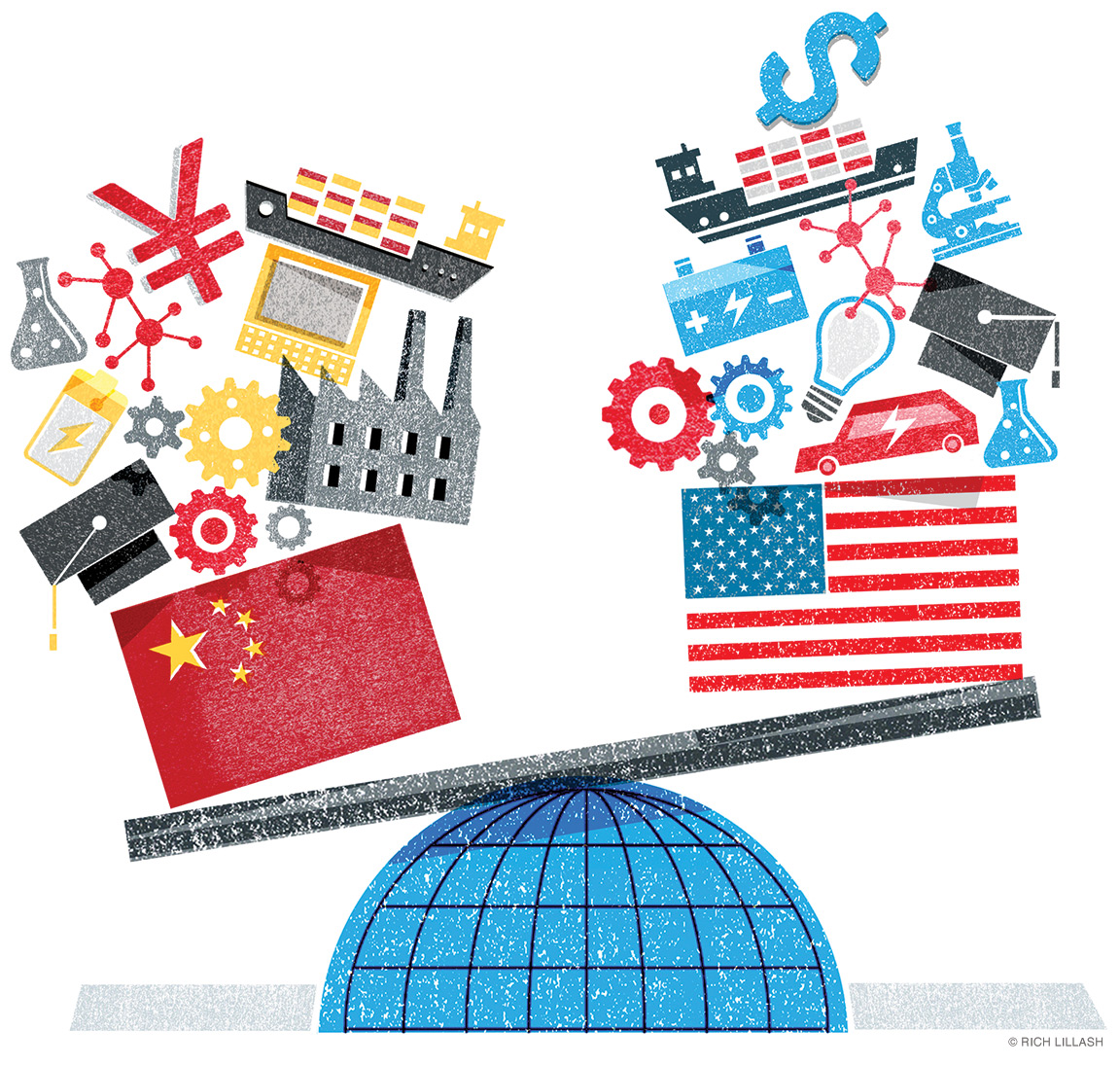
Penn economist Hanming Fang on China’s rise and the future of US–China relations.
That the Iran war delayed but did not derail a planned trip by President Donald Trump W’68 to Beijing—rescheduled from April to May 14–15 at this writing, with a reciprocal visit to Washington, DC, by Chinese leader Xi Jinping expected later in the year—highlights the ongoing strategic competition between the two nations, which will shape the future of geopolitics and international trade.
Hanming Fang Gr’00, Penn’s Norman C. Grosman Professor of Economics, is coeditor of The Arc of the Chinese Economy (Cambridge University Press, 2025), which provides a timely account of how China’s economy has evolved and where it may be headed. In an email interview, Fang, who is spending the current academic year as a visiting scholar at Pembroke College at Cambridge, shared some thoughts on China’s ascent and vulnerabilities, US–China trade, and the prospects for Chinese students coming to America in light of US immigration policies and broader issues of cost and opportunities elsewhere.
He began by noting that, in the face of US tariffs, China announced the world’s largest trade surplus ever last year. The goods and services it sold abroad in 2025 were valued at $1.19 trillion more than its imports—a near 20 percent increase over 2024, which was fueled by exports to the European Union, Africa, Latin America, and Southeast Asia.
“The growth of the Chinese economy in the last four decades is one of the most transformative events of global economic history,” Fang said, but he also pointed to “signs of fragility.” For example, another driver of China’s trade surplus was “a weakness in Chinese currency and the country’s domestic consumption.” The buying power of Chinese families has withered since a housing market crash in 2021 eroded the life savings of many who had invested in property. “The loss in value of the renminbi,” which makes imports more expensive, “has depressed consumer spending.”
When asked how China went from a technological backwater to a superpower in his lifetime, Fang noted that government subsidies were an important factor, but not sufficient in themselves. “They functioned primarily as accelerants,” he said, “helping firms scale early, move rapidly down learning curves to improve quality, and survive periods of low profitability while building industrial capacity.”
But other “structural and market forces” were at least as important: “intense internal competition, vast domestic market, strong infrastructure investment, and the clustering of supply chains that dramatically reduced transaction and coordination costs. Local governments, incentivized by growth and employment targets, competed to attract industry.”
“Human capital” was also central. “China trained large numbers of engineers and technicians skilled in applied, production-oriented problem-solving. Of course, in early stages, precisely because China was a long way from the global technological frontier, openness to foreign technology—through trade, joint ventures, imported equipment, and learning-by-doing—played a critical role.”
China’s dominance in the production of lithium-ion batteries—which were invented by American and Japanese scientists and are used to power electric vehicles and store excess energy captured by solar panels, as well as for AI data centers and modern weapons systems—reflects its “control over the entire midstream of the supply chain,” Fang said. “While China did not have a monopoly on raw materials, it invested heavily in mineral processing, component materials for batteries, cell production, and pack integration. These activities benefit enormously from manufacturing at scale, learning-by-doing, and tight supplier coordination. Strong domestic demand—especially from electric vehicles—created early volume, while fierce competition forced continuous cost reduction and process innovation.”
A similar story can be told about China’s preeminence in the chemical separation and refinement of rare earth metals needed, alongwith the magnets made from them, for almost all modern manufacturing.
Along with its advances, Fang also pointed to “several interrelated vulnerabilities” confronting China. “The property sector, still recovering from the burst of the domestic housing bubble in 2021, remains a major drag,” he said. “Debt constrains fiscal flexibility of local governments. Demographic decline will weigh on long-term growth and raise social spending pressures. Youth unemployment reflects structural mismatches between education and labor demand, as well as subdued private-sector confidence.
“More broadly, China faces the challenge of transitioning from investment- and property-led growth to productivity- and consumption-led growth while operating in a more constrained external environment. China’s ability to realize its growth potential will depend on stabilizing the property sector without reigniting excesses, restoring private-sector confidence, raising household consumption, improving productivity, and managing fiscal and demographic pressures.”
Dramatic as China’s economic ascendancy has been, he added, “the United States retains major strengths. They include capital markets, alliances, immigration capacity, and not least research universities, but sustaining them requires confidence, openness, and investment.”
Fang grew up in the Zhoushan Islands in the East China Sea and graduated from Fudan University in Shanghai before earning his PhD in economics at Penn in 2000—when he was one of some 55,000 Chinese students enrolled at US colleges and universities. At its pre-pandemic peak in 2019–2020, that number swelled to 372,000 but shrank to 277,000 in 2023–24 (still about a quarter of all international students). The decline reflects “visa uncertainty, geopolitical tensions, and perceptions of discrimination,” as well as “the increasing attractiveness of Hong Kong and Singaporean universities, relative to those in the US and the UK, as destinations of overseas education for Chinese families, both for geopolitical reasons and for cost-effectiveness,” he said, adding that cost “becomes a more salient consideration due to the decline in housing wealth.” Fang speculated that “future flows will depend on US immigration policy, campus climate, post-graduation work opportunities, and the attractiveness of alternative destinations.”
Should the number of Chinese students coming to the US to study—and remaining in the country after graduation—continue to trend downward, the economies of both countries would suffer, he contended. “The United States would lose tuition revenue, local economic activity, and a key source of high-skilled labor, particularly in STEM fields,” Fang said. “China would lose some access to US-based research networks and tacit knowledge, though it may retain more talent domestically. Overall, both economies would lose from reduced talent circulation.” Furthermore, “reduced contact increases misunderstanding, mistrust, and the risk of miscalculation,” he added. “It weakens informal channels that help societies interpret each other accurately and undermines cooperation in areas such as science, health, and climate change.”
While the economies of the United States and China remain deeply interdependent through trade, finance, and global supply chains, more segmentation is occurring in strategic sectors such as semiconductors and AI. Going forward, “we are likely to see selective decoupling, alongside continued integration in many non-strategic areas. Interdependence will persist, but it will be narrower and more managed,” Fang predicted. “How the future will shape up depends a lot on whether a certain level of mutual trust can be sustained to serve as the foundations of collaboration.”
And on that, while admitting that he may be naïve, he remains “cautiously optimistic.”
—Mary Ann Meyers Gr’76