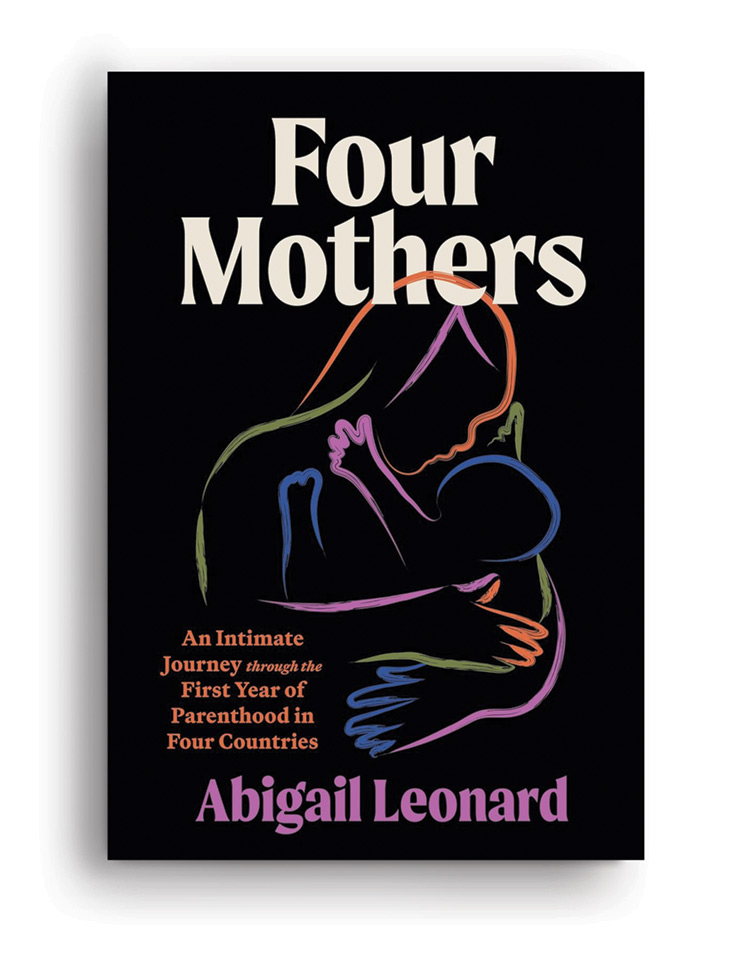
Algonquin Books, 288 pages, $30.
A new book takes stock of motherhood in Japan, Kenya, Finland, and the US.
Abigail Leonard C’02 was an international journalist with three young children—the littlest just eight months old—when she swung her reporting to the highs and lows of new motherhood.
Her own experience had been unconventional, starting with a trans-Pacific move while pregnant. In Japan, she used an obstetrician who “sped across Tokyo behind the wheel of a ruby red convertible to deliver babies at three different hospitals,” she later wrote. The usual postpartum questions around sleep, feeding, and returning to work became even tougher with cultural differences layered on top. And through it all, “I was filled with a deep longing for home,” she wrote.
But as a journalist, Leonard wasn’t interested in telling her own story, unique as it was. She had something bigger in mind: chronicling the lives of multiple new mothers around the world to see how that tender time unfolded—and how their countries’ policies supported them (or didn’t).
“The first year of motherhood and struggles of motherhood are underreported,” she says. “Treating it like a valid subject of reporting and documentation is really important.” Four Mothers, which came out in May, follows the pregnancies and first year of motherhood for Tsukasa in Japan, Chelsea in Kenya, Anna in Finland, and Sarah in the US.
Through Leonard’s absorbing, deeply personal accounts, the book shows how different new motherhood can look from country to country.
Nordic countries are renowned for their pro-family policies, and Four Mothers confirms that many times over. Anna is among the 99.5 percent of Finnish moms who receive prenatal care at a public maternity clinic—including a special appointment focused on parenting philosophies and breaking intergenerational trauma.
Parents in Finland also get 40 days of paid leave before their child is born, which continues for almost a year after birth. “Latte pappas” fill city cafes and parks, sipping coffee and enjoying time with their new babies. Leonard writes that according to Anna, “the debate over working mothers [in Finland] seems so resolved that the conversation has largely moved on to fathers and non-birthing partners.”
Even as she struggles through a breakup with her baby’s father, Anna is buoyed by government support; on top of her paid leave, there’s a monthly child stipend, plus some extra given to single parents. She returns to her job part-time one year postpartum, though it’s protected for three years. Finding quality daycare is a slam dunk, too.
Now compare that to Sarah, a happily married Utahn whose story will be much more familiar to American readers. Her husband returns to work a week after their daughter is born. Sarah has three months of protected leave, then she’s back at her own job while juggling childcare, breast pumps, and lack of sleep. And despite an uncomplicated birth, her hospital bills are the highest of all four women.
“In the US, the last few generations have really failed parents in major ways,” Leonard says. “We’ve come so close on things like universal daycare and guaranteed paid leave, and then the same forces arise—sexism, racism and corporate greed.” She hopes her book will help “move the conversation forward” on policies that could improve life for new parents.
It wouldn’t be the first time Leonard’s reporting has spurred change. After she produced a series for PBS on the caregivers—often spouses—of veterans with traumatic brain injuries, the US Senate Committee on Veterans’ Affairs requested a copy to screen. Then they established two federal programs to support those caregivers.
A story she reported for Al Jazeera revealed the dangers that people in prisons were facing due to a private healthcare contractor. “The ACLU referenced our story in a legal case against the healthcare provider, and the provider ended up being kicked out from working in prisons after that,” Leonard says. “In both those stories, I felt like I contributed to helping make a better society for people. Journalism can do that.”
Before she became a professional journalist, Leonard dabbled in it at Penn. She wrote a few stories for the Daily Pennsylvanian and 34th Street but mostly focused on her anthropology major. Those classes laid the groundwork for Four Mothers, she says, which at times reads like an ethnography in its level of detail, close observation, and historical context.
After a year in New Orleans with Teach for America, she moved to New York to pursue a master’s degree in science journalism at New York University. Then she worked in TV journalism: ABC to PBS to Al Jazeera, with a short detour on political commentary shows.
But when her husband began making weekly commutes from their home in San Francisco to his company’s Tokyo office, Leonard—pregnant with their first child—moved with him to Japan. As she soaked up Japanese culture over the next six years, she also reported on it for major news outlets, relaying its challenges and triumphs to American audiences. For Newsweek: “Could Japan’s Shrinking Population Lead to Shrinking Rights for Women?” For Time: “This Japanese Island Lifted Its Coronavirus Lockdown Too Soon and Became a Warning to the World.” For the Washington Post: “For Some Expats, US Gun Violence Makes Japan Feel Like a Haven.”
Her family returned to the US in 2021 as a party of five, which is when Leonard’s work on Four Mothers began. “I sort of had in mind what I wanted,” she recalls: “middle-class, first-time moms in or near a city, because that sort of represents the world’s population. And I wanted geographic representation.”
With help from local reporting partners, Leonard followed the women for a full year. There were site visits, phone debriefs, texts, emails, photos, videos, and baring of souls. The result is a level of access and engaging prose that makes Four Mothers read like a novel at times. Here’s Chelsea in Kenya, back to work when her baby is three months old, trying desperately to pump milk on a short break:
She scours the facility for a concealed corner where she can pump. Finally, she settles for the book room, a storage area for documents and other miscellany. It’s relatively private, but the air is dank and the stench of old paper turns her stomach.
As she unpacks her pump, she can already hear coworkers calling for her: Chelsea? Chelsea! A customer needs help!
[…] Suddenly there is a slash of light and before she knows what’s happened, she sees one of her coworkers silhouetted in the doorway. He is looking for a file but instead finds Chelsea, wide-eyed and half naked. He turns as quickly as he came and leaves the room, a flurry of frantic apologies trailing in his wake. Chelsea is stunned, then mortified. But she decides there isn’t much she can do—Ada still needs to eat.
Leonard mostly kept her own experiences out of the interviews, but “knowing that I understood what they were going through, [these women] were able to open up,” she says. “I just tried to follow them wherever they wanted to go. They often went to these places that were sort of unexpected and pretty vulnerable.”
Like when Sarah, the Utahn, talked about her husband coming out as bisexual and requesting a polyamorous relationship. Or when Tsukasa in Japan revealed the sexual abuse she’d suffered in elementary school.
Surprises pop up in the research and facts Leonard weaves in, too: Only 40 percent of Japanese families have ever hired a babysitter. Some public hospitals in Kenya are so overcrowded that three or four women in active labor may share a single bed. Pain medicine is almost never used for births in Japan, so some doctors encourage pregnant women to diet to keep their babies smaller and make a medication-free delivery easier.
Still, it’s clear throughout the book just how far the US lags behind other countries in parental support. Japan has roughly 14,000 community centers for moms to meet up and enjoy activities with their babies and toddlers. It also has free daycare. In Kenya, new moms receive three months of guaranteed paid leave. And Finland has “a 100-year head start on us,” Leonard says, referencing their national maternity leave.
She says it’s been “really interesting” to hear American mothers respond to her book. They’re curious, angry, and motivated. When they ask her how to get involved, she directs them to the Chamber of Mothers, a grassroots group striving to improve maternal rights and support.
“I feel like we’re getting to this inflection point where people are realizing it’s unsustainable to go on the way we are and to think about other ways of moving forward,” Leonard says. “I just want the US to be better, and I think we can get there.”
—Molly Petrilla C’06