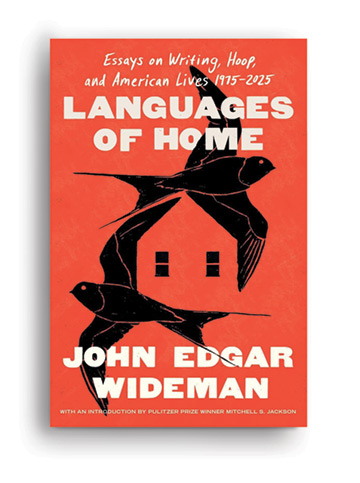
Essays on Writing, Hoop, and
American Lives 1975–2025
By John Edgar Wideman
Scribner, 400 pages, $29
The many voices of John Edgar Wideman.
Review by Julia M. Klein
Works by John Edgar Wideman C’63 Hon’86 crowd my shelves: The Homewood Trilogy, Philadelphia Fire, Two Cities, Hoop Roots, God’s Gym. But the book that remains indelible for me is his 1984 memoir Brothers and Keepers, which Wideman described in an author’s note as a “mix of memory, imagination, feeling and fact.”
Wideman wrote that book in two voices: his own and his youngest brother’s. Robby, involved in a botched robbery that led to a death, was convicted in 1976 of felony murder and sentenced to life imprisonment without the possibility of parole. By then, Wideman had earned a Rhodes Scholarship, become a novelist and English professor, and served as founding director, in the early 1970s, of Penn’s Afro-American Studies Program (now the Department of Africana Studies). Brothers and Keepers gained Wideman critical acclaim and a larger audience, further accentuating the contrast between his fate and his brother’s. (Robby’s sentence was commuted in 2019 after he had served 43 years in prison.)
But even as Wideman continued to write, teach, and earn literary prizes—including two PEN/Faulkner Awards and, in 1993, a coveted MacArthur Fellowship—another murder was haunting him and his family. In 1986, at age 16, his son Jacob Wideman fatally stabbed a summer camp roommate, Eric Kane, for no apparent reason. Jacob confessed, accepted a plea deal, and was sentenced to 25 years to life. Paroled in 2016, he stayed on home arrest for less than a year before being reincarcerated on a technical violation. His legal battle continues.
The best account of that tragedy is probably the 2023 podcast Violation, from WBUR and the Marshall Project, to which the elder Wideman, as well as Jacob and other family members, contributed. But there are scattered references to the catastrophe and its aftermath in Wideman’s new nonfiction anthology, Languages of Home, and they comprise some of his most searing writing.
The collection as a whole is a deliberately mixed bag. It contains political and literary essays, reviews, profiles, and other pieces published between 1971 and 2025—more than a half-century of industry—in an array of outlets, including Esquire, Harper’s, the New Yorker and the New York Times. Some pieces are introductions to books by or about other Black writers. What is most striking is the range of styles, voices, and poses Wideman adopts, sometimes within the same piece—more varied even than his subject matter. In his use of inventive structures and stream-of-consciousness prose, Wideman illustrates one of his own favorite dicta: that the line between fiction and nonfiction is often blurry at best.
For both aficionados and readers new to him, Languages of Home offers a cogent summary of the writer’s overlapping preoccupations. These include African American literature and music, his beloved sport of basketball, and the ways in which the American struggle around race has shaped his literary forebears, his Pittsburgh neighborhood of Homewood, and his own identity. “History is a cage, a conundrum we must escape or resolve before our art can go freely about its business,” he writes in a 1990 preface to Breaking Ice, an anthology of African American fiction. At the same time, Wideman, who is both the product and progenitor of mixed-race families, critiques the idea of the Black-white binary and insists that Black history cannot be separated from the larger American story.
Languages of Home is a testament to Wideman’s heroes. His own modest celebrity has helped him score incisive interviews with the actor Denzel Washington, the filmmaker Spike Lee, and the basketball star Michael Jordan. He has admired and decoded the writings of Charles W. Chesnutt, Richard Wright, Ralph Ellison, W. E. B. Du Bois, and Zora Neale Hurston. He has pondered the meaning of Malcolm X’s many incarnations and various attempts to interpret Malcolm’s legacy. And he has mourned both the lynching of Emmett Till and the execution of his estranged father, Louis Till, a World War II soldier convicted of rape and murder in a court-martial that may have been marred by racial bias.
If Wideman appears bitter at times, history, he tells us, is to blame. With Du Bois, he argues that the American Dream has been undercut by the persistence of “the race problem.” In a 1990 introduction to The Souls of Black Folk, he credits Du Bois with making him realize that it “wasn’t simply my personality, my overwrought imagination that created the alienation and ambivalence dogging me, my seesawing emotions as I negotiated the unspoken, unwritten iron rules of racial etiquette with their violent sanctions always simmering just below the surface.”
Wideman’s 1985 title essay, “The Language of Home,” for the New York Times Book Review, is similarly a comment on the wages of racial bias: “One of the earliest lessons I learned as a child was that if you looked away from something, it might not be there when you looked back. … Being black and poor reinforced the wisdom of a tentative purchase on experience.” But he adds: “Writing forces me to risk ignoring the logic of this lesson.”
A student of voice and dialect in African American literature, Wideman himself assumes different personae. In the 1977 essay “Defining the Black Voice in Fiction,” he bemoans the “emasculation of oral culture” in which “Black speech was reduced in print to the arbitrary shorthand of Negro dialect.” One of his aims is to wed a Black vernacular with the European literary tradition—to take his legacy seriously while being taken seriously himself.
The task, he suggests, isn’t easy. “To protect ourselves as critics and artists, we are forced to jump back and forth, measure ourselves against an imaginary mainstream, define what we are doing in somebody else’s terms,” Wideman declares in “The Black Writer and the Magic of the Word,” a 1988 New York Times Book Review essay. “One thing for sure: it is a terrible bind.”
Some of Wideman’s best work has appeared in magazines such as Esquire and the New Yorker. “Michael Jordan Leaps the Great Divide,” a 1990 Esquire feature, conveys Wideman’s passion for the sport. (He captained Penn’s basketball team, was an all-Ivy and all-Big 5 player, and continued to play recreationally for decades afterward.) “A great artist transforms the world,” Wideman writes, touting Jordan’s artistry. But the Esquire story is also about race in America, and what it might take to transcend it.
The tragedy of Wideman’s son Jacob informs a 1994 New Yorker piece, “Father Stories,” an elliptically written meditation on fathers and sons. Wideman refers elegiacally to “the summer you left and never returned.” After “we’d lost you,” he writes to his imprisoned son, the family “had then begun to understand that answers were not around us, not in the air, and not exclusively in you, but inside us all.” He adds: “I hope you can muster peace within yourself and deal with memories, the horrors of the past eight years.” He recalls praying to take his son’s place, to suffer in his stead. His anguish is at once veiled and unvarnished.
In 1995, introducing the Death Row memoir of Mumia Abu-Jamal, a Black journalist convicted of killing a Philadelphia policeman, Wideman seems also to be writing about his brother and his son, as well as other family members ensnared in violence and the US legal system. Two years later, in “Justice: A Perspective,” he manages to be more direct. The unprovoked stabbing of Eric Kane occurred because “my son lost control of the howling chaos inside him,” Wideman writes. After that, he became “a caged beast, hunted, baited, condemned,” someone who “needed help not punishment.” The courts disagreed.
In the 2005 essay “Looking at Emmett Till,” Wideman identifies with the martyred, mutilated teenager—who was born the same year as the author, though never permitted to grow old. Till, visiting Mississippi from Chicago, violated Southern norms in his interaction with a white woman, though just how is still contested. The 14-year-old paid with his life, and his killers, who confessed to Life magazine after being acquitted, escaped justice.
For Wideman, Till’s shattered face represents an unhealed historical wound. He likens it to terrifying, mask-like West African sculptures, which “reveal the chaos always lurking within the ordinary, remind us the gods amuse themselves by snatching away our certainties”—a recurrent motif of both Wideman’s life and his work.