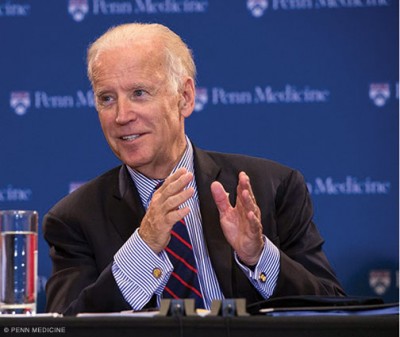
Cancer Moonshot Launched by Mission Control
Biden’s cancer “moonshot” lifts off at Penn.

WetLand
Learning lab on the river.
Findings
Research findings, Jan|Feb 2016

Our Labs, Our Health?
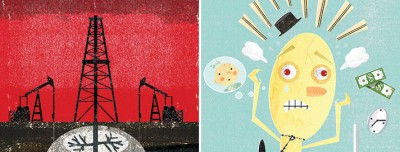
In Risky Medicine, History and Sociology of Science Professor Robert Aronowitz argues that today’s fixation on diagnosing and managing risk factors rather than treating diseases leads to anxiety and stress, over-diagnosis of conditions and overuse of drugs, and radical treatments that are unnecessary or harmful.

The Gift
When a Penn-CHOP team performed the world’s first double hand transplant on a child last summer, the landmark operation generated headlines around the world and young Zion Harvey became a YouTube star. But there’s a lot more to the story.

Extreme Makeover: Debate Edition
No argument: Presidential debates need fixing.

Want to Quit Smoking? Care to Make It Interesting?
Is gambling on quitting smoking a smart bet?
Plastic Fantastic
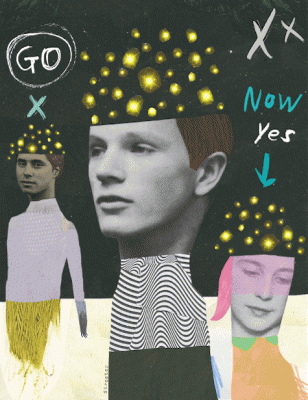
Penn Medicine’s Frances E. Jensen is a leader in studying how the brain develops and what that means for learning, behavior, and the treatment of disease at different ages. For her book on the teenage brain, she drew on the latest neuroscience findings—and the experiment going on in her own home.
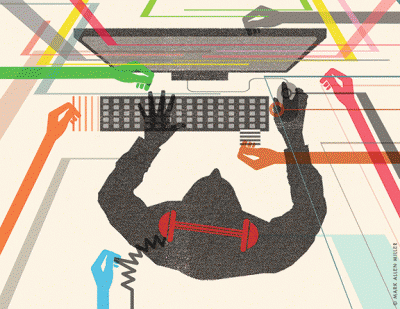
Heart Palpitations? Beware of Dr. Google
Risk factor: health-related websites track and share search data.
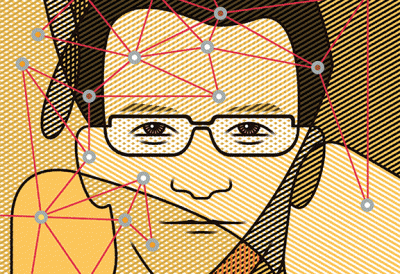
Pure to Applied
Unconventional mathematician Robert Ghrist is using one of mathematics’ most abstract disciplines—algebraic topology—to solve real-world problems in robotics and sensor networks.
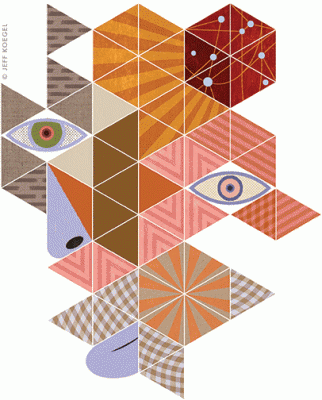
Neuroscience for Poets (or Lawyers, or Nurses…)
SCAN certificate program serves non-specialists in neuroscience.

Unconditional Pavlov
Daniel Todes spent 25 years researching and writing his epochal biography of Ivan Pavlov. The result is a science historian’s answer to Tolstoy, Turgenev, and Dr. Zhivago.
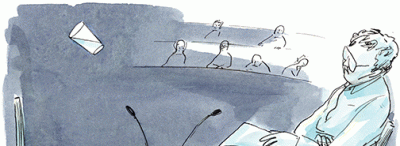
Ghost Boosters
Who ya gonna call … to study the “sociological truth” of ghosts?
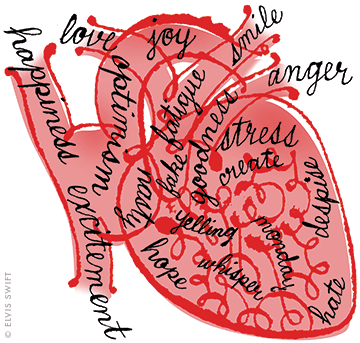
A Twitter Eclipse of the Heart
Language on Twitter can predict heart-disease risk in a community.
Findings
High altitude and lung cancer, Alzheimer's and antidepressants, all work and no sleep.
Elementary
Even in the era of Big Science, some of the greatest discoveries start with someone—Penn physics professor and Nobel contender Charles Kane, for instance—just sitting in a room and thinking.
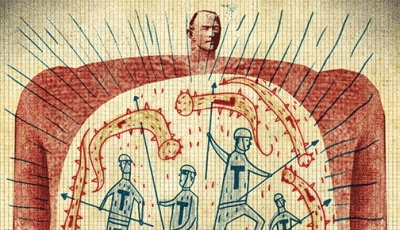
The T-Cell Warriors
Four years after a tentative but tantalizing breakthrough against leukemia, Carl June and Bruce Levine C’84 have gone from the fringes of gene therapy to the center of a revolutionary approach to cancer treatment.
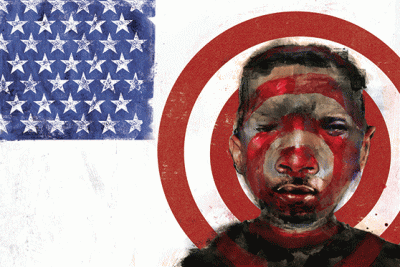
Down By Law
Alice Goffman was a Penn undergraduate when she began doing the fieldwork for the project that became On the Run: Fugitive Life in an American City. It’s an important, unsettling exploration of a serious issue. Just try not to focus on her.
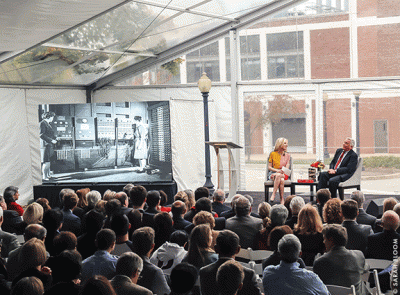
Tracing the Digital Revolution at Penn’s New Home for Innovation
Silfen Forum: Isaacson on The Innovators.
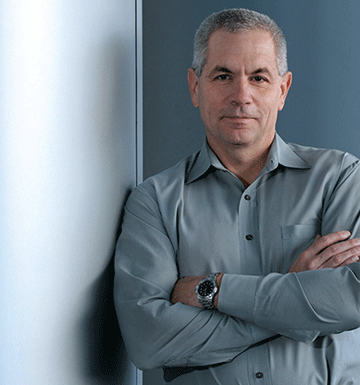
Leading the Fight Against Childhood Cancer
John Maris M’89 co-leads a “Dream Team” fighting childhood cancers.
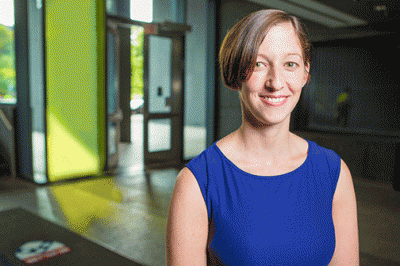
First-year Bioengineering Prof Nabs “Genius Grant”
Bioengineering professor Danielle Bassett wins “genius” grant.

From Printer to Prototype
An “entry-level 3D printer” is still pretty impressive.
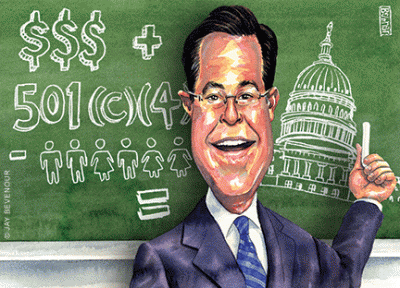
Civics and Truthiness
Funny but true: study says Colbert explained Super PACs best.

Course Evaluation: MOOC Edition
Tempered expectations on MOOCs.