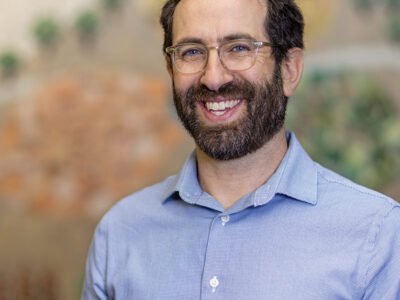
David
Goodhand C’85 and Vincent
Griski W’85
met at Penn in 1983, began dating, and lived together in Stouffer House
as undergraduates. Now they are life partners—financially successful ones
at that—and this past fall they returned to announce a $2 million lead
gift for a new home for Penn’s Lesbian Gay Bisexual Transgender (LGBT)
Center.
“It was the nurturing
environment of Penn almost 20 years ago that brought us to this point
today,” said Goodhand during an October ceremony on Wynn Commons. “When
I came here as a freshman in the fall of 1981, I never could have imagined
this day, an event like this.”
The LGBT Center,
one of the oldest and most active centers of its kind in U.S. higher education,
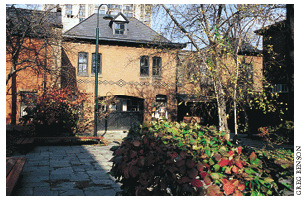
will move from the third floor of 3537 Locust Walk to the Carriage House,
which was built in 1877 at 3905 Spruce Street. Renovations are expected
to begin next year, with a grand opening in the spring of 2002—the 20th
anniversary of the Center.
Goodhand, a former
Microsoft executive who designed Internet products, is retired at age
37. Griski, 36, is a former Wall Street financial analyst and executive
and is currently an at-home parent, raising the couple’s two-year-old
son. Both are now involved in local and national politics and philanthropy.
Their gift opens a $5 million fundraising campaign to complete the restoration
of the Carriage House and endow the Center’s programs. (Those include
outreach, education, advocacy and networking, and special events and public
forums.) The refurbished Carriage House will provide study and meeting
space; a multi-media classroom for guest speakers, film screenings and
classes; a research library focused on gay issues and themes; office space;
student conference rooms; and multi-purpose spaces for the LGBT and larger
Penn communities.
The ceremony
was timed to coincide with National Coming Out Day, a project sponsored
by the Human Rights Campaign that encourages gays to be open and honest
about their sexual orientation. The gift is the first and largest of its
kind in the nation to directly benefit an LGBT campus community.
“We at Penn love
to remind ourselves and others that we are the nation’s first university,”
said University President Judith Rodin CW’66. “So on this National Coming
Out Day, it is altogether fitting that we can proudly and officially proclaim
that Penn is the first university in the nation to dedicate a campus building
… as the home for a comprehensive campus community center for lesbian,
gay, bisexual and transgender people.”
In the view of
Dr. Larry Gross, the Sol Worth Professor of Communication, the gift and
the Center “should serve as a stimulus both to Penn alumni and other universities
and their alumni.” While LGBT students and alumni have “long been accorded
benign neglect, at best, in most American institutions,” he notes that
“Penn’s record is among the best, and this new development signals a move
to a new level of support and recognition.”
In 1982, Bob
Schoenberg SW’68 GrS’89 joined Penn as the founding director of the LGBT
Center, which then operated part-time. (Schoenberg and the Center went
full-time in the early 1990s.) “Penn’s is one of a handful of LGBT centers
nationally to have the range of services and programs that we do,” Schoenberg
says. “A building dedicated to the LGBT community puts us in a class of
our own.”
Some 300 students
are active in the Center’s 10 student-affiliate groups. However, the LGBT
student population has not always been met with open arms by other members
of the campus community.
“None of us can
or should pretend that the environment at Penn has always been one in
which gays and lesbians have felt comfortable, safe and accepted,” noted
Provost Robert Barchi Gr’72 M’72 GM’73 at the ceremony. “Individual stories
vary, of course, and there have been instances even recently in which
hate e-mail is received or a student feels ostracized or threatened by
his or her peers because of his or her sexual identity. These moments
only argue more strongly for an LGBT Center that can thrive at Penn …
No student at Penn need ever feel alone because of his or her sexual orientation.”
Christopher Nguyen,
a fourth-year student in the medical school and former student co-chair
of the LGBT Center’s advisory board, expects that the increased visibility
of the LGBT’s new location will further enhance the welcoming atmosphere
at Penn. “Students who might be questioning their sexuality or [are] still
closeted will know that there are resources for them,” he says, while
the Center’s prime residential location will “increase the campus’s exposure
to LGBT people and their lives, with the result of diminishing the ignorance
that comes with the lack of understanding of a minority group.”
Rodin highlighted
this point, and emphasized that the Center is open to the entire campus
community. “Truly, we must always strive to be one campus in which we
all learn from one another, and resist breaking up into a multitude
of enclaves that isolate us from one another,” she said. “Nonetheless,
as long as women and racial, ethnic, religious and sexual minorities fight
an uphill battle for full equality and acceptance, it is vitally important
that they have supportive places and organizations that raise awareness
and reinforce pride in who
they are.”
—Jennifer Baldino Bonett