
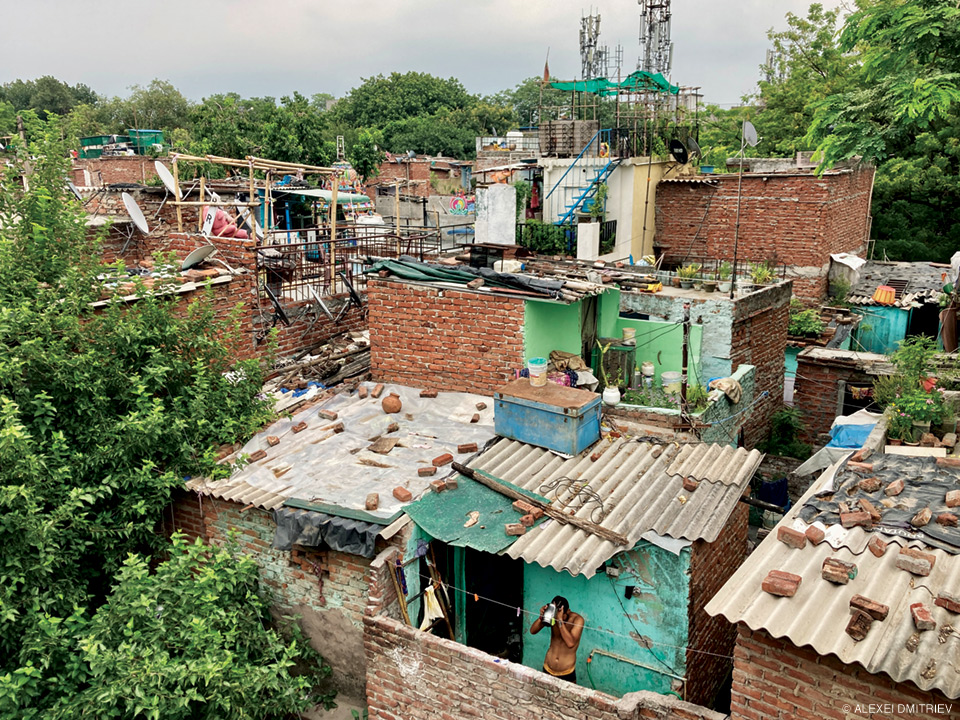
“There are a lot of aspirations in these narrow alleys.”
by Alexei Dmitriev
“Who lives here?” I asked Dharshini, taking in the small, neat room: a dirt floor swept clean, a single bed, a small stove, and an armoire that looked too large for the space. The words escaped before I could stop them, and I regretted them instantly. Dharshini’s soft reply felt like a gracious reprimand: “My two sisters, my parents, and me. My little family.”
It’s hard to shed the lenses we look through, and I thought I’d known better. I had already spent two weeks teaching English to children in a slum in Southern Delhi’s Kalkaji neighborhood, volunteering with Prajna Foundation, a local NGO that runs an afterschool center there.
Few experiences prepare you for the India beyond palaces and monuments. The first-time visitor sees only chaos, noise, and dust—what an untrained eye may mistake for misery. But beneath that apparent squalor runs a deep current of raw vitality and relentless striving. I’ve been coming to India for years, long enough to know that its contradictions aren’t things to be “understood” but accepted. Yet here, standing in Dharshini’s one-room home, I still felt like a failure.
Dharshini was one of my students. Her mother sold flowers at a nearby market. I’d stopped by in the afternoon to buy some garlands for my daughter Dora, who was flying in to join me and teach drawing at the center. Dharshini’s family had migrated from Tamil Nadu in search of better opportunities. Like countless others, they came north chasing the promise of a better future in a big city.
Many outsiders think of slums as static—places where people are trapped. But they are in fact unbelievably dynamic. Slums like this one are constantly evolving: a tarp tied to a wall one year becomes a tin roof the next; a man pushing a cart today saves for a rented stall tomorrow. As RK Sinha, who joined Prajna as a volunteer in 2005 and now chairs the board that runs the foundation, told me one afternoon, “Just poverty does not create slums; there must be prospects of social mobility as well. There are a lot of aspirations in these narrow alleys.”
And that, I realized, was why working here never felt depressing. The air is thick not with despair, but with ambition—an urgent, collective hunger to rise. Many Western visitors find it hard to believe that people with so little can laugh so easily. But I’ve heard more laughter by the water pumps in the alleys of Kalkaji than in the gated suburban communities that surround Washington, DC. Darshini and her neighbors don’t see themselves as victims. Their joy serves a function; it’s an endurance skill.
In the Prajna center’s ground-level studio older girls learn hairdressing. Upstairs, two small classrooms pulsate with energy. One is proudly equipped with PCs; digital literacy lies at the heart of Prajna’s mission. “Just because the kids are underprivileged, the facilities should not be underprivileged,” Sinha told me, as he tells his donors.
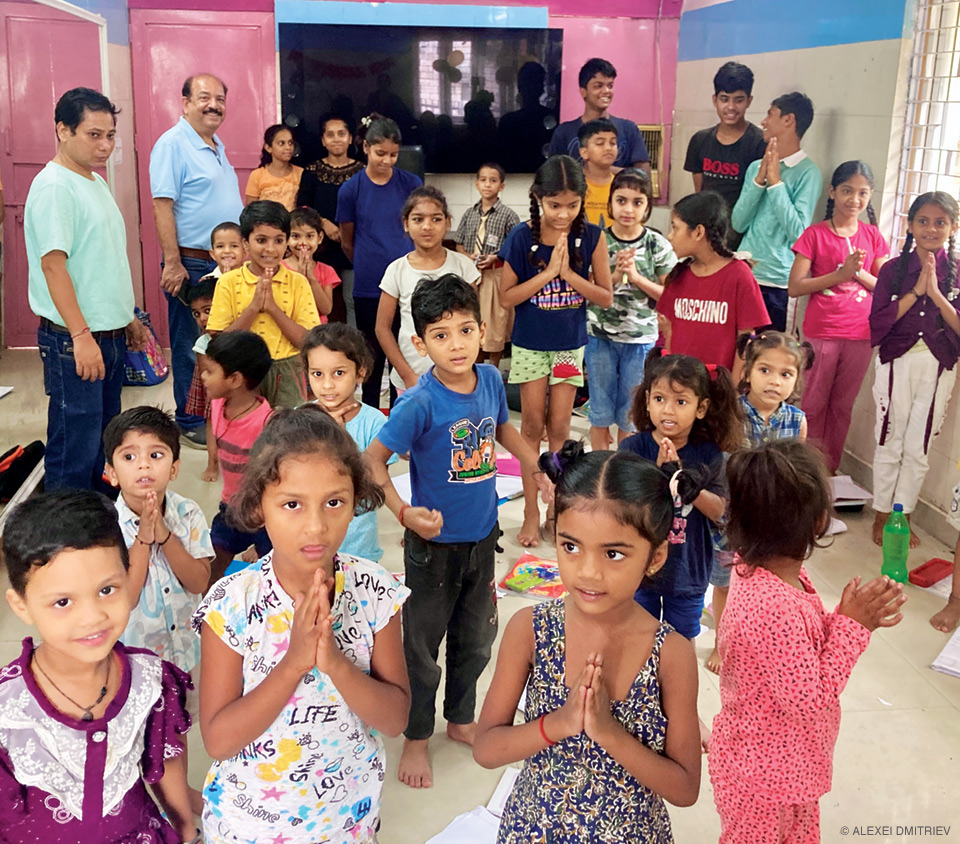
The younger group arrives first, around two in the afternoon. Despite having no running water, every child comes clean and neatly dressed, as if to prove that dignity does not depend on indoor plumbing.
The day begins with the national anthem followed by a devotional songwhose lyrics carry an ecumenical message:
Early in the morning, taking Your name, O Lord,
We begin our work today, O Lord.
With pure devotion, we meditate on You.
We receive the boon of knowledge from You.
You are the beginning, and You are the end.
We never forget to respect our teachers.
May we become so great that we reach for the sky.
When they sing the final line, eyes closed and palms pressed together, I can almost see the invisible ladder they’re climbing, one small step at a time. I teach English to newly arrived kids from Central America at a public middle school in Maryland, yet these children somehow seem closer to “reaching the sky” than my students back home. And as I’ve tried to figure out why over the last two weeks, I’ve come to think that this corny ritual—which my stateside students would scorn as irremediably “cringe”—actually plays a big part in it. Singing is definitively outré in American schools, but in Kalkaji it imbues the classroom with a social architecture that seems indispensable.
When these students chant together, they seem to conjure an immediate sense of belonging that loosens the social anxiety that so many American children carry into school. On one side of the globe, tweens file down hallways mesmerized by a thousand algorithmic media feeds. Here they literally sing in unison, preparing their minds for reflection and sustained effort with a collective commitment that morning intercom announcements in US schools cannot hope to match. And the words invoking guidance, honoring teachers, and asking “to reach the sky”—these supply a communal narrative that dignifies striving by infusing daily chores with deeper meaning. In a few minutes, a foundation for steadier self-discipline, a forward-looking confidence, and a patience for gradual progress has been laid down.
They sit on the floor, notebooks on their laps, focused for an hour straight—unthinkable in so many American classrooms. A wedding orchestra clatters by outside, announcing the arrival of a groom, but no one rushes to the window. Some, like Janvi, who looks older in her hand-me-down uniform, bring along younger siblings who curl up in their laps. Yet the mixed ages don’t create chaos; as I write on the board, I feel their eyes on my back. They know instinctively that education is a rope that might pull them up—an attitude that often seems to elude my students back home, who are spellbound by media feeds that glorify lucky breaks and shortcuts to viral fame rather than the humdrum work of steady, cumulative progress.
Arya captivates me most. She doesn’t come daily; she helps her mother at home. But when she is here, it’s as if she brings her own light with her. Her eyes—large, bright, endlessly curious—seem capable of absorbing everything. When I ask for a volunteer to write on the board, her hand rises first. Her handwriting, elegant and assured, puts mine to shame.
From the window I see a woman washing her hair in a courtyard, fully dressed. Privacy doesn’t exist here, life spills into the open. She could be Arya’s mother or aunt. And I find myself wishing for Arya’s future to include a door she can close when she takes a bath.
By five o’clock, the older group arrives. Dharshini and her best friend Mithra come prancing arm in arm. Tall, shy Ayyanar slips in later; his questions are never easy to answer. These teenagers are mostly Tamil speakers, so my Hindi is useless, but communication hardly suffers. Their eagerness bridges every linguistic gap.
Our daily activity features a reenaction of “The Boy Who Cried Wolf.” More hands go up for the wolf’s part than the boy’s. Not because the wolf has fewer lines, but because no one wants to play someone “flaky.” Their moral compass is instinctive. If little Janvi and Arya grow up to be like Dharshini and Ayyanar, Prajna’s work is succeeding.
I saw that success in Gokila, one of the center’s early students. Her grades had improved dramatically after joining Prajna, but when her parents fell deep into debt, they pulled her out of school to work as a housemaid. Sinha intervened, helped the family through the crisis, and Gokila returned—eventually earning a degree in education from Amity University. Today she teaches at the Delhi Tamil Education Association school, where she’d excelled as a student. Almost every afternoon, Gokila comes back to mentor the Tamil children at Prajna. The center’s narrow staircase does lead upward.
Watching the kids bent over their notebooks, I kept circling back to a phrase that I can’t shake: the same human material. These children are made of the same potential and intelligence as their compatriots who, having grown up in the same country but under radically different circumstances, get into the best US universities, like Penn.
When I first arrived, the children began calling me “sir.” I tried to stop it. “Please, call me Mr. Alexei,” I said, but the habit proved unbreakable. “Well done, sir,” I told Aravind one afternoon after he gave me the perfect answer. The class giggled; Aravind turned red. “You are sir,” he protested. “I am not.”
“You are as much a sir as I am,” I replied. “I am no better than you. We are all human beings.” He stared at me, unsure whether I was joking or insane.
That exchange stayed with me. Respect for teachers is instilled here early on, but it carried a sting, too. Their reverence for me, a pale-skinned Westerner, was humbling and often uncomfortable. The only thing that softened this awareness of imbalance was the children’s warmth. On our final day the children showered Dora and me with handmade cards, written in the careful, looping English that they were still working so diligently to master:
“I feel very happy you come here teach us, Mam.”
“Your English is good, and I liked it, Sir.”
“Sir and Mam, we will miss you very much.”
“You very care of the students, Sir.”
Many cried and so did we. The kids waved until we were out of sight. Yet life in this remarkable place, where hope is woven into the rough cloth of daily struggle, refused to pause for a sad moment. The narrow alley outside the center smelled of jasmine and fried snacks; a stage was being set up for a temple play that would run all night.
Alexei Dmitriev G’88 last wrote for the Gazette about volunteering to support Ukrainian refugees in Poland [“Alumni Voices,” Nov|Dec 2022].