The Most Popular Insurance Product You’ve Never Heard Of
Tontines started out as fundraising schemes by governments. Louis XIV used them to finance military operations in the Nine Years’ War in the late 17th century. London’s Richmond Bridge was built on the back of two tontine offerings in the 18th. The general set-up was that investors would part with their capital forever in return for dividends whose value would increase every time another investor died (whereupon the deceased’s dividend would be split evenly among remaining shareholders). The longer you lived, the more you stood to gain. Louis XIV’s first state tontine cost 300 livres to join; its last survivor was drawing an annual dividend of 73,500 livres when she died at 96.
In time, tontines got tripped up by increasing life spans—and savvy investors who would do things like buy shares in the names of their 6-year-old daughters. But when they were resurrected by the American life-insurance industry in the 19th century, things got interesting.
This time, the idea grew out of a common practice among mutual insurance companies, which are owned by policyholders. These companies would typically collect too much in premiums to make sure they’d have enough to cover losses. At the end of the year, they would return whatever money was left over to policyholders as a sort of dividend. Often it would just be applied as a modest credit to the next year’s premiums, but then a clever marketer had an idea: instead of returning dividends every year, why not let them build up and earn interest over a number of years, and then return people a heftier sum? “Technically, these were called deferred-dividend policies,” says Tom Baker. “But they came to be called colloquially tontines.”
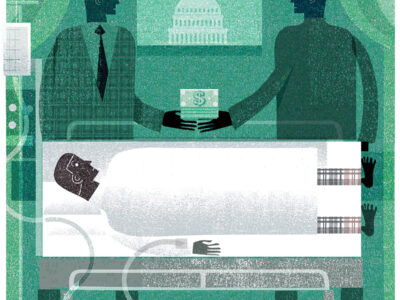
And they spread like kudzu—so much so that the companies behind them, which were now stockpiling cash they used to return more regularly, became viewed as a scourge. “Tontines were so popular that the companies amassed enormous sums of money that they used to do things like buy railroads, kind of dominate Wall Street, and also buy off lots of politicians,” Baker says. “In 1905 there was a scandal, including sex and all that kind of stuff, that led to an investigation of the life-insurance industry.”
The end result was that the New York state legislature set out to reform the life-insurance industry, “or really to neuter it,” Baker says, “since it was the most powerful force in the U.S. economy, in terms of being activist investors.” Setting an example other states would follow, in 1907 the New York legislature passed laws limiting the kind of things life-insurance companies could invest in, and mandating that dividends be returned every year. “So those laws eliminated the possibility of deferred-dividend life-insurance policies,” Baker says. But he hastens to add that they applied only to life insurance. For as many problems as we have with health insurance coverage today, there was a bigger one back in 1907: it didn’t exist.
—T.P.