
Losing Chinese Camp.
By Karen Fang
“Wildfire … gutted … Chinese Camp, California …”
The words crackled through the radio as I rustled around the kitchen putting away groceries. A late-summer lightning strike had started a brush fire that quickly accelerated, as they always do in California. Although no lives were lost and firefighting crews had worked quickly to control the spread, damage in the dusty central California town was near total. I only caught half the headline, but I already felt a sharp pang of despair. Just two months ago I had visited Chinese Camp with my 84-year-old father and 13-year-old son. I knew that the fire must have gobbled the handful of crumbling 19th-century buildings that were all that remained of the town’s Gold Rush history. Those buildings were some of the last physical remnants of the early history of Chinese in America. Now that history had all gone up in smoke.
For years I’d been fascinated by Chinese Camp’s name, which pops up on a big green interstate highway sign along Route 120 between San Francisco and Yosemite. I often felt I was alone in this interest. Far more Yosemite pilgrims stop in nearby Groveland, a larger, much better maintained Gold Rush settlement. Groveland is a verdant town whose brightly painted jail, saloon, and old hotel sit among leafy trees, the Disneyland to Chinese Camp’s all-but-abandoned ghost town. Even my brother, whose annual Yosemite trips have been drawing a large group of fellow Chinese and Filipino American friends to the area for the past 20 years, never had much to say about Chinese Camp.
“I think you’ll find it disappointing,” cautioned my friend David, an ardent advocate for Chinese American historical preservation. Unlike other former Old West settlements or abandoned Chinatowns, where gravestones, incense sticks, mahjong tiles, and broken teacups have sometimes been found, at Chinese Camp “there’s nothing left of the original Chinese history there but the name.”
David was right about the absence, but not about its effect on me and my family. The first thing we saw when we turned off the highway was a rough-hewn timber trading post bearing a large sign reading “Chinese Camp Store & Tavern” in the cartoonish “chop suey” lettering common on Chinese menus from 50 years ago. Like Groveland, the shop was cute but didn’t feel authentic, and we were surprised that there wasn’t an all-weather educational sign, like those sprinkled throughout Yosemite with period photographs from John Muir’s treks or information about the native peoples who first lived there. So inside the trading post, browsing among the polished rocks and bottled water, we asked directions from a petite Asian lady manning the counter. I wondered if she was a longtime resident or if it was just coincidence—or canny marketing—that she had this job, but I couldn’t figure out a polite way to ask.
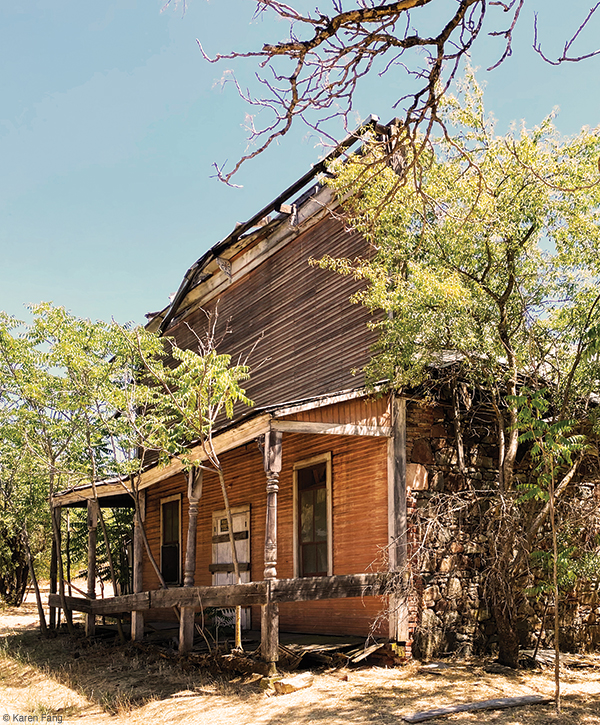
The lack of buildup to Chinese Camp actually heightened our wonder, however, when we rounded the corner onto a single block of uncurbed road, surrounded on both sides by dry yellow grasses baked crisp and golden in the hot Central Valley sun. On one side was an imposing two-story, brick-fronted office building with a small porch and a brass plate identifying it as a post office built in 1855. A few paces down was a pink clapboard house skirted by a collapsing picket fence. Beyond that was a squat single-story shop or workshop whose warped corrugated tin roof was held in place by spindly, unsanded beams. Across the road, set farther back and wholly enclosed by chicken wire, was a quaint saloon with pyramidal roof. Nothing moved, and the deafening buzz of insects underscored the lack of human life. Signs prohibiting entry warned would-be trespassers away from the rusted fixtures, broken floorboards, and branches poking through cracked windows.
Yet it was precisely their state of abandonment that made these 19th-century ruins so compelling, even despite the glaring absence of any allusion to the Chinese of “Chinese” Camp. “Cool!” my son exclaimed, betraying an enthusiasm rare amidst his usual teenage ennui. Immediately he whipped out his cell phone to snap selfies and call his older brother to gloat over the experience his sibling was missing.
My dad never says much, so I didn’t expect the same reaction, but I couldn’t help but wonder what he was thinking. Although I remember him once flaring in anger over the word “Chinaman”—then common in TV westerns when I was a kid—I wasn’t sure how much he knew about the era that produced these ruins. My father came to the US from Taiwan in 1965, one of thousands of hopefuls from east and south Asia pursuing opportunities made possible by a new Immigration and Nationality Act that welcomed those seeking higher education. Our family’s American history started more than a century after Chinese Camp was settled, so it’s possible that he saw no relation between this place and ourselves.
To be honest, I hadn’t known much about this era either, when I first became intrigued by Chinese Camp’s evocative name. I figured the town must have had something to do with Chinese miners and laborers who crossed the Pacific in the middle of the 19th century, seeking their fortune in the Gold Rush or recruited to build the Transcontinental Railroad. But what I later learned was that after the railroad was built and the ore veins emptied, those same migrants were aggressively—often violently—harassed and marginalized. Chinese were restricted to limited areas, prohibited from certain businesses and charged exorbitant licenses to work. They couldn’t vote or own land, and as anti-Asian tensions increased they were often run out of town, sometimes with arson, lynching, and looters at their heels. This discrimination worsened through the 1860s and 1870s, culminating in the 1882 Chinese Exclusion Act. The first national law to limit immigration based on race lived up to its name, drastically limiting the number and rights of ethnic Asians in the US.
Chinese Camp, in fact, was the result of that dogged march toward Exclusion. First settled in the early 1850s by Chinese miners unwelcome at other camps, the settlement grew rapidly during the 1860s as other Chinese sought community. The town’s vitality and industriousness made that imposing brick post office and its surrounding businesses a regular stop on stagecoach journeys through the area. But after the population’s peak in the early 1870s, when Chinese Camp bustled with several thousand Chinese, the era’s rising anti-Asian feeling worked inexorably to empty the once flourishing town of any trace of its original founders. The same dynamic played out across the country, as persecution intensified in Chinatowns throughout the west. The number of Chinese immigrants fell dramatically, and would not change again for more than 60 years—until the 1965 immigration bill under which my dad arrived.
This dual history of exclusion and persistence was precisely why the fire at Chinese Camp hit me so strongly. It wasn’t just that my family and I may have been some of the last visitors to explore that long-forgotten site in Chinese American history. More poignant was the fact that Chinese Camp had survived Exclusion and 170 years of neglect and decay, only to be destroyed by wildfire. Although this climatic accident was nothing like the malicious arson of the past, the result was the same. Where once there were evocative ruins whose very silence on the eponymous Chinese spoke volumes, now there was nothing—a complete and total erasure that Exclusion originally sought to realize.
It also was hard to ignore, as three 21st-century visitors struck by these 19th-century ruins, the parallels between that past and our present. Chinese Camp briefly flowered in the middle of a roughly 60-year period, from the first Chinese arrivals in the 1820s to the start of Exclusion in 1882, in which only a few generations experienced a dramatic reversal from welcome to erasure. My father’s 1965 arrival was part of a democratic immigration policy reflecting Civil Rights-era idealism, but now, just two generations later, he and his children and grandchildren inhabit a dismaying new chapter of anti-immigrant xenophobia and post-pandemic Sinophobia. As the US renews racialized immigration standards amid rising anti-Asian violence at home, and many Americans celebrate a new era of nativism, we’re left with uncomfortable questions. What progress has there been, between my father’s US immigration and the present day? Or, for that matter, from Exclusion until now?
For a brief moment last summer, my father, son, and I were the Chinese in Chinese Camp. With its history now in ashes, we wonder uneasily what winter will bring.
Karen Fang C’94 is the author of Background Artist: The Life and Work of Tyrus Wong, which tells the story of a Chinese immigrant and future Disney legend who arrived in the US during Exclusion.