
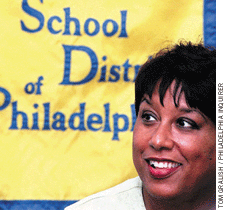
Dr. Deidrè Farmbry GrEd’97 began her school career forty some years ago with a fit of protest. Or so her mother tells her. The then-kindergartner was so resistant on her first morning at Lingelbach Elementary School that the principal had to “come outside, grab me by the hand and drag me in, kicking and screaming,” she recalls. “The joke is, I loved it, and here I am, after all these years, still with Philadelphia schools.”
Farmbry, who has spent her whole 26-year career working for the School District of Philadelphia, was recently named its chief academic officer—a new position created by the board of education after the resignation of schools superintendent Dr. David Hornbeck L’71 [“The Education of Pedro Ramos,” Sept/Oct].
Facing school-funding challenges, an unsettled teachers’ contract and pressure from the state to dramatically improve students’ test scores, the board decided to split the myriad duties traditionally handled by one superintendent and assign them to two people: Farmbry, in the top academic post, and a CEO, Philip Goldsmith, a human resources consultant, to handle fiscal matters and government relations.
“If it really plays out the way it was designed to,” Farmbry says, this separation “will really enable me to focus on assisting parents to become stronger partners in their children’s educational process and being on the frontlines with teachers, students and principals to get a handle on what’s working and what needs to be improved.”
Despite Farmbry’s long history with the district—as a high school English teacher, a department head, a principal, and then the leader of a cluster of local schools—“What’s been most revealing to me has been the complexity of the job, because the district is so large,” she says. “Now that I’m here, I realize how much I don’t know.” To get up to speed, she’s been doing a lot of background reading and talking with employees at all levels of the district.
As the Gazette was going to press, the teachers union, after a month of tense negotiations, was still without a new contract. Though she was only “marginally involved” in these negotiations, Farmbry has been fully steeped in discussions of the district’s academic goals. She gives this interview, in fact, during a break from her meeting with a district “empowerment team,” charged by Pennsylvania’s Department of Education to make “some major revisions.” She wouldn’t divulge the details of a report the committee was preparing for the state, but said it does “heighten the challenge to have our students do better on the PSSA, which is the state system of assessment.”
Farmbry says she knew “since about age six that I wanted to be a teacher.” In the neighborhood where she grew up, the women who worked outside the home were teachers. “I remember when [friends’] moms came home from work, I was just very impressed with what they did and how they looked.” She attended Temple University for her bachelor’s and master’s degrees, and, well into her career, completed her Ph.D. at Penn’s Graduate School of Education three years ago.
Since August, Farmbry says she’s gotten “lots of nice handwritten notes from former teachers of mine and former colleagues who are now retired.” Former classmates she hasn’t seen in years have also e-mailed with kudos and encouragement.
She is prepared, however, for the challenges which inevitably come with this high-visibility job. “I also am very much aware of the fact that the tough decisions which lie ahead mean at some point a decision is going to really annoy some folks or alienate some people.” Hopefully, Farmbry says, “people will understand that any decision I make is a decision that has been well researched and well thought out.”