
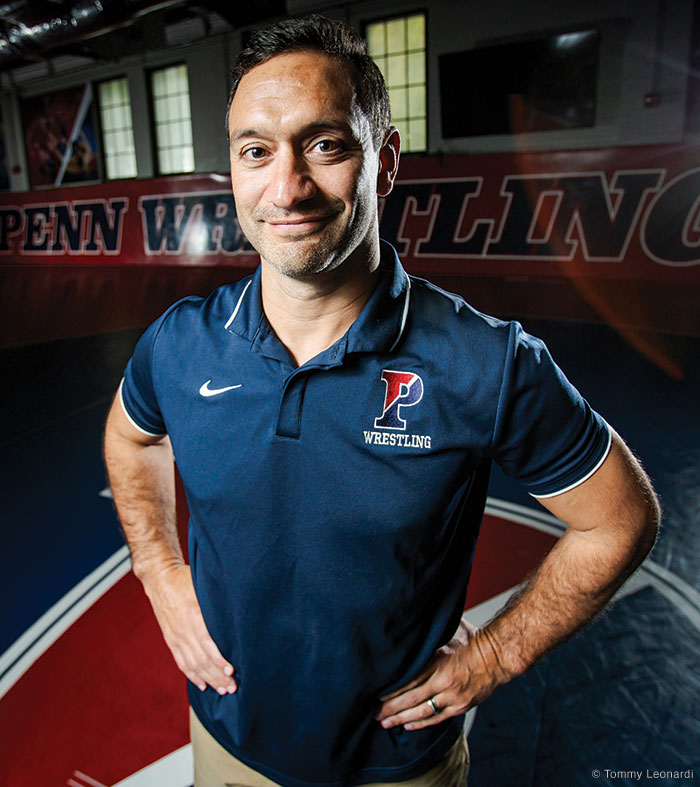
Matt Valenti, one of the greatest wrestlers in school history, takes the keys of Penn’s wrestling program.
Twenty years ago, Matt Valenti C’07 hopped into his 1994 stick-shift Honda Accord and drove 14 hours from Philadelphia to St. Louis to watch the 2005 NCAA Division I Wrestling Championships.
A standout wrestler at Penn, Valenti would likely have been competing had he not taken the year off from school to rehabilitate a shoulder injury. Instead, he watched alongside his coach, Roger Reina C’84 WEv’05, as Joe Dubuque, a wrestler Valenti had defeated the previous year (“essentially with one arm” because of his injury), win a national championship in Valenti’s weight class.
At that moment, Reina asked Valenti if that made him believe that he too could win a national title. “And I was like, ‘Yeah, Coach, I think I can do it,” Valenti recalls. “And he just turned and looked at me and said, ‘Then you won’t.’ And I was like, ‘What do you mean I won’t?’ And he said, ‘You just said you think you will. That means there’s doubt.’ I had to fortify that belief that I would do it, not just that I thought I could.”
That lesson proved to be transformative for Valenti, who battled back from his injury to soar into Penn athletics lore with individual national championships in both 2006 and 2007—the last Quaker wrestler to do so.
Now, two decades later, Valenti has taken the reins from Reina as the head coach of Penn’s wrestling program, aiming to impart similar wisdom to athletes striving to reach the same mountaintop Valenti once did.
“It still feels a little surreal taking over a program from one of the legendary coaches not just at Penn but in the sport,” Valenti said of Reina, who’s notched more than 250 career wins over his two stints as the Quakers’ head coach. “At the same time, I’m incredibly fortunate that I’ve taken over a program that’s in a really good place with a great foundation and great culture. The hardest work has already been done, and now my job is to maintain that—and then build and grow on top of it.”
In part due to their longstanding relationship, a unique succession plan was announced last year with Valenti joining as an associate head coach (essentially Reina’s top assistant) for the 2024–25 season, before officially taking over as head coach for the upcoming 2025–26 campaign with Reina remaining as head coach emeritus. Reina then plans to retire when this season ends in March, though he will remain connected with the program as it moves forward with plans for a new wrestling practice facility in Weightman Hall, thanks to a fundraising initiative spearheaded by a $20 million gift from former wrestler and former University trustee Dave Pottruck C’70 WG’72. (The Pottruck–Reina Wrestling Center is slated to open in spring 2028 after major renovations are made to a Weightman gym that hosted the first-ever collegiate wrestling tournament in 1905, as well as the adjacent Donaldson Room, which will be used for team space with a lounge, locker room, and fueling and recovery stations.)
Valenti notes that the succession plan was designed to “make sure we minimized as much disruption as possible” for the student-athletes. “And me being in an assistant role last year let them get a little feel for who I am and how I approach things, a little bit of a flavor for how I lead. And now they’re getting more of who I am as a coach.”
At the end of the 2025 NCAA Wrestling Championships, which was held last March at Philadelphia’s Wells Fargo Center, the torch was officially passed—in the form of a challenge brick (a soft, foam-filled brick coaches use to signal a video review of a referee’s call) Reina handed to Valenti in front of hundreds of Penn alumni at a post-tournament reception at the Loews Philadelphia Hotel.
It was an emotional moment for Valenti, whose relationship with Reina began 24 years ago when the longtime coach “was sitting in my living room pitching me on Penn,” says Valenti, a New Jersey native who was persuaded to come to the University even though his dad had wrestled at Princeton. “And it almost feels like a dream that I get to sit in living rooms with recruits, next to Roger, making the same pitch.”
It comes naturally to Valenti, who says Penn has “made me into the person I am today.” As a student-athlete, he burst onto the scene as a freshman starter before becoming an All-American as a sophomore in 2003–04, meaning he was “top six in the country with a bum shoulder.”
After his redshirt season, he stormed to the first of his two national championships in the 133-pound weight class with a title-bout triumph over Purdue’s Chris Fleeger—the same person who had blown out his shoulder—at an Oklahoma City arena that was completely in Valenti’s corner. He closed his college career the following year by defeating Oklahoma State’s Coleman Scott (who went on to win an Olympic bronze medal) for the 133-pound NCAA title, finishing as the program’s career leader in wins with 137.
Valenti served as an assistant coach at Penn from 2009 to 2015, during which he helped Zack Kemmerer C’12 become an All-American at the 2011 NCAA Championships in Philadelphia. “That memory,” Valenti says, “will live front of mind for me for my entire coaching career.” But Penn had a couple of different head coaches during that stretch (Reina served as head coach from 1986 to 2005 before returning in 2017), and “the dynamics and constant change started to wear on me,” Valenti says. His love for Penn remained, however, so he transitioned into a role with the athletic department, serving in various administrative positions for Penn Athletics for nine years. There he “learned a whole lot about the inner workings of an athletic department,” as well as other things he thinks can carry over to his new job. “I had to be on my toes at all times and be capable of adjusting on the fly,” Valenti says. “And there’s nowhere that’s more prevalent than in a room filled with 18- to 22-year-olds.”
One reason Valenti wanted to return to coaching was because of his wife, Kim Parsons Valenti, who spent years working at Penn before becoming the head gymnastics coach at Ursinus College. “I got to watch her interactions with her team, watch her impact on her team,” he says. “That was a reminder of how much I enjoyed that part of what I did in coaching. … That’s where my heart is at, being able to help young people become better.”
He got to experience that again last season when Penn’s CJ Composto rallied to a fourth-place All-American finish at NCAAs, in front of a huge Penn crowd in Philly. Valenti called it “way more of a rush” than his own NCAA runs, which he says he can barely remember (and doesn’t like to watch on video). “You are way more stressed as a coach on the sideline than the guy on the mat actually wrestling,” says Valenti, who recalls “high-fiving and hugging” assistant coach Darian Cruz when Composto “comes walking over stone-faced and is like, ‘Let’s get ready for the next match.’”
Composto—who Valenti describes as a calm character who likes to put on Bob Marley music in the wrestling room—returns this season to headline a group that Valenti believes can do big things. Composto can even vie to become Penn’s first national champion since Valenti—if he is convinced he can. That’s something Valenti will try to instill in the wrestler, the same way Reina once did in him.
And, for one more season, Valenti and Reina will get to do it together.
“He’s one of the best people in the world at drawing the best out of people,” Valenti says of Reina. “He knows how to encourage you to believe in yourself, to think bigger, think broader, set really big goals—sometimes goals that seem scary. I think that’s the way he’s approached program building, and it’s a testament to where the program is today.” —DZ
