Whether probing the concept of common sense, mulling the role of expertise in a democracy, or examining how choice intersects with freedom, Sophia Rosenfeld is carving out new realms of cultural and intellectual history.
By Julia M. Klein
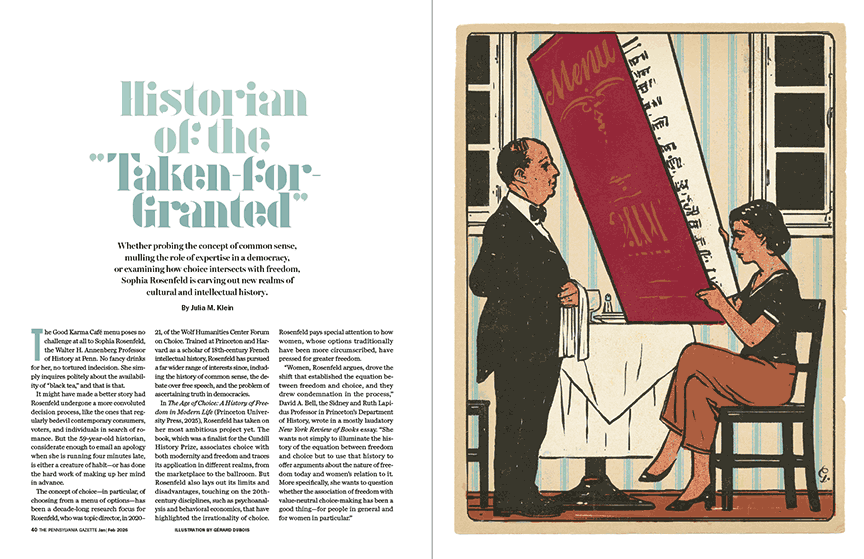
The Good Karma Café menu poses no challenge at all to Sophia Rosenfeld, the Walter H. Annenberg Professor of History at Penn. No fancy drinks for her, no tortured indecision. She simply inquires politely about the availability of “black tea,” and that is that.
It might have made a better story had Rosenfeld undergone a more convoluted decision process, like the ones that regularly bedevil contemporary consumers, voters, and individuals in search of romance. But the 59-year-old historian, considerate enough to email an apology when she is running four minutes late, is either a creature of habit—or has done the hard work of making up her mind in advance.
The concept of choice—in particular, of choosing from a menu of options—has been a decade-long research focus for Rosenfeld, who was topic director, in 2020–21, of the Wolf Humanities Center Forum on Choice. Trained at Princeton and Harvard as a scholar of 18th-century French intellectual history, Rosenfeld has pursued a far wider range of interests since, including the history of common sense, the debate over free speech, and the problem of ascertaining truth in democracies.
In The Age of Choice: A History of Freedom in Modern Life (Princeton University Press, 2025), Rosenfeld has taken on her most ambitious project yet. The book, which was a finalist for the Cundill History Prize, associates choice with both modernity and freedom and traces its application in different realms, from the marketplace to the ballroom. But Rosenfeld also lays out its limits and disadvantages, touching on the 20th-century disciplines, such as psychoanalysis and behavioral economics, that have highlighted the irrationality of choice. Rosenfeld pays special attention to how women, whose options traditionally have been more circumscribed, have pressed for greater freedom.
“Women, Rosenfeld argues, drove the shift that established the equation between freedom and choice, and they drew condemnation in the process,” David A. Bell, the Sidney and Ruth Lapidus Professor in Princeton’s Department of History, wrote in a mostly laudatory New York Review of Books essay. “She wants not simply to illuminate the history of the equation between freedom and choice but to use that history to offer arguments about the nature of freedom today and women’s relation to it. More specifically, she wants to question whether the association of freedom with value-neutral choice-making has been a good thing—for people in general and for women in particular.”
But Rosenfeld’s overall aims are broader still. In The Age of Choice, she describes herself as “a historian of the taken-for-granted.” She seeks to surface and historicize ideas so mundane that we barely conceive of them as having a history. Her use of evidence is equally inventive, going beyond the “great man” texts that comprise the traditional sinews of intellectual history (though, to be fair, Rosenfeld can quote Mill or Locke with the best of them). The Age of Choice is anchored in material ephemera: auction catalogs, menus, dance cards, commonplace books, election ballots. And Rosenfeld uses fiction, especially early realist novels, to probe the psychology behind those objects and the practices they represent.
“Sophie has carved out a highly distinctive way of studying ideas,” says Benjamin Nathans, director of Penn’s Robert K. Johnson Integrated Studies Program and the Alan Charles Kors Endowed Term Professor in Penn’s Department of History. Nathans won the 2025 Pulitzer Prize in General Nonfiction for his book To the Success of Our Hopeless Cause: The Many Lives of the Soviet Dissident Movement [“Gazetteer,” Jul|Aug 2025].
“Rather than focus on prominent thinkers and famous texts,” Nathans says, Rosenfeld “explores the stories behind our self-evident truths, which is to say, common assumptions about our society and ourselves, stripping them of their self-evidence, holding them up for inspection, explaining how they have changed over time. She is curious not just about concepts, but about how concepts become embedded in everyday practices and assumptions, how they become taken-for-granted and therefore invisible.”
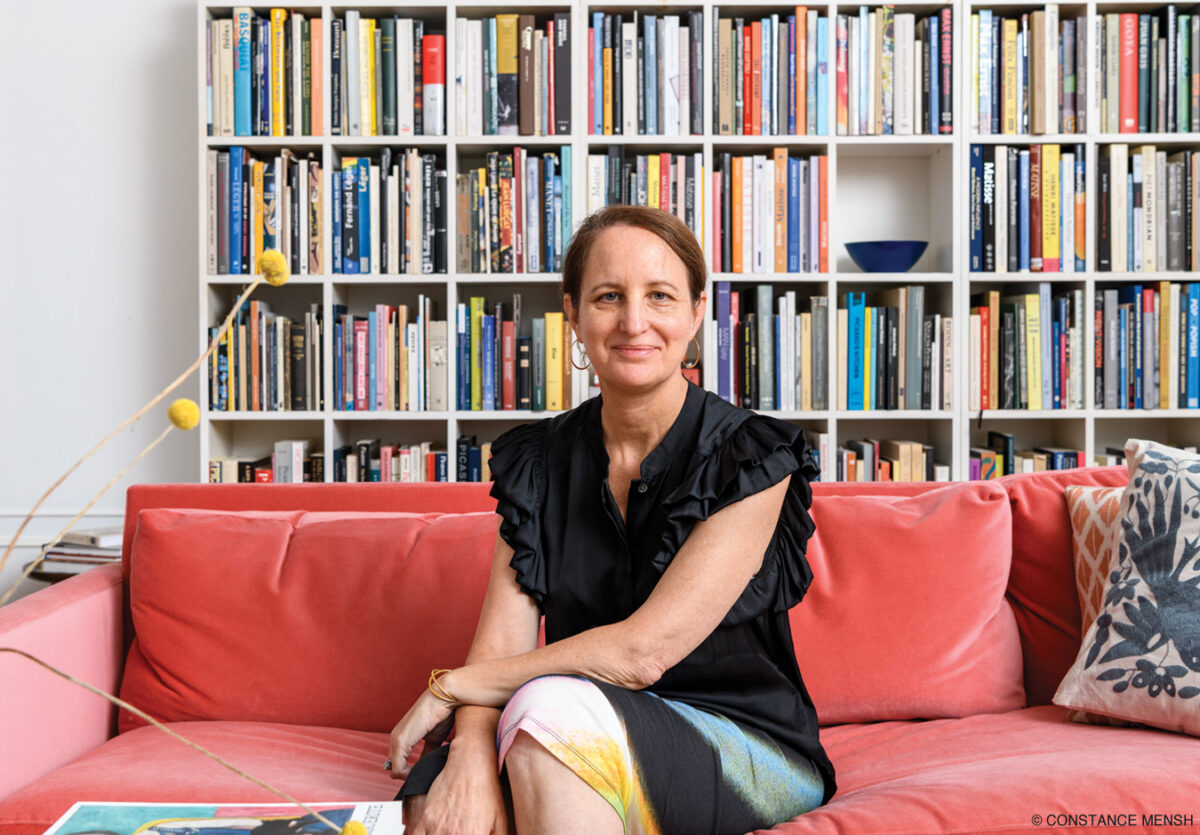
Rosenfeld grew up in Leonia, New Jersey, near New York City, in a family with literary and artistic inclinations. Her father was a professional cellist; her mother wrote and edited art and travel books. She has two sisters, a novelist and a sound artist. “I’m the one with the boring job,” she jokes.
She credits her academic path to being “in college at the right time and the right place, at Princeton in the ’80s, which had one of the great history departments in the world.” She cites such mentors as Philip G. Nord, Rosengarten Professor of Modern and Contemporary History, Emeritus; the late Anthony Vidler, former director of Princeton’s Program in European Cultural Studies; and Robert Darnton, a longtime French cultural historian at Princeton who is now the Harvard University Librarian, Emeritus.
“Princeton really was the place where the so-called new cultural history was taking off, and I was lucky to coincide with its big moment,” Rosenfeld says. “So, I had some legendary classes, and I was exposed to a lot of the most cutting-edge work of that era. And, in fact, a lot of the most cutting-edge work was being done in French history.”
One influence, she says, was the Annales School, which embraced the “history of mentalities”—“not just how did great thinkers think, what did Descartes say, but the history of how people saw the world around them.” The interests of its practitioners—including Roger Chartier, Annenberg Visiting Professor of History at Penn—lay “between social history and intellectual history,” Rosenfeld says, a rich vein that she has continued to mine. (Chartier, now a colleague, praises her for challenging “traditional divisions…between intellectual history and cultural history, between the written words and the languages of signs, between ideas and practices.”)
Rosenfeld graduated summa cum laude from Princeton and won a prize for her senior thesis, on the politics of the early critical response to Cubism in France. Encouraged by her teachers to apply to graduate school, she received a Mellon Fellowship in the Humanities that covered tuition. “So, it seemed like it would be crazy not to do this,” she says. After a year working in public policy, another of her interests, she matriculated at Harvard. “I went to graduate school thinking I would do the 20th century,” Rosenfeld says, “but I discovered the 18th century, and that’s really been my home. I’ve sort of gone backwards from that, and forwards from that, ever since.” In particular, she became “interested in how this study of culture and mentalities could illuminate political history.”
Rosenfeld’s first post-graduate job, in 1995, was at a “dream location,” the University of Virginia, where the influence of Thomas Jefferson, its founder, loomed large. “It’s a very beautiful place to be an 18th-century-ist. And I got more interested in American subjects by being there,” she says. She stayed in Charlottesville for almost two decades, working her way up the academic ladder.
Her reasons for leaving were personal and practical: In 2013, her husband, Matthew Affron, an art historian and curator, landed a plum job as the Muriel and Philip Berman Curator of Modern Art at the Philadelphia Museum of Art. The couple, who have two children, moved to Philadelphia, and Rosenfeld started looking for geographically closer employment.
After stints at Princeton’s Institute for Advanced Study and Yale, she landed at Penn in 2017. “Why Penn? One, I already lived in Philadelphia,” she says. “Two, it’s an amazing institution. It was an appealing place to teach—and it’s walking distance from my house.” She soon discovered other pluses: “It’s exciting to be at an urban school. An incredible number of people come through the city, come through Penn. There’s an energy to the place.”
“Penn was extraordinarily lucky to lure Sophie away from Yale,” says Nathans. “In the decade since, she has brought a trifecta of talent to the Department of History: as one of the leading cultural historians of Europe and the Atlantic world; as a hugely successful teacher of both undergraduates and graduates, offering courses on the Enlightenment, free speech, modern Europe, and much else; and most recently, as chair of the department, where she applied her trademark elegance, diplomacy, and wit.” (Rosenfeld, who is on sabbatical for the 2025–26 academic year, stepped down from the department chairmanship in July.)
There are plenty of indices of Rosenfeld’s scholarly bona fides. Here is a highly condensed list: From 2013 to 2017, she coedited the journal Modern Intellectual History. She was co-general editor (with Penn classicist Peter Struck, the Stephen A. Levin Family Dean of the College of Arts and Sciences) of the six-volume A Cultural History of Ideas (Bloomsbury, 2022), winner of the Association of American Publishers’ award for best reference work in the humanities. From 2018 to 2021, she was vice president of the American Historical Association. In 2022, she held the Kluge Chair in Countries and Cultures of the North at the Library of Congress. And this year she was elected to the American Academy of Arts and Sciences.
But the arc of Rosenfeld’s career bends—quite deliberately—toward greater accessibility and recognition as a public intellectual. Her goal, she says, is to become “part of a broader conversation” extending beyond history to contemporary politics.
That evolution has been marked by articles in outlets such as the New York Times, the Washington Post, the Nation, and the Guardian, interviews in European and Latin American media, and appearances on numerous podcasts—at least 20 for the Age of Choice book alone. In one Times essay, written in 2023 amid campus protests over Gaza, she celebrated the civility of her students in a course she teaches on free speech. The piece received a strong response, Rosenfeld says. “We’re in a moment in which the boundaries of academic freedom and also student voice are really being challenged,” she says, and it’s a topic that preoccupies her.
Rosenfeld’s first book, A Revolution in Language: The Problem of Signs in Late Eighteenth-Century France (Stanford University Press, 2001), was, as is typical, a reworking of her doctoral dissertation. “It’s dense,” she says. (No argument there.) With your first book, “you’re proving yourself to your profession. And I wrote it hoping that scholars within my field would be interested and think that I had something new to say. I didn’t really write it thinking, ‘Gosh, I really hope this gets me on TV.’ ”
A Revolution in Language covers such seemingly disparate topics as pantomime, ideographic sign systems, and a conception of the Terror as “rendered possible by deception and division stemming from the abuse of words.” It’s an idiosyncratic amalgam. “I’ve always been interested in dance, and I got interested in this idea of a system of communication that came out of bodily movement or gesture,” she says. “I also wanted to respond to a lot of new scholarship on the French Revolution that really made the language of politics a subject of concern.”
The book earned her tenure and set her current intellectual course. “It was the beginning of my interest in trying to understand how people thought in different periods about things that are so ubiquitous that you don’t notice them, like how a language works,” she explains. “I’m interested in what you might call tacit ideas or taken-for-granted ideas or even common-sense ideas. Which is how I got to the next project.”
That was a deep dive into the evolving notion of common sense itself. Titled Common Sense: A Political History (Harvard University Press, 2011), the book, a decade in the making, was a way of challenging herself: “Could I write a history of something that sounds as ahistorical as common sense?” It required her to develop a method for writing about an idea and “how it moves through time and space,” using texts but also putting them in context.
Common Sense won the Mark Lynton History Prize, awarded by the Columbia School of Journalism and the Nieman Foundation for Journalism at Harvard, and the SHEAR Book Prize, from the Society for Historians of the Early American Republic. It also got Rosenfeld noticed outside the profession, in part because “it coincided with a moment in which right-wing populists in the US and elsewhere were starting to talk about a politics of common sense.” (Of course, liberals, too, use the term, as in “common sense gun reform.”)
In fact, common sense is often associated with controversial policies. That turns out to have been the case historically as well.
Rosenfeld started the book with the loosest of hypotheses—that common sense does indeed have a history, and that it’s been “caught up in both the making of and challenges to democracy.” But she didn’t realize at first that the book would focus so strongly on the roots of populism.
“There has to be some place for being surprised by the evidence. And usually when you find something surprising, it means you’re onto something interesting. To find that Tom Paine,” who authored the celebrated 1776 revolutionary pamphlet Common Sense, “was influential is not a great find,” she says. “To find that Tom Paine was hardly articulating the common sense of his moment”—that his ideas were radical and ahead of popular opinion “is a more interesting discovery.”
Rosenfeld prefers to focus on what she calls “bedrock ideas of modern democracy” rather than more contentious, hot-button issues. “So that makes me a little bit of a weird intellectual historian,” she says. “I’m often interested in figuring out the low-level consensus points that shape all of our politics”—and how that consensus both emerges and dissolves.
Some of these ideas came into play in Democracy and Truth: A Short History (University of Pennsylvania Press, 2019). The book was solicited by the Penn Press based on Rosenfeld’s writings, and it was inspired in part by debates about “fake news” and conspiracy theories early in President Donald Trump W’68’s first term.
That project relied less on archival research than on argument, she says. “And the argument is that truth is essential to democracy, but not in the way that we expect—in part, because there’s no one locus of truth in a democracy and in part because it depends on a delicate balance between popular knowledge and expert knowledge.”
Since the book’s publication, Rosenfeld says, the situation she outlines has grown more dire. The disconnect between experts and the general publichas increased, with mounting post-pandemic skepticism about vaccines and science in general, as well as “the dismantling of data” about subjects such as climate change and the economy. In her view, “democracy requires a meeting place between expert knowledge and non-expert knowledge.” When those bodies of knowledge are distinct, as they now seem, Rosenfeld says, “it’s quite dangerous.”
So, just how did Rosenfeld choose choice as a topic?
“This is a good example of something where the idea comes to you, say, in the shower, and it sounds kind of cool, but how to do it is the big problem,” she says. “The trick of some kinds of history writing is sometimes to find the smaller thing that lets you talk about the bigger thing.”
The subject of choice interested her for two reasons. First of all, it seemed to fit her larger intellectual project. “To me,” she says, “it seemed totally unexplored and fascinating, one of these taken-for-granted ideas. And I was particularly interested in the fact that it seemed to be the meeting point of our economic lives and our political lives. It’s also everywhere in political discourse, on the right and on the left, from school choice to reproductive choice.”
Then there was the personal angle. “Like many people,” she says, “I often have trouble making up my mind, and I don’t like to go to a place with a menu with 150 items on it or look online on Amazon.com and find that there are 500 toasters—when you just need one at a good price that works. And I don’t think that’s such an uncommon feeling.”
In other words, choice, so often ballyhooed in advertising and popular culture, did not strike her as an unalloyed good. “I was interested in the tension between this idea that what democracy and capitalism give us that’s so great is this freedom of choice, and the fact that choice is often so stressful,” she says. Too much choice can be paralyzing, while in other cases, people have only limited choices—and get blamed for making bad ones. Some of the downsides to choice have been explored in the social sciences. But no one, it seemed to her, had put all these pieces together.
Rosenfeld ended up looking at how “choice practices,” like ordering from a menu or using a secret ballot, developed and operated. Her chapters explore shopping (“Choice in Things”), belief systems (“Choice in Ideas”), finding a partner (“Romantic Choice”), voting (“Political Choice”), and what she calls “The Sciences of Choice.” An epilogue deals with the history and future prospects of what has become known as the “right to choose.”
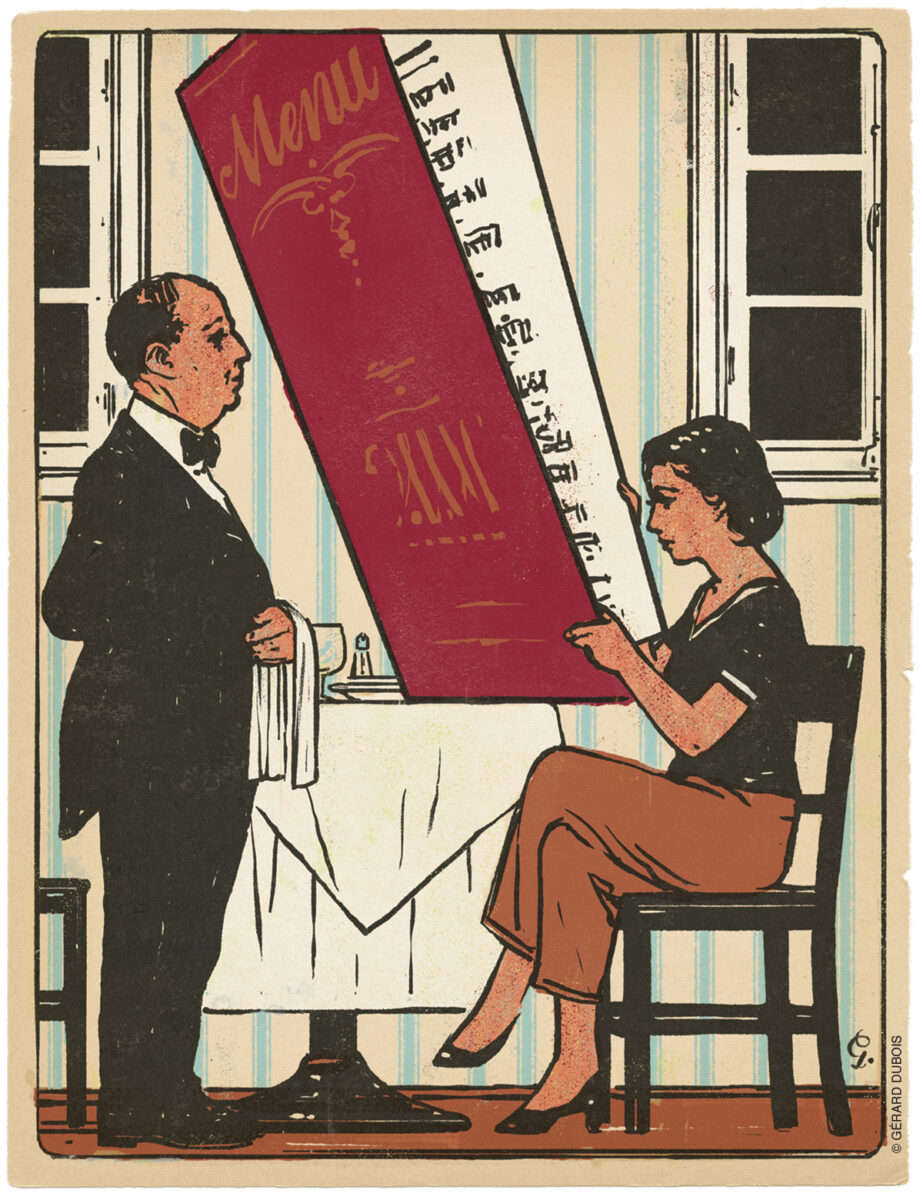
Each chapter is built around artifacts, as she explained in a September talk at the Kislak Center for Special Collections, Rare Books and Manuscripts. In fact, stumbling on a rare early menu—from a French restaurant, circa 1800—in a display of new acquisitions at the Kislak was one of her inspirations. “A lot of research is serendipity always,” she said.
“This was a new technology,” she told the hybrid audience of about 75 Penn faculty, students, and others. “And what’s so interesting about this menu is that it’s both an advertisement for the plentiful choices on offer and a kind of finding aid. It’s a way to actualize a choice. Some of the early menus come with a pencil, and you put a little check to indicate what you’ve selected. And the menu exists along with this new institution, the restaurant, to make this feasible.” Since then, she noted, the opportunities for choiceand the quantity of options have expanded “not only in sheer numbers, but across so many of the different domains of our lives.”
To write the book, Rosenfeld says, she had to break with chronology, to “violate some of the rules” by “jumping around in time a bit, letting the past illuminate the present, the present illuminate the past.”
A second decision was “to think about the people left out of this paradigm as much as the people who were at the center of it. Because sometimes the view from the margins helps you see what’s hard otherwise to see.” She consideredfocusing on children or on “slavery and abolitionism and the changing understandings of freedom that came with that.” She settled instead on using the experience of women as a lens. Despite their historically restricted options, women, as shoppers and consumers, are “the paradigmatic first modern choosers,” she argues.
Finally, Rosenfeld realized, the great texts “couldn’t really explain how conceptions of freedom became so different and so widespread over such a long period of time.” So, she landed on the idea of examining “social practices with ideological effects.” She perused archival images and read widely: newspapers, how-to manuals, diaries, sermons, works of philosophy, and, importantly, novels.
“The novel emerges as a commercial entity in just the period we’re talking about, the 17th to 18th centuries,” she says. “And soon there’s all kinds of choice technology associated with it: library catalogs, booksellers, listings, lending libraries.” But that’s not all. The novel, she says, “actually is the genre about choice.”
The protagonist—often female—is generally torn between her desires and obligations to family or society, Rosenfeld says. “And the reader can watch somebody grappling with how to make the choice, what the right choice is, debating the pros and cons of different pathways. And then the reader has the satisfaction of seeing the consequences, both psychological and material, that result from the choice.” So literary fiction, Rosenfeld says, “gave me a way into the psychology of choosing as it emerged.”
More clues came from all those artifacts, some of them purchased on eBay: auction catalogs, fabric sample books, dance cards, election ballots, ballot postcards with multiple-choice options (“Weather very pleasant,” “I think of you often,” “Be good and you will be happy”). “In addition to the choosers,” Rosenfeld says, “there were choice architects,” who “designed the menus, the rules, the options, how to actualize them. They’re both part of the story and a source for reconstructing the history of choice.”
The Age of Choice is at times a celebration of choice, but it also sounds some (epigrammatic) cautionary notes:
“The sum of our choices might well be a world no one would actually choose.”
“Choice, whether about babies or baubles or beliefs, should be a means, not an end unto itself.”
Though choice is associated with freedom, Rosenfeld grapples with the paradox that “there is no such thing as really free choice.” Choice is always “bounded”—think of those election ballots, and our perennial complaint about having to pick “the lesser of two evils.” Even the old-fashioned dance card had only so many slots.
Choices are made “within frames of social norms, family expectations, economic needs,” and other constraints, Rosenfeld says. “Sometimes those structures are deeply limiting. And sometimes those structures actually are necessary to make it possible for us to move in the world.”
Both the complexity of the concept and Rosenfeld’s own ambivalence are clear. But what, in practical terms, would she like readers to take away from The Age of Choice?
“A lot of people have asked that question,” she says. But the book isn’t, in the end, a self-help volume. “My entire goal is to challenge all sets of ideas,” Rosenfeld says. “I don’t take anything to be an orthodoxy. Intellectuals are generally pretty useless in most practical ways. The only thing I think they can do is sometimes offer new ways of seeing old problems.”
Julia M. Klein, a frequent contributor to the Gazette, has written for the Atlantic, the Nation, Mother Jones, the New York Times, the Wall Street Journal, the Washington Post, and other publications.