
With extensive input from Native American collaborators, the Penn Museum highlights Indigenous cultures from the continent’s four corners.
In November, the Penn Museum opened a new showcase for its extensive and wide-ranging collection of Native American materials and launched the “great next chapter” in its collaboration with Native experts, communities, and artists to share stories of North America’s Indigenous cultures.
The 2,000-square-foot Native North America Gallery includes more than 250 items drawn from the museum’s collections, plus work by contemporary creators, representing regional cultures from the Northeast (Lenape/Delaware), Southeast (Eastern Band Cherokee, Muscogee Creek), Southwest (Pueblo), and Northwest (Tlingit, Alutiiq). The oldest objects on view—spearpoints excavated from Clovis, New Mexico, in 1936—date from 9500 BCE, and the newest is “Parceled Space #2,” a woven sculptural work commissioned by the museum from Cherokee artist Brenda Mallory. Video and audio testimony, interactive touch screens, and opportunities to hear Native languages and try out traditional weaving techniques are also part of the gallery’s multisensory experience.
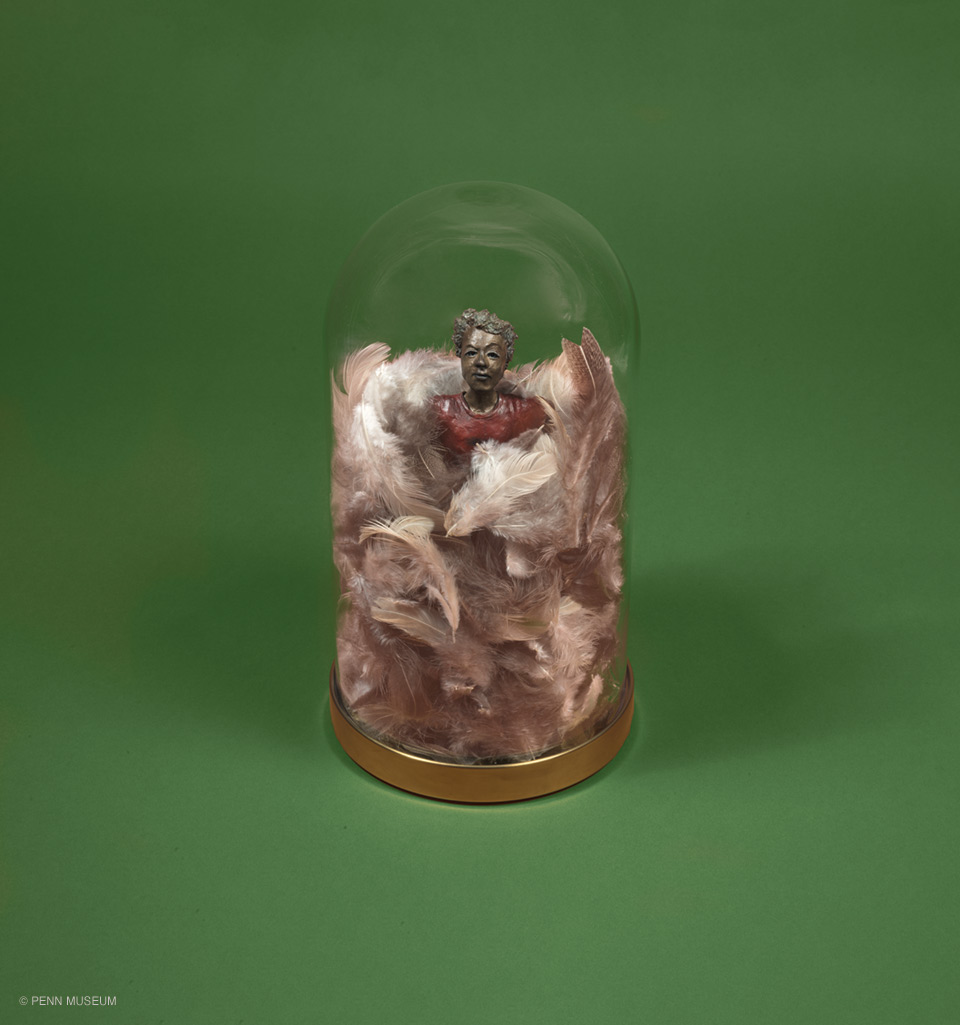
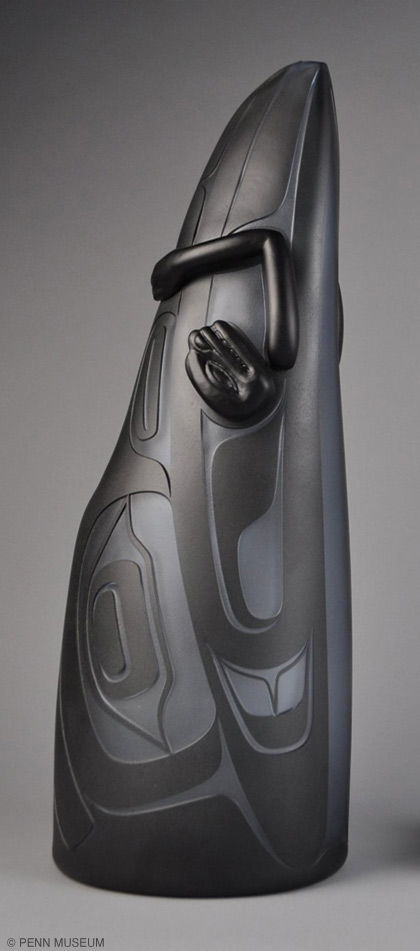
Works by contemporary Native artists include “I’m More than Fluff” by Holly Wilson (left) and “Emerging from Raven” by Preston Singletary (right).
But the first thing visitors will encounter upon entering is an empty display case, referencing issues of repatriation and the debate between Indigenous communities and museum institutions on what materials are appropriate for display. “In its absence, the object becomes an act of Indigenous sovereignty—an assertion of agency over the stewardship and future of cultural heritage,” explained Joseph Aguilar Gr’19, tribal historic preservation office board member of the San Ildefonso Pueblo, one of eight Indigenous consulting curators involved in shaping the display, in press materials for the show.
The gallery is the successor to Native American Voices: The People—Here and Now [“Know That We Are Still Here,” Jul|Aug 2014]. The lead curator for that show was Lucy Fowler Williams CGS’01 Gr’08, the Jeremy A. Sabloff Senior Keeper in the Museum’s American Section, who is also cocurator of the Native North America Gallery with Megan Kassabaum, Associate Professor of Anthropology and Weingarten Associate Curator for North America. The earlier exhibition was originally intended to run for five years only, rather than the eventual decade it spanned. “It was time for that show to come down,” Fowler Williams says.
Both exhibitions feature many “organic items that needed to be rotated every year. So even as we extended it to 10 years, we were rotating every corner of that show annually just to protect and take care of the items as stewards of the collections. That’s just what we do,” she adds. “So for that reason, really, we started this new initiative, and we worked really drawing from the strengths of our collection. In this iteration, we wanted to do a deeper dive into fewer regions, so that we could talk about the deep time through periods of rupture and conflict and then into the present.” Such a focus was made possible by the breadth of the museum’s holdings. “Not all museums can do that kind of story,” she says. “But we’re positioned to do that.”
Collaboration with Native experts was a priority for both shows, but “it’s a totally different group of people” this time around, Fowler Williams says. The earlier exhibition brought in four prominent Native women as consulting colleagues, plus about another 80 “individuals whose voices were involved in the show, either through written text or their artwork.” Rather than taking Native American Voices’ thematic approach, the current show has a primarily geographic framework. “Here, we have eight consulting curators who are from the four regions, and 10 artists who contributed. So it’s a large group again.” But there are “certainly a lot of continuities” between the exhibitions, Fowler Williams says. “It’s really interesting, because a lot of these important topics are kind of further developed in this show. So for me, it’s a great next chapter.”
A common theme in comments by the Indigenous guest curators at a preview event was that the objects displayed were signifiers of cultures that, though often exploited, remain vibrant and continue to develop. “This is one of the first collaborations that I’ve had with these types of institutions in which we were heard, in which we were consulted,” said one of them, Jeremy Johnson, cultural education director of the Delaware Tribe of Indians, calling it “an important example” for other institutions going forward.
“We have been here for thousands and thousands of years, and this knowledge that we have is exhibited in these items. They’re not artifacts. They’re living items that have eons of knowledge contained within them, and to be able to express that in the way that we have here, I think it’s been a blessing.”—JP