
How an unlikely and decorated athletic career on the ice led to a rewarding one in medicine.
When Ami Parekh C’12 first stepped onto the ice at seven years old, she ended her exhilarating debut with a split chin and a trip to the emergency room. “I thought I was done with trying that sport out after that happened,” she recalls. But two years later, watching her older sister take lessons, she found herself begging her parents for another chance at ice skating. From that moment, she was “hooked for good.”
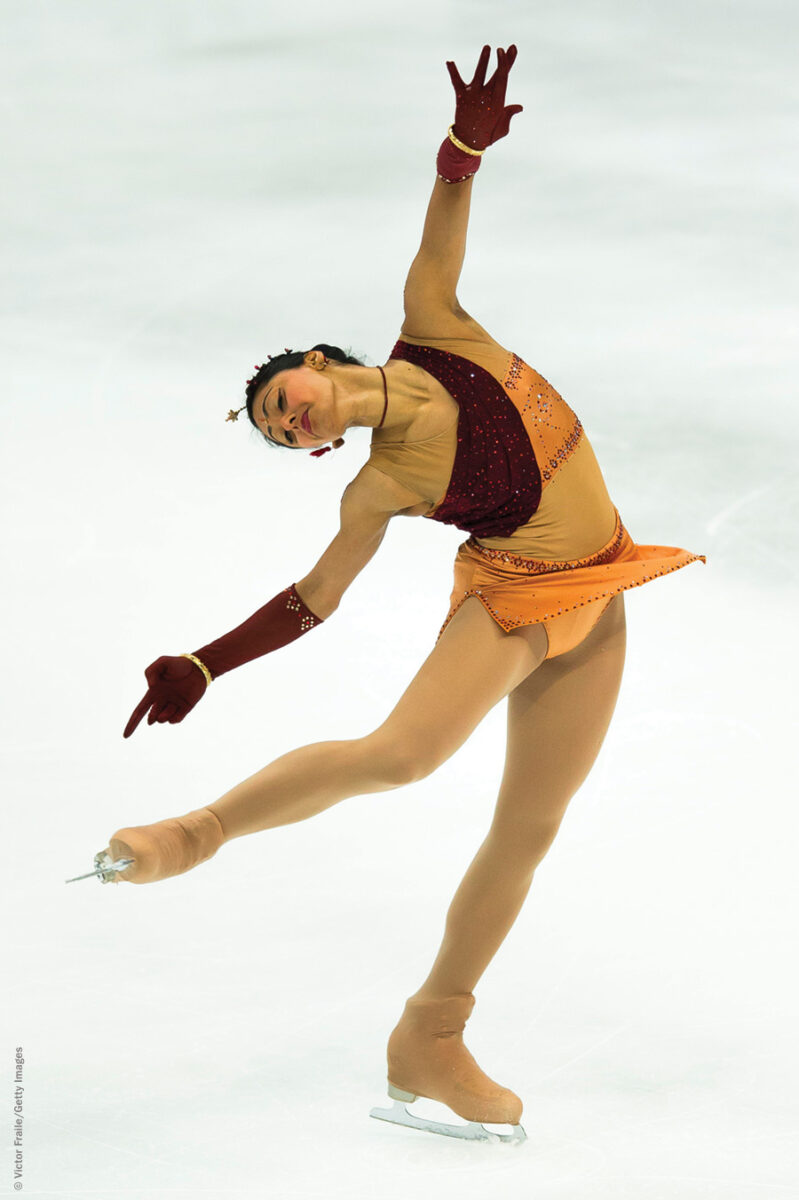
What followed was an unlikely transformation: the girl who was “always [the] worst at everything” in gym class made history as the first person to represent India in an international senior figure skating competition. “I am pretty sure anyone who took a look at me back then would not have guessed how sports would change my life,” says Parekh, who despite being born in New Jersey and raised in the US, competed for India at the 2007 World Figure Skating Championships and became an eight-time Indian ladies’ champion.
Today, Parekh is a physical medicine and rehabilitation physician who’s also certified in electrodiagnostic medicine, balancing a demanding medical career with motherhood and her continued involvement in skating through the Chicago Youth Foundation, where she serves as executive director. Her journey from ice rinks to medical clinics—with an important stop at Penn along the way—illustrates how seemingly disparate passions can ultimately converge into a meaningful career.
Growing up in a South Asian family where, she notes, “a sedentary woman is often idealized” and athletics weren’t encouraged, Parekh’s skating career was unconventional from the start. “Our family had no athletes whatsoever at any stage of their lives,” she says. It was her physician father who first took her to that public skating session, unknowingly setting her on a path that would shape her life.
The sport demanded everything. Figure skating, she notes, “is a year-round sport with grueling hours of on- and off-ice practice.” By age 12, she had gone from dreading gym class to winning junior competitions representing the US. She pioneered something entirely new in the skating world: performing the classical Indian dance Bharatanatyam on the ice. When she found out India was becoming a new, provisional member of the International Skating Union in 2003, she decided to represent the country internationally. The path wasn’t easy—she competed with minimal sponsorship “since no one in the country knew who I was and what figure skating was at the time.” But she was glad to help “bring the sport to India,” which she says, “gave me a new mission, a new purpose in ice skating.”
But at 19, shortly after competing at the 2007 World Figure Skating Championships, a major back injury forced her to quit. “It was horrible timing and led to a lot of self-reflection about my purpose in life and the grueling process of reinventing my identity,” recalls Parekh, adding that she gutted through the event, despite the injury almost forcing her to withdraw and the media attention causing her to feel overwhelmed and burnt out. This crisis, she notes, is “not unique to me, actually, but one that many elite athletes face when an injury completely stalls their dreams and warps their whole idea about who they are.”
Aspirations for a career in medicine, however, had been there all along. “I actually wanted to be a doctor as early as my toddler years,” she says. Her father’s influence was strong—when he brought her to work with him as a four-year-old, “I found what he did fascinating.”
After coaching young skaters full-time while studying for standardized tests, Parekh began her college journey at Wesleyan University, before transferring to Penn two years later. “I was yearning for a city experience and direct exposure to other types of science professionals and business education,” she says. The move also made practical sense—her family and coaches were still in Delaware, where she had spent part of her childhood, and she wanted to return to training. (She notes that over the years she worked with some of the best jump and spin coaches and choreographers in the world, who’ve also coached Olympic medalists including Oksana Baiul, Scott Hamilton, Tara Lipinski, Sasha Cohen, and Sarah Hughes L’18.)
At Penn, Parekh found her groove. Majoring in biological basis of behavior (now neuroscience) with a minor in South Asia Studies, she conducted research with Abass Alavi in the department of radiology and nuclear medicine. She also danced with PENNaach, an all-female South Asian fusion dance troupe, and Penn Ballet. And remarkably, after a five-year retirement to recover and focus on her medical career goals, she returned to competitive skating.
“After having quit skating for several years, I spent most of my junior year working really hard, playing catch-up with courses as well as with skating,” she recalls. The challenge was immense: relearning double axels and triples in her twenties as an “adult” skater, “when most usually start retiring,” she says. It also required strict discipline and time management, though having a rink on campus helped her squeeze in some practice between classes. During her senior year at Penn, she returned to international competition at the World Figure Skating Championships. Her figure skating fire rekindled, she continued to compete for the next two years, though failed in her attempt to qualify for the Winter Olympics at the 2014 Olympic Trials. She then retired again after getting into medical school.
The skills from skating proved invaluable in medical training. “Being able to mentally switch gears, and compartmentalize during almost all stages of my life, while also balancing my mental and physical well-being, became almost second nature,” she says, adding that “learning from mistakes, and then promptly moving on, was key.”
Her athletic background led her to physical medicine and rehabilitation, a specialty where “teamwork is mandatory.” Working with exercise physiologist Kat Arbour had sparked her early interest in anatomy, physiology, and sports science. And the athlete-centered care model she experienced daily as a competitor informed her approach to medicine.
Perhaps most challenging was having children during training, but motherhood ultimately enhanced her medical practice. “Being a mother has 100 percent made me a better doctor,” she says. “It has made me fully understand what it is like to sacrifice myself to support life and care for another human being.”
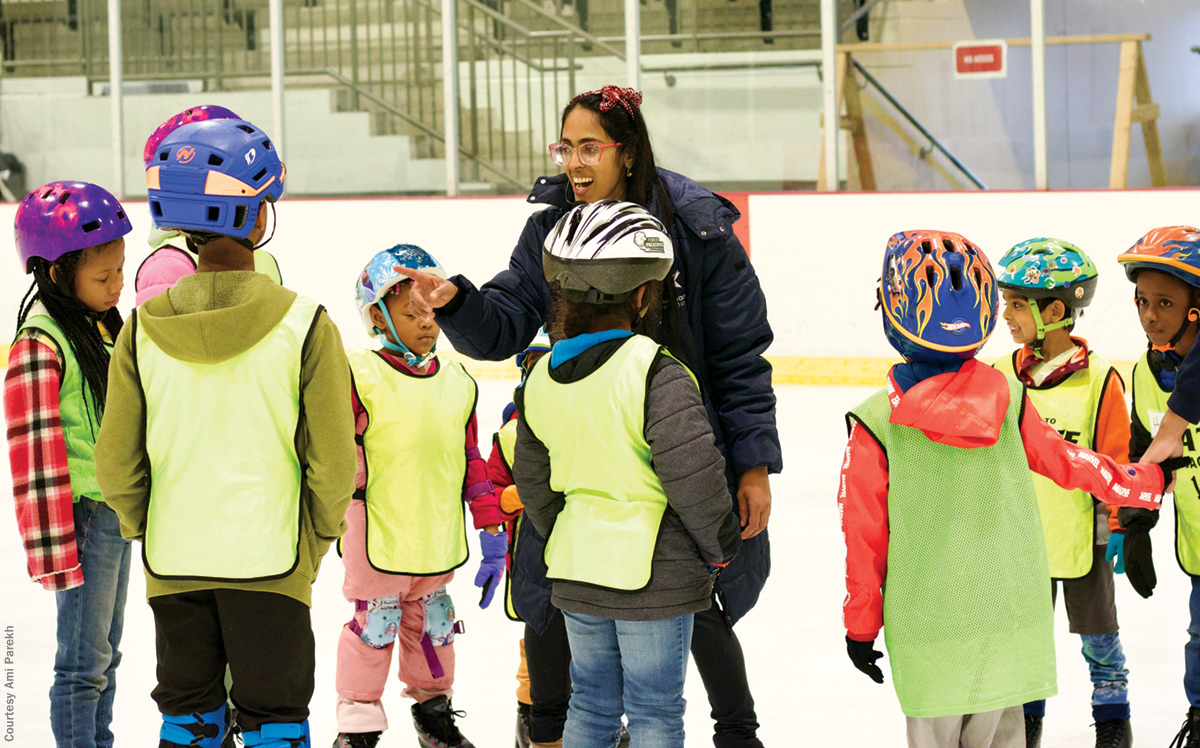
Today, Parekh continues to bridge her two worlds through the Chicago Youth Foundation, bringing “ice sports to the underserved populations” and providing free ice time and equipment to racial minorities and low-income families. After nearly losing all programming during COVID, the organization now operates at four rinks, partnering with the Chicago Blackhawks Foundation and the City of Chicago.
For current students juggling multiple pursuits, her advice is to “become experts in those realms,” she says, “and then as time passes you will likely automatically find creative ways to combine your passions into a new kind of career path.”
—Tasmiha Khan

Kudos Ami. Nice article.